• Fri frakt över 249 kr
  • •
  • Snabba leveranser
  • •
  • Billiga böcker
Kundservice

Du är på sajten för privatpersoner.

Företag, bibliotek eller offentlig verksamhet?

Du handlar på classic.bokus.com, där alla dina funktioner finns intakta.
Till classic.bokus.com
Bokus logotyp. Gå till startsidan.
  • Erbjudanden
  • Nyheter
  • Student
  • Topplistor
  • Barn & ungdom
  • Bokus Play
  • E-böcker
  • Pocketböcker
  • Spel & pussel

10% rabatt på allt med kod: NYSTART10 →

Sidfot

Mina sidor

    Hjälp

    • Kundservice
    • Vanliga frågor och svar
    • Frakt och leverans
    • Retur vid ångerrätt
    • Reklamera vara
    • Betalning
    • Köpvillkor
    • Allmänna villkor
    • Information om webbplatsens tillgänglighet

    Om Bokus

    • Om oss
    • Pressrum
    • För studenter
    • För företag
    • För bibliotek och offentlig verksamhet
    • För leverantörer
    • Hållbarhet

    Populärt

    • Aktuella erbjudanden
    • Presentkort
    • Studentlitteratur
    • Nya böcker
    • Topplistor
    • Signerade böcker
    • Engelska böcker

    Inspiration

    • Boktips
    • BookTok
    • Populära bokserier
    • Barnbokskaraktärer
    • Populära författare
    Logotyp för Bokus
    Följ oss på Facebook (extern länk)Följ oss på Instagram (extern länk)Följ oss på YouTube (extern länk)Följ oss på TikTok (extern länk)
    bokus @ CookiesAnpassa cookiesIntegritetspolicyKöpvillkor
    Till Citymail hemsida (extern länk)Till Budbee hemsida (extern länk)Till Postnord hemsida (extern länk)Till Schenker hemsida (extern länk)Till Early Bird hemsida (extern länk)Till Walleys hemsida (extern länk)
    1. Historia och arkeologi
    2. Historia
    3. Allmän historia och världshistoria

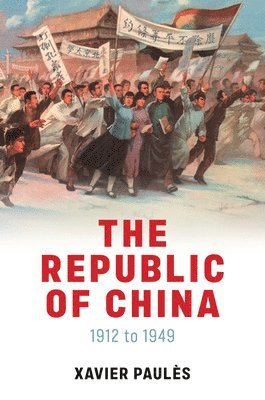
    Republic of China

    1912 to 1949

    AvXavier Paulès

    Inbunden, Engelska, 2023

    251 kr

    Beställningsvara. Skickas inom 5-8 vardagar. Fri frakt över 249 kr.

    Beskrivning

    The declaration of the Republic of China in 1912 signalled an entirely new era. Not only did the revolution of 1911–12 bring about the fall of the Qing dynasty: it also brought an end to the entire series of dynasties that had marked Chinese history for over two millennia. Radical reforms since 1901 had culminated in the ending of the political status quo and the rejection of the very idea of empire. Drawing on the most recent historical research, Xavier Paulès provides a comprehensive account of the crucial but chaotic period that stretched from the founding of the Republic of China in 1912 to the civil war of 1945–9, which ended with the victory of the Chinese Communist Party (CCP) and the establishment of the People's Republic of China.  Paulès challenges various common claims about this period. It is often assumed that the CCP was instrumental in bringing about key events by skilfully mobilizing the population to serve its ends. Paulès argues, by contrast, that the CCP took advantage of fortunate circumstances and that, even then, it was only in a position to challenge the supremacy of the Guomindang as late as 1944. His analysis takes a broad view by considering the importance of political actors both within and external to the revolutionary movement, enabling him to offer a balanced interpretation of the republican period which sheds new light on China’s political, cultural and economic development.

    Produktinformation

    • Utgivningsdatum:2023-11-24
    • Mått:150 x 234 x 38 mm
    • Vikt:680 g
    • Format:Inbunden
    • Språk:Engelska
    • Antal sidor:368
    • Förlag:Polity Press
    • ISBN:9781509552573
    • Översättare:Lindsay Lightfoot

    Utforska kategorier

    • Allmän historia och världshistoria inom Historia och arkeologi

    Mer om författaren

    Xavier Paulès is Associate Professor in History at EHESS, Paris.

    Recensioner i media

    ‘All too often the Chinese Republic is overlooked as a wretched interlude between imperial collapse and communist victories. Yet its contribution to a Chinese modernity that a century later is still in the making was essential. Paulès’ nuanced and erudite synthesis introduces us to the paradoxes of these creative and dramatic decades like no other book I know of.’Pierre-Etienne Will, Collège de France‘The Republic was a short but transformative period for China.  Xavier Paulès shows its importance as a time of political possibility, covering conflict, economics and culture with flair and precision.’Rana Mitter, University of Oxford‘Paulès presents a fascinating account of the decades that followed the collapse of China’s imperial order, highlighting the effects of political fragmentation, imperialism, industrialization, domestic and international migration, and world war. This lively book analyses current debates about the politics and personalities of the era, arguing that the decades before 1949 demonstrate the fluidity and resilience of Chinese culture.’Kristin Stapleton, University at Buffalo

    Innehållsförteckning

    • AcknowledgementsList of Illustrations and Maps Introduction Chapter 1: The 1911 RevolutionThe flashpoint in WuhanThe last dynasty’s unorthodox downfall 1912, the year of many possibilitiesThe years under Yuan Shikai (1913-1916)The international context and the influence of the war in EuropeThe fall of Yuan Shikai Chapter 2: Cliques And Warlords (1916-1928)The rivalry amongst North China's major cliques for control of the governmentWho were the warlords?The implausible identikit portraitThe driving forces behind junfa power Conflicts, alliances and viscosityWas national unity in jeopardy?The diplomatic context, May Fourth Movement (1919) and the rise of nationalismTwo decades of spectacular diplomatic recovery for China (1906-1926)Disappointed expectations from the Versailles negotiationsA movement without precedentThe rise of the Guomindang (1917-1926) and the Canton decade925: the death of Sun Yat-sen and its aftermath, the May Thirtieth MovementThe Northern ExpeditionPhase 1: the defeat of Wu Peifu and Sun Chuanfang Phase 2: the time of divisionsPhase 3: Zhang Zuolin’s defeat Chapter 3: The Nanking Decade (1928-1937)1928-1932: Troublesome former alliesThe period of stabilisation: 1932-1935 The Guomindang’s achievementThe looming Japanese threat Warlords on the waneThe successful marginalization of the Chinese Communist PartyThe successful marginalisation of the Chinese Communist PartyThe run up to the Sino-Japanese war: 1935-1937 Chapter 4: The War Against Japan (1937-1945)The war of movement: 1937-1939Why did Chiang Kai-shek choose confrontation? Japan’s first victoriesThe Second United Front and Soviet aid 938, the difficult conquest of the Middle Yangtze River basin1939, settling in for a long warThe war of position (1940-1944)Stabilisation of the front Population movementsChina and the Allies1940: the beginning of the Guomindang state’s disintegrationThe CCP, a new forceMao Zedong and Chiang Kai-shek, the crossed paths of destiny Occupied China and the collaborating governments1944-1945: return to the war of movementFrom the Ichig  offensive to the surrenderThe war's outcome Chapter 5: Civil War (1945-1949)A very favourable situation for the GuomindangThe political and symbolic dividends of victoryThe economic rebound in the immediate post-war periodImmediately post-war: 1945-1946 The role of the USSR and the USALocking of horns for the first timeThe Guomindang’s post-war failureThe military era: 1946-1949 Sclerosis of the GuomindangThe issue of corruptionLack of renewal within the Guomindang The impossible democratic transformationThe CCP's policyA third force gone missingThe withdrawal to Taiwan, a victory for the Guomindang? Chapter 6: Overview of the Chinese EconomyChina in an international contextThe financial and monetary systemThe shortcomings of the financial system Progress and crisis in the monetary systemThe primary sectorThe very slow evolution of the agricultural sectorMining: the triumph of coal and emergence of oilThe secondary sectorIndustry and the rise of Chinese capitalismMaintaining cottage industriesThe service sectorTransportTraditional servicesThe effects of the 1937-1945 war and the civil warRelocation and state control of the economyThe origins of Communist China's planned economy? Chapter 7: Building the StatePolitical cultureInventing a political cultureContinuities with the New Policies periodContinuity with an older political orderThe Guomindang and the party-state model post 1928Sun Yat-sen, a guiding lightInstitutional structureCliques and clique strugglesThe endless return of revolutionThe question of fascismThe extension of the State's scope, a fundamental trendThe question of the relationship between the State and local elitesA plurality of State-building trajectories Chapter 8: Changes in SocietyThe PopulationDemographicData MigrationsSocial groupsThe proletariatThe urban middle classesThe recomposition of elitesHighly resilient intermediary bodiesLiving standards and lifestylesThe issue of the impoverishment of Chinese peasantsDid the Guomindang lose interest in the countryside?Endemic insecurity in the countryside ‘Problems’ in Chinese societyNew leisure activitiesCan we call it westernisation?Women Chapter 9: Cultural RenewalThe dissemination of ideasThe development of primary and secondary educationHigher educationThe mediaPassing influencesNew interest in the non-Western worldThe May Fourth Movement 1919 and that of the new culture (xin wenhua yundong      )Chinese Culture’s Western CrisisA reinvented languageThe wenti   The competition of 'isms’Religious revivalsChina's cultural influence.The undiminished prestige of classical cultureChina as a conduit for knowledge from the WestTransmission of popular culture Conclusion And Epitaph Timeline AppendixesSun Yat-sen’s Last Will (yizhu   )Comparison of China’s population with that of other major countriesComparison of the length of China's rail network with that of other countries (in kilometres)The Song family simplified family tree MapsBibliographyNotesIndex