• Fri frakt över 249 kr
  • •
  • Snabba leveranser
  • •
  • Billiga böcker
Kundservice

Du är på sajten för privatpersoner.

Företag, bibliotek eller offentlig verksamhet?

Du handlar på classic.bokus.com, där alla dina funktioner finns intakta.
Till classic.bokus.com
Bokus logotyp. Gå till startsidan.
  • Erbjudanden
  • Nyheter
  • Student
  • Topplistor
  • Barn & ungdom
  • Bokus Play
  • E-böcker
  • Pocketböcker
  • Spel & pussel

Må bättre, för mindre! Upp till 50% rabatt på hälsoböcker

Sidfot

Mina sidor

    Hjälp

    • Kundservice
    • Vanliga frågor och svar
    • Frakt och leverans
    • Retur vid ångerrätt
    • Reklamera vara
    • Betalning
    • Köpvillkor
    • Allmänna villkor
    • Information om webbplatsens tillgänglighet

    Om Bokus

    • Om oss
    • Pressrum
    • För studenter
    • För företag
    • För bibliotek och offentlig verksamhet
    • För leverantörer
    • Hållbarhet

    Populärt

    • Aktuella erbjudanden
    • Presentkort
    • Studentlitteratur
    • Nya böcker
    • Topplistor
    • Signerade böcker
    • Engelska böcker

    Inspiration

    • Boktips
    • BookTok
    • Populära bokserier
    • Barnbokskaraktärer
    • Populära författare
    Logotyp för Bokus
    Följ oss på Facebook (extern länk)Följ oss på Instagram (extern länk)Följ oss på YouTube (extern länk)Följ oss på TikTok (extern länk)
    bokus @ CookiesAnpassa cookiesIntegritetspolicyKöpvillkor
    Till Citymail hemsida (extern länk)Till Budbee hemsida (extern länk)Till Postnord hemsida (extern länk)Till Schenker hemsida (extern länk)Till Early Bird hemsida (extern länk)Till Walleys hemsida (extern länk)
    1. Juridik
    2. Internationell rätt

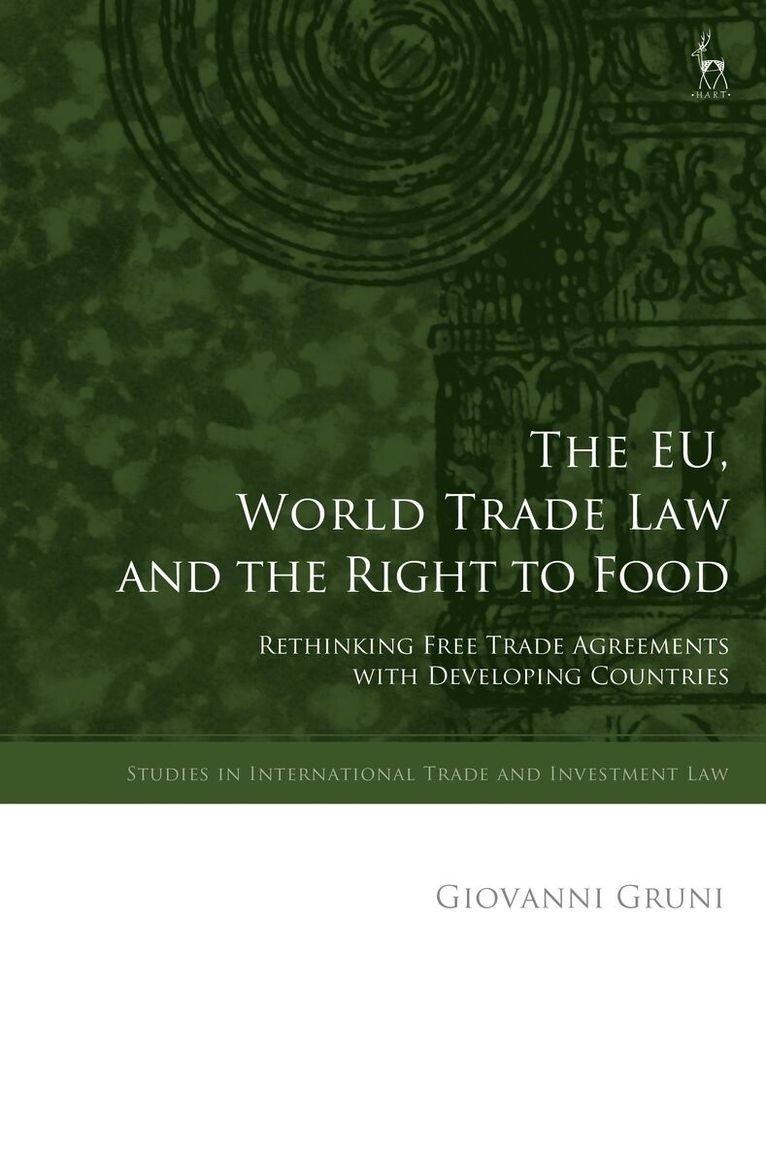
    EU, World Trade Law and the Right to Food

    Rethinking Free Trade Agreements with Developing Countries

    AvGiovanni Gruni,Gabrielle Marceau

    Inbunden, Engelska, 2018

    Del i serien Studies in International Trade and Investment Law

    1 219 kr

    Beställningsvara. Skickas inom 10-15 vardagar. Fri frakt över 249 kr.

    Fler format och utgåvor

    E-bok

    583 kr

    E-bok

    564 kr

    Häftad

    543 kr

    Beskrivning

    In recent years the European Union has developed a comprehensive strategy to conclude free trade agreements which includes not only prominent trade partners such as Canada, the United States and Japan but also numerous developing countries. This book looks at the existing WTO law and at the new EU free trade agreements with the Caribbean and sub-Saharan Africa through the lens of the human right to adequate food. It shows how the clauses on the import and export of food included in recent free trade agreements limit the capacity of these countries to implement food security policies and to respect their human rights obligations. This outcome appears to be at odds with international human rights law and dismissive of existing human rights references in EU-founding treaties as well as in treaties between the EU and developing states. Yet, the book argues against the conception in human rights literature that there is an inflexible agenda encoded in world trade law which is fundamentally conflictual with non-economic interests. The book puts forward the idea that the European Union is perfectly placed to develop a narrative of globalisation considering other areas of public international law when negotiating trade agreements and argues that the EU does have the competences and influence to uphold a role of international leadership in designing a sustainable global trading system. Will the EU be ambitious enough? A timely contribution to the growing academic literature on the relation between world trade law and international human rights law, this book imagines a central role for the EU in reconciling these two areas of international law.

    Produktinformation

    • Utgivningsdatum:2018-08-09
    • Mått:156 x 234 x undefined mm
    • Vikt:490 g
    • Format:Inbunden
    • Språk:Engelska
    • Serie:Studies in International Trade and Investment Law
    • Antal sidor:224
    • Förlag:Bloomsbury Publishing PLC
    • ISBN:9781509916207

    Utforska kategorier

    • Internationell rätt inom Juridik
    • Folkrätt inom Juridik

    Mer om författaren

    Giovanni Gruni is a research fellow at ESADE Law School.

    Recensioner i media

    This is a very well-crafted book. The structure is good, the analysis clear, and the arguments flow well, both in the chapters, as well as between them. The result is a very readable book... In essence, this is an excellent book that is an important addition to the literature. It is a ‘must read’ on the subject for both academics and students alike.

    Innehållsförteckning

    • 1. Introduction I. Why a Book on Human Rights and International Trade Agreements? II. Area of Research III. Objective of the Book IV. Book Outline 2. The Right to Food in International Law I. Introduction II. The Content of the Right to Food III. State Duties IV. The Right to Food and the Negotiation of Trade Agreements V. Defragmenting International Law: Paths of Legal Dialogue between Human Rights and Trade Law and the Role of the EU VI. Conclusions 3. Realising the Right to Food in the Global Food Market I. Introduction II. Market Failures III. Limits of Development Aid and Domestic Policies IV. Vulnerable Categories V. The Role of the European Union VI. Conclusions 4. The EU External Trade Policy and the EU External Food Security Policy I. Introduction II. The Influence of the EU on International Trade Law: Institutional Dimension III. The EU Trade Strategy IV. The Right to Food in the External Relations of the EU V. Food Security in the Negotiations of Free Trade Agreements VI. Conclusions 5. The Right to Food in the WTO I. Introduction II. Import Restrictions III. Safeguards IV. The Special Safeguards (SSG) V. The Enabling Clause, Waivers and Free Trade Agreements VI. Export Restrictions VII. Conclusions 6. The EU–CARIFORUM Economic Partnership Agreement I. Introduction II. The EU–CARIFORUM Economic Partnership Agreement III. Import Restrictions IV. Safeguards V. Export Restrictions VI. Conclusions 7. The Economic Partnership Agreements between the EU and Sub-Saharan Africa I. Introduction II. The State of Negotiations between the EU and Africa III. Sub-Saharan Africa’s Economic and Legal Setting IV. Import Restrictions V. Safeguards VI. Export Restrictions VII. Conclusions 8. Conclusions I. Introduction II. Summary of the Main Findings of the First Four Chapters III. Main Findings of the Case Studies IV. An EU Trade Policy for Global Food Security V. The EU, the Right to Food and Developing Countries