• Fri frakt över 249 kr
  • •
  • Snabba leveranser
  • •
  • Billiga böcker
Kundservice

Du är på sajten för privatpersoner.

Företag, bibliotek eller offentlig verksamhet?

Du handlar på classic.bokus.com, där alla dina funktioner finns intakta.
Till classic.bokus.com
Bokus logotyp. Gå till startsidan.
  • Erbjudanden
  • Nyheter
  • Student
  • Topplistor
  • Barn & ungdom
  • Bokus Play
  • E-böcker
  • Pocketböcker
  • Spel & pussel

10% rabatt på allt med kod: NYSTART10 →

Sidfot

Mina sidor

    Hjälp

    • Kundservice
    • Vanliga frågor och svar
    • Frakt och leverans
    • Retur vid ångerrätt
    • Reklamera vara
    • Betalning
    • Köpvillkor
    • Allmänna villkor
    • Information om webbplatsens tillgänglighet

    Om Bokus

    • Om oss
    • Pressrum
    • För studenter
    • För företag
    • För bibliotek och offentlig verksamhet
    • För leverantörer
    • Hållbarhet

    Populärt

    • Aktuella erbjudanden
    • Presentkort
    • Studentlitteratur
    • Nya böcker
    • Topplistor
    • Signerade böcker
    • Engelska böcker

    Inspiration

    • Boktips
    • BookTok
    • Populära bokserier
    • Barnbokskaraktärer
    • Populära författare
    Logotyp för Bokus
    Följ oss på Facebook (extern länk)Följ oss på Instagram (extern länk)Följ oss på YouTube (extern länk)Följ oss på TikTok (extern länk)
    bokus @ CookiesAnpassa cookiesIntegritetspolicyKöpvillkor
    Till Citymail hemsida (extern länk)Till Budbee hemsida (extern länk)Till Postnord hemsida (extern länk)Till Schenker hemsida (extern länk)Till Early Bird hemsida (extern länk)Till Walleys hemsida (extern länk)
    1. Juridik
    2. Särskilda rättsområden
    3. Författningsrätt och förvaltningsrätt

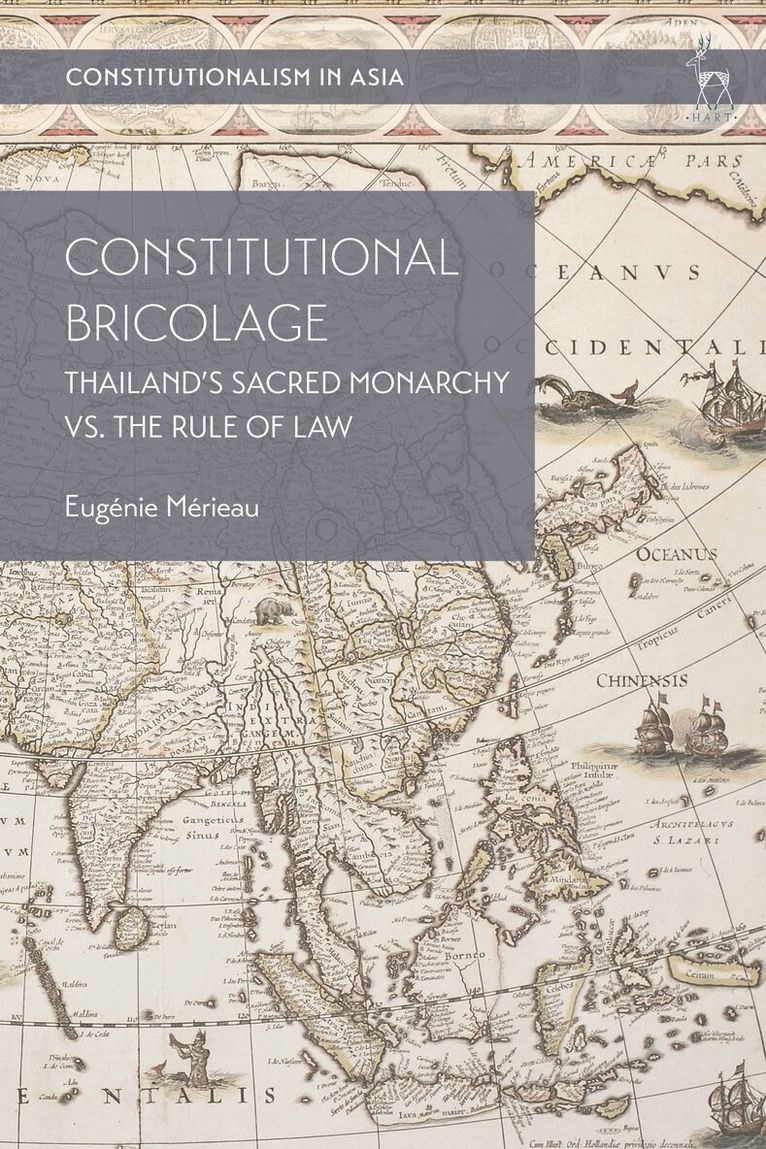
    Constitutional Bricolage

    Thailand's Sacred Monarchy vs. The Rule of Law

    AvEugénie Mérieau,Kevin Yl Tan

    Inbunden, Engelska, 2021

    Del i serien Constitutionalism in Asia

    964 kr

    Beställningsvara. Skickas inom 10-15 vardagar. Fri frakt över 249 kr.

    Fler format och utgåvor

    E-bok

    472 kr

    E-bok

    472 kr

    Häftad

    440 kr

    Beskrivning

    This book analyses the unique constitutional system in operation in Thailand as a continuous process of bricolage between various Western constitutional models and Buddhist doctrines of Kingship. Reflecting on the category of 'constitutional monarchy’ and its relationship with notions of the rule of law, it investigates the hybridised semi-authoritarian, semi-liberal monarchy that exists in Thailand. By studying constitutional texts and political practices in light of local legal doctrine, the book shows that the monarch's affirmation of extraordinary prerogative powers strongly rests on wider doctrinal claims about constitutionalism and the rule of law. This finding challenges commonly accepted assertions about Thailand, arguing that the King's political role is not the remnant of the 'unfinished' borrowing of Western constitutionalism, general disregard for the law, or cultural preference for 'charismatic authority', as generally thought. Drawing on materials and sources not previously available in English, this important work provides a comprehensive and critical account of the Thai ‘mixed constitutional monarchy’ from the late 19th century to the present day.

    Produktinformation

    • Utgivningsdatum:2021-12-30
    • Mått:156 x 234 x undefined mm
    • Vikt:653 g
    • Format:Inbunden
    • Språk:Engelska
    • Serie:Constitutionalism in Asia
    • Antal sidor:344
    • Förlag:Bloomsbury Publishing PLC
    • ISBN:9781509927692

    Utforska kategorier

    • Författningsrätt och förvaltningsrätt inom Juridik

    Mer om författaren

    Eugénie Mérieau is Associate Professor of Public Law at the University of Paris 1 Panthéon-Sorbonne, France.

    Recensioner i media

    As a work that explains in depth the evolution of monarchical domination over Thailand’s various constitutions, it is unsurpassed.

    Innehållsförteckning

    • 1. Introduction: Is Thailand a Constitutional Monarchy? I. The Purpose and General Argument of the Book: Why the Thai Constitution Matters II. The Issue of Royal Prerogatives in a Constitutional Monarchy: Text, Conventions and Doctrines III. Sacred Monarchy vs. the Rule of Law: The Interplay of Law and Religion Mediated through Kingship IV. Constitutional Bricolage: The Indeterminacy of Legal Transplants and their Political Re-assignments V. Outline of the Chapters PART IIMPORTING THE MODERN CONSTITUTION2. Siam’s First Constitutions: The Rise and Fall of the Sacred Monarchy I. The Hindu-Khmer Origins of the Traditional Constitution II. The 1889, 1926 and 1932 Draft Constitutions: The Bonapartist and British Tropes III. The 1932 Constitutions: The Soviet/Chinese and Prussian/Japanese Influences 3. Legal Positivism and Buddhist Kingship: Establishing the King as the Source of the Constitution I. Hindu-Buddhist Theories: The Devaraja and Dharmaraja Kings II. The European Influence: Importing Doctrines of Royal Absolutism III. From the European Doctrine of ‘Royal Octroy’ to the King’s Granted Rattathammanun 4. From the Sacred Monarchy to the Sacred Constitution I. Royal Despotism, Theocracy and Sacred Law II. Royal Reforms: The Westernisation of Law and Kingship III. Royal Vetoes and Amnesties versus the Sacred Constitution PART IIIMPORTING THE STATE OF EMERGENCY5. Thailand’s Cold War Constitutions: Constitutions for the Military I. The 1947–1949 Constitutions: The Royalist Restoration and the Rejection of the British ModelII. The 1959, 1968 and 1972 Constitutions: Military Dictatorship and the Gaullist Inspiration III. The 1974–1991 Constitutions: The US Influence on Military Dictatorship under Royal Command? 6. Revolutionary Legality and Buddhist Kingship: Theorising the King’s Extra-Constitutional Powers in Times of Crisis I. From Kelsen’s Revolutionary Legality to Thai-Style Democracy II. From Bagehot’s Three Conventional Powers of the Monarch to the Invention of Thai Constitutional CustomsIII. Revolutionary Legality Revised: The Doctrine of Shared Sovereignty between the King, the Military and the People 7. From Military Dictatorship to Military Dictatorship under (Sacred) Royal CommandI. The Monarchy against the Military: Practices of Royal Constitutional Veto II. The Monarchy on Top of the Military: Royally Sanctioned Military Coups and Amnesty Laws for Coup-Makers III. The Monarchy above the Military: Direct Royal Interventions against Military Juntas PART IIIIMPORTING CONSTITUTIONAL JUSTICE8. Thailand’s Post-Cold War Constitutions: Constitutions for the Judiciary I. The 1997 Constitution: The Transformative ‘Global South’ Constitution II. The 2007 Constitution: Juristocracy under US Inspiration? III. The 2017 Constitution: Juristocracy and Military Dictatorship under Royal Command 9. The Rule of Law and Buddhist Kingship: Turning the Constitutional Court into a Substitute King I. From the Rejection of the British Practice of the Royal Prerogative to the Creation of a Constitutional Court Ruling in the Name of the King II. From US-Style Judicial Activism to ‘Judicialisation’: Transferring the King’s Extra-ConstitutionalPowers to the Constitutional Court III. From Global Discourses on the Rule of Law and Good Governance to the Doctrine of Dharmaraja Governance 10. From Judicialisation at the King’s Request to Juristocracy under Royal Command I. Judicialisation at the King’s Request: Practices of Direct and Indirect Royal Vetoes II. More Judicialisation at the King’s Request: The Constitutional Court Defines ‘DKHS’ and its Customs III. Royal Constitutional Vetoes, Lèse-Majesté and ‘DKHS’: The Affirmation of the Royal Prerogative 11. Conclusion: Democracy with the King as Head of State: The Bricolage of Thai Constitutional Identity I. Summary of the Book’s Contribution: Bricolage as a Process and Method in Comparative Constitutional Law II. Taking Textual Provisions Seriously: On the Royal Prerogative and Constitutional Conventions III. Taking Local Doctrine Seriously: On the Power of Legal Ideas and the Use of Religion to Localise Legal Transplants IV. Taking Constitutional Practices Seriously: On Political Precedents and the Performativity of ConstitutionalStory-telling V. Epilogue: Thailand and the Possibility of Decentring Comparative Constitutional Law