• Fri frakt över 249 kr
  • •
  • Snabba leveranser
  • •
  • Billiga böcker
Kundservice

Du är på sajten för privatpersoner.

Företag, bibliotek eller offentlig verksamhet?

Du handlar på classic.bokus.com, där alla dina funktioner finns intakta.
Till classic.bokus.com
Bokus logotyp. Gå till startsidan.
  • Erbjudanden
  • Nyheter
  • Student
  • Topplistor
  • Barn & ungdom
  • Bokus Play
  • E-böcker
  • Pocketböcker
  • Spel & pussel

10% rabatt på allt med kod: NYSTART10 →

Sidfot

Mina sidor

    Hjälp

    • Kundservice
    • Vanliga frågor och svar
    • Frakt och leverans
    • Retur vid ångerrätt
    • Reklamera vara
    • Betalning
    • Köpvillkor
    • Allmänna villkor
    • Information om webbplatsens tillgänglighet

    Om Bokus

    • Om oss
    • Pressrum
    • För studenter
    • För företag
    • För bibliotek och offentlig verksamhet
    • För leverantörer
    • Hållbarhet

    Populärt

    • Aktuella erbjudanden
    • Presentkort
    • Studentlitteratur
    • Nya böcker
    • Topplistor
    • Signerade böcker
    • Engelska böcker

    Inspiration

    • Boktips
    • BookTok
    • Populära bokserier
    • Barnbokskaraktärer
    • Populära författare
    Logotyp för Bokus
    Följ oss på Facebook (extern länk)Följ oss på Instagram (extern länk)Följ oss på YouTube (extern länk)Följ oss på TikTok (extern länk)
    bokus @ CookiesAnpassa cookiesIntegritetspolicyKöpvillkor
    Till Citymail hemsida (extern länk)Till Budbee hemsida (extern länk)Till Postnord hemsida (extern länk)Till Schenker hemsida (extern länk)Till Early Bird hemsida (extern länk)Till Walleys hemsida (extern länk)
    1. Juridik
    2. Särskilda rättsområden
    3. Arbetsrätt

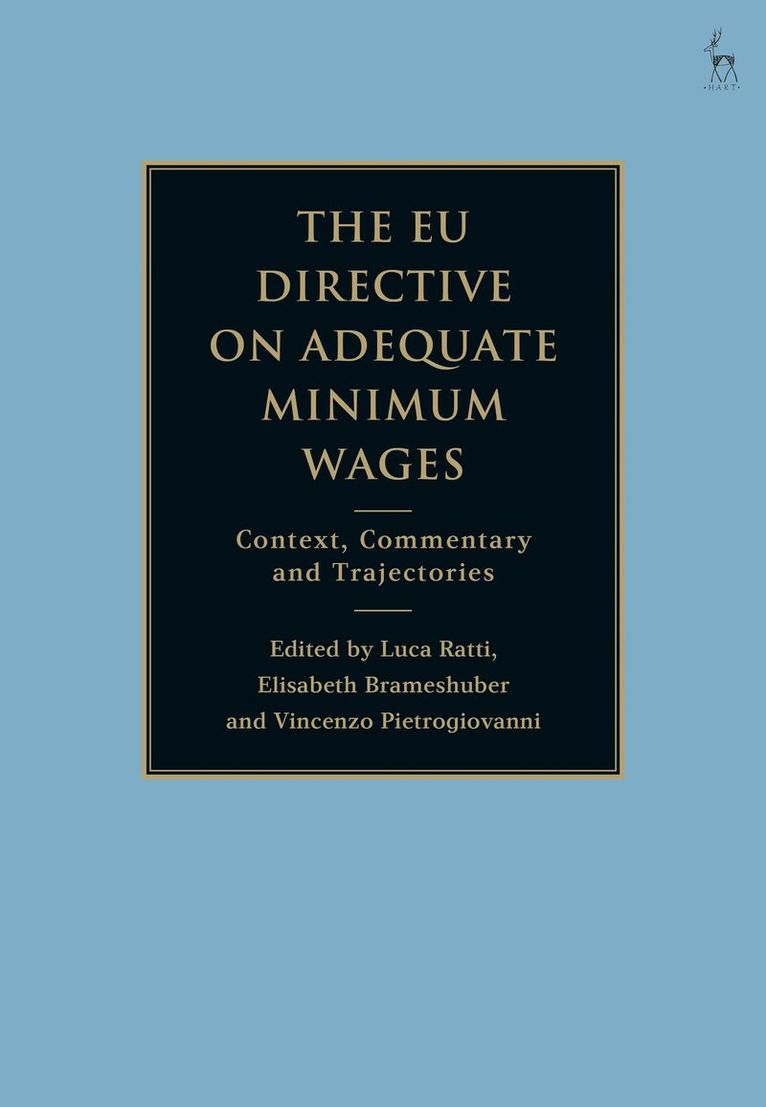
    EU Directive on Adequate Minimum Wages

    Context, Commentary and Trajectories

    AvLuca Ratti,Luca Ratti

    Inbunden, Engelska, 2024

    1 957 kr

    Beställningsvara. Skickas inom 5-8 vardagar. Fri frakt över 249 kr.

    Beskrivning

    This book provides an all-encompassing and timely analysis of the EU regulatory framework deriving from the enactment of Directive 2022/2041 on adequate minimum wages. In the first part, the book discusses the function of minimum wage policies in contemporary labour markets and the role of social partners and collective bargaining in governing minimum wage determinants and trends. The second part provides an article-by-article commentary of the Directive, including insights on crucial aspects such as the EU competence to intervene on wages, the concept of minimum wage adequacy, and the measurement and promotion of collective bargaining coverage. The third part assesses the impact of the Directive across the EU, focusing on the main systemic implications of the Directive as well as on the structural changes that Member States will need to implement.With contributions written by scholars and stakeholders from across Europe, the book sheds light on one of labour law’s most fundamental objectives – to provide for adequate minimum wages. It is an invaluable resource for researchers, policy makers, trade unionists and employers’ representatives.

    Produktinformation

    • Utgivningsdatum:2024-03-21
    • Mått:170 x 244 x 33 mm
    • Vikt:1 180 g
    • Format:Inbunden
    • Språk:Engelska
    • Antal sidor:624
    • Förlag:Bloomsbury Publishing PLC
    • ISBN:9781509968725

    Utforska kategorier

    • Arbetsrätt inom Juridik

    Mer om författaren

    Luca Ratti is Associate Professor of European and Comparative Labour Law at the University of Luxembourg, Luxembourg. Elisabeth Brameshuber is Professor of Labour and Social Security Law at the University of Vienna, Austria. Vincenzo Pietrogiovanni is Associate Professor of Labour Law at University of Southern Denmark.

    Innehållsförteckning

    • 1. Introduction: Regulating Minimum Wages as Fundamental Challenge for EU LawLuca Ratti (University of Luxembourg), Elisabeth Brameshuber (University of Vienna, Austria) and Vincenzo Pietrogiovanni (University of South Denmark)Part I: Cross-Cutting Themes2. In Search of Adequacy in Contemporary Labour Markets, Zoe Adams (University of Cambridge, UK)3. Choosing a Tightrope Instead of a Rope Bridge – The Choice of Legal Basis for the AMW Directive, Sacha Garben (College of Europe, Belgium)4. The Impact of the AMW Directive on EU Labour Law, Claudia Schubert (University of Hamburg, Germany)5. The Legal Institutions of Industrial Relations on Wage-setting, Vincenzo Bavaro (University of Bari, Italy)6. The Collective Bargaining Directive in Disguise – How the European Minimum Wage Directive Aims to Strengthen Collective Bargaining, Torsten Müller (European Trade Union Institute for Research, Belgium) and Thorsten Schulten (Hans Böckler Foundation, Germany)7. Minimum Wages in OECD Countries, Andrea Garnero (OECD, France)8. The Directive on Adequate Minimum Wages and the Revival of a European Social Union, Luca Ratti (University of Luxembourg)9. Constitutionalisation and Social Rights – A Fundamental Right to Adequate Minimum Wages? Elisabeth Brameshuber (University of Vienna, Austria)Part II: Commentary of the Text of the Directive10. Subject Matter (Article 1), Erika Kovács (WU Vienna University of Economics and Business, Austria)11. Scope (Article 2), Emanuele Menegatti (University of Bologna, Italy)12. Definitions (Article 3), Mijke Houwerzijl (Tilburg University, Netherlands)13. Promotion of Collective Bargaining on Wage Setting (Article 4), Antonio Lo Faro (University of Catania, Italy)14. The Procedure for Setting Adequate Statutory Minimum Wages (Article 5), Adam Sagan and Alexander Schmidt (University of Bayreuth, Germany)15. Variations and Deductions (Article 6), Piotr Grzebyk (University of Warsaw, Poland)16. Involvement of Social Partners in the Setting and Updating of Statutory Minimum Wages (Article 7), Antonio Garcia-Muñoz (University of Castilla La Mancha, Spain)17. Effective Access of Workers to Statutory Minimum Wages (Article 8), Ane Aranguiz (Tilburg University, Netherlands) and Bartlomiej Bednarowicz (European Economic and Social Committee, Belgium) 18. Public Procurement (Article 9), ACL Davies (University of Oxford, UK)19. Monitoring and Data Collection and Information on Minimum Wage Protection (Articles 10 and 11), Rüdiger Krause (University of Göttingen, Germany)20. Right to Redress and Protection against Adverse Treatment or Consequences (Article 12), Sylvaine Laulom (French Cour de Cassation, France)21. Penalties (Article 13), Piera Loi (University of Cagliari, Italy)22. Final Provisions (Articles 14-19), Jérôme Porta (University of Bordeaux, France)Part III: The Impact of the Directive in the Member States23. Austria, Thomas Dullinger (WU Vienna University of Economics and Business, Austria)24. Baltic States, Daiva Petrylaite (Vilnius University, Lithuania) and Vida Petrylaite (Vilnius University, Lithuania)25. Belgium, Filip Dorssemont (UCLouvain, Belgium)26. Croatia and Slovenia, Luka Ticar (University of Ljubljana, Slovenia) and Ivana Grgurev (University of Zagreb, Croatia)27. Cyprus and Greece, Stamatina Yannakourou (European University Cyprus)28. France, Gwenola Bargain (University of Tours, France)29. Germany, Monika Schlachter (University of Trier, Germany)30. Hungary, Tamás Gyulavári (Pázmány Péter Catholic University Budapest, Hungary)31. Iberian States, Teresa Coelho Moreira (University of Minho, Portugal) and Daniel Pérez del Prado (Universidad Carlos III Madrid, Spain)32. Ireland, Mark Bell (University College Dublin, Ireland) and Alan Eustace (University of Oxford, UK)33. Italy, Orsola Razzolini (University of Milan, Italy)34. Poland, Izabela Florczak (University of Lodz, Poland) and Marta Otto (University of Warsaw, Poland) 35. Scandinavian States, Petra Herzfeld Olsson (Stockholm University, Sweden) and Mette Søsted Hemme (Aarhus University, Denmark)