• Fri frakt över 249 kr
  • •
  • Snabba leveranser
  • •
  • Billiga böcker
Kundservice

Du är på sajten för privatpersoner.

Företag, bibliotek eller offentlig verksamhet?

Du handlar på classic.bokus.com, där alla dina funktioner finns intakta.
Till classic.bokus.com
Bokus logotyp. Gå till startsidan.
  • Erbjudanden
  • Nyheter
  • Student
  • Topplistor
  • Barn & ungdom
  • Bokus Play
  • E-böcker
  • Pocketböcker
  • Spel & pussel

10% rabatt på allt med kod NYSTART10 →

Sidfot

Mina sidor

    Hjälp

    • Kundservice
    • Vanliga frågor och svar
    • Frakt och leverans
    • Retur vid ångerrätt
    • Reklamera vara
    • Betalning
    • Köpvillkor
    • Allmänna villkor
    • Information om webbplatsens tillgänglighet

    Om Bokus

    • Om oss
    • Pressrum
    • För studenter
    • För företag
    • För bibliotek och offentlig verksamhet
    • För leverantörer
    • Hållbarhet

    Populärt

    • Aktuella erbjudanden
    • Presentkort
    • Studentlitteratur
    • Nya böcker
    • Topplistor
    • Signerade böcker
    • Engelska böcker

    Inspiration

    • Boktips
    • BookTok
    • Populära bokserier
    • Barnbokskaraktärer
    • Populära författare
    Logotyp för Bokus
    Följ oss på Facebook (extern länk)Följ oss på Instagram (extern länk)Följ oss på YouTube (extern länk)Följ oss på TikTok (extern länk)
    bokus @ CookiesAnpassa cookiesIntegritetspolicyKöpvillkor
    Till Citymail hemsida (extern länk)Till Budbee hemsida (extern länk)Till Postnord hemsida (extern länk)Till Schenker hemsida (extern länk)Till Early Bird hemsida (extern länk)Till Walleys hemsida (extern länk)
    1. Ekonomi och Ledarskap
    2. Nationalekonomi
    3. Mikroekonomi

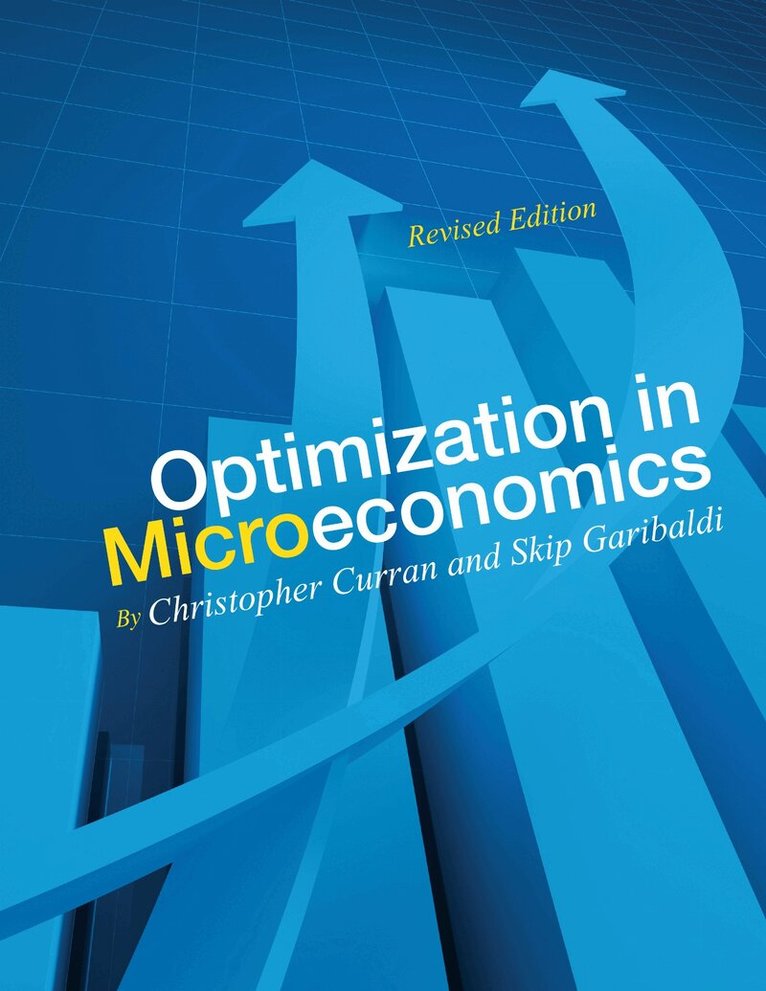
    Optimization in Microeconomics

    AvChristopher Curran,Skip Garibaldi

    Häftad, Engelska, 2016

    1 137 kr

    Beställningsvara. Skickas inom 10-15 vardagar. Fri frakt över 249 kr.

    Fler format och utgåvor

    Inbunden

    3 417 kr

    Beskrivning

    Optimization in Microeconomics is a mathematical economics textbook that synthesizes what the reader knows about mathematics and economics. The exercises in the book ask readers to translate verbal descriptions of an economic problem into mathematical terms for use with optimization techniques to analyze and then translate the mathematical answers back into economic language.The optimization topics include functions of one variable, two variables, several variables, constrained optimization, and finally duality. In each case, the reader is asked to find optima, solve comparative statics problems, and to apply the Envelope Theorem. These last two topics are treated as central and are included from the beginning whereas other books view them as advanced topics.Optimization in Microeconomics is intended for a one-semester course in mathematical economics for undergraduates. Readers should already have seen some microeconomics and partial derivatives of functions of several variables.

    Produktinformation

    • Utgivningsdatum:2016-01-20
    • Mått:203 x 254 x 8 mm
    • Vikt:525 g
    • Format:Häftad
    • Språk:Engelska
    • Antal sidor:152
    • Förlag:Cognella, Inc
    • ISBN:9781516505517

    Utforska kategorier

    • Mikroekonomi inom Ekonomi och Ledarskap

    Mer om författaren

    Dr. Christopher Curran is associate professor of economics at Emory University. He earned his B.A. at Rice University and a masters and Ph.D. in economics at Purdue University. He has taught at Emory University since 1970. He created the mathematical economics course in 1973, and has co-taught the course with a faculty member from the mathematics department since 1975. Dr. Curran has published papers in journals on economic history, urban economics, and law and economics. His current research interests include the role of economic constraints on human evolution.Dr. Skip Garibaldi is a research staff member at the Center for Communications Research. Previously, he was associate director of the Institute for Pure and Applied Mathematics at UCLA and Winship Distinguished Research Professor of Mathematics at Emory University, where he co-taught the mathematical economics course. He has degrees in mathematics and computer science from Purdue University, and a Ph.D. in mathematics from the University of California, San Diego. His paper on the economics of the lottery won the Lester R. Ford Award from the Mathematical Association of America, and his second paper on detecting criminals in the lottery resulted in 6 arrests. He has written two other books on mathematics as well as numerous research articles.