• Fri frakt över 249 kr
  • •
  • Snabba leveranser
  • •
  • Billiga böcker
Kundservice

Du är på sajten för privatpersoner.

Företag, bibliotek eller offentlig verksamhet?

Du handlar på classic.bokus.com, där alla dina funktioner finns intakta.
Till classic.bokus.com
Bokus logotyp. Gå till startsidan.
  • Erbjudanden
  • Nyheter
  • Student
  • Topplistor
  • Barn & ungdom
  • Bokus Play
  • E-böcker
  • Pocketböcker
  • Spel & pussel

10% rabatt på allt med kod: NYSTART10 →

Sidfot

Mina sidor

    Hjälp

    • Kundservice
    • Vanliga frågor och svar
    • Frakt och leverans
    • Retur vid ångerrätt
    • Reklamera vara
    • Betalning
    • Köpvillkor
    • Allmänna villkor
    • Information om webbplatsens tillgänglighet

    Om Bokus

    • Om oss
    • Pressrum
    • För studenter
    • För företag
    • För bibliotek och offentlig verksamhet
    • För leverantörer
    • Hållbarhet

    Populärt

    • Aktuella erbjudanden
    • Presentkort
    • Studentlitteratur
    • Nya böcker
    • Topplistor
    • Signerade böcker
    • Engelska böcker

    Inspiration

    • Boktips
    • BookTok
    • Populära bokserier
    • Barnbokskaraktärer
    • Populära författare
    Logotyp för Bokus
    Följ oss på Facebook (extern länk)Följ oss på Instagram (extern länk)Följ oss på YouTube (extern länk)Följ oss på TikTok (extern länk)
    bokus @ CookiesAnpassa cookiesIntegritetspolicyKöpvillkor
    Till Citymail hemsida (extern länk)Till Budbee hemsida (extern länk)Till Postnord hemsida (extern länk)Till Schenker hemsida (extern länk)Till Early Bird hemsida (extern länk)Till Walleys hemsida (extern länk)
    1. Medicin
    2. Medicin: allmänt
    3. Medicinhistoria

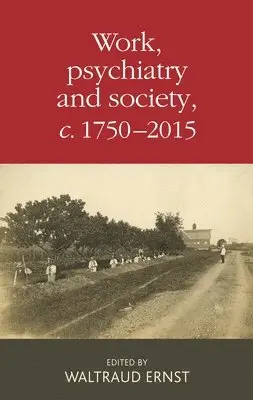
    Work, Psychiatry and Society, c. 1750–2015

    AvWaltraud Ernst

    Häftad, Engelska, 2018

    513 kr

    Beställningsvara. Skickas inom 5-8 vardagar. Fri frakt över 249 kr.

    Beskrivning

    This book offers the first systematic critical appraisal of the uses of work and work therapy in psychiatric institutions across the globe, from the late eighteenth to the end of the twentieth century. Contributors explore the daily routine in psychiatric institutions and ask whether work was therapy, part of a regime of punishment or a means of exploiting free labour. By focusing on mental patients’ day-to-day life in closed institutions, the authors fill a gap in the history of psychiatric regimes. The geographical scope is wide, ranging from Northern America to Japan, India and Western as well as Eastern Europe, and the authors engage with broad historical questions, such as the impact of colonialism and communism and the effect of the World Wars. Work, psychiatry and society presents an alternative history of the emergence of occupational therapy and will be of interest not only to academics in the fields of history and sociology but also to health professionals.

    Produktinformation

    • Utgivningsdatum:2018-03-06
    • Mått:156 x 234 x 21 mm
    • Vikt:553 g
    • Format:Häftad
    • Språk:Engelska
    • Antal sidor:392
    • Förlag:Manchester University Press
    • ISBN:9781526127099

    Utforska kategorier

    • Medicinhistoria inom Medicin
    • Psykiatri inom Medicin
    • Psykisk hälsovård inom Medicin

    Mer om författaren

    Waltraud Ernst is Professor of the History of Medicine at Oxford Brookes University

    Recensioner i media

    'Overall, this volume is an eye-opener. It breaks new ground in clarifying questions of history of psychiatry by focusing on the role of work in mental-health institutions. It contains some first-rate chapters for historians of medicine and psychiatry, social and economic historians and sociologists. It will also inform students, healthcare pro­fessionals and, hopefully, the administrators of medical institutions.' Felicitas Söhner, Universität Ulm (DE), Gesnerus 73 May 2016‘For all the sophistication of the arguments put forward, the introduction and the chapters that follow are very easy to read, making them accessible to a wide audience and hopefully a core text for students being introduced to the history of asylums.’Pamela Dale, University of Exeter, The Economic History Review‘In this volume, Waltraud Ernst has brought together 17 essays with great skill. Together, they demonstrate how ‘work’ with its myriad meanings has different significance – treatment, punishment, reform, exploitation, empowerment – within shifting conditions brought about by colonialism, revolution, war, economic change, and new medical ideologies. The collection makes a great temporal and geographical sweep across the entire modern period to the present day, addressing attitudes and praxis in North America, Japan, India, and Western and Eastern Europe…It will be of interest to historians of medicine and psychiatry, labour and economics, as well as to sociologists, anthropologists, and healthcare professionals.’ Louise Hide, Birkbeck, UCL, History of the human sciences, November 2016‘Work, Psychiatry, and Society, c. 1750–2015, marks a welcome advance in the historiography of madness by placing psychiatricpatients’ work as a topic of central importance that deserves further scholarly attention.’Geoffrey Reaume, Isis Journal, June 2017'Edited books based on conference papers (like this one) can suffer from a certain lack of focus. In this case, however, Professor Ernst has drawn together 17 chapters which relate well to each other and share underlying themes. She has done this partly by including contributions from authors beyond the conference participants – a strategy that deserves to be used more widely.'Cultural and Social History

    Innehållsförteckning

    • Introduction: Therapy and empowerment, coercion and punishment: historical and contemporary perspectives on work, psychiatry and society – Waltraud Ernst1. The role of work in late eighteenth- and early nineteenth-century treatises on moral treatment in France, Tuscany and Britain – Jane Freebody2. Therapeutic work and mental illness in America, c. 1830–1970 – Ben Harris3. Travails of madness: New Jersey, 1800–70 – James Moran4. From blasting powder to tomato pickles: patient work at the provincial mental hospitals in British Columbia, Canada, c. 1885–1920 –Kathryn McKay5. ‘Useful both to the patients as well as to the State’. Patient work in colonial mental hospitals in South Asia, c. 1818–1948 – Waltraud Ernst6. ‘A powerful agent in their recovery’: work as treatment in British West Indian lunatic asylums, 1860–1910 – Leonard Smith7. Work and activity in mental hospitals in modern Japan, c. 1868–2000 – Akira Hashimoto8. Patient work and family care at Iwakura, Japan, c. 1799–1970 – Osamu Nakamura9. Work and occupation in Romanian psychiatry, c. 1838–1945 – Valentin-Veron Toma10. Between therapeutic instrument and exploitation of labour force: patient work in rural asylums in Württemberg, c. 1810–1945 – Thomas Müller11. The patient’s view of work therapy: the mental hospital Hamburg-Langenhorn during the Weimar Republic – Monika Ankele12. They were ‘improved’, punished and cured: the construction of ‘workshy’, ‘industrious’ and (non-)compliant inmates in forced labour facilities in the First Republic of Austria between 1918 and 1938 – Sonja Hinsch13. Useful members of society or motiveless malingerers? Occupation and malingering in British asylum psychiatry, 1870–1914 – Sarah Chaney14. Work and the Irish District Asylums during the late nineteenth century – Oonagh Walsh15. From work and occupation to occupational therapy. The policies of professionalisation in English mental hospitals from 1919 to 1959 – John Hall16. Work is therapy? The function of employment in British psychiatric care after 1959 – Vicky Long17. The hollow gardener and other stories: reason and relation in the work cure – Jennifer LawsIndex