• Fri frakt över 249 kr
  • •
  • Snabba leveranser
  • •
  • Billiga böcker
Kundservice

Du är på sajten för privatpersoner.

Företag, bibliotek eller offentlig verksamhet?

Du handlar på classic.bokus.com, där alla dina funktioner finns intakta.
Till classic.bokus.com
Bokus logotyp. Gå till startsidan.
  • Erbjudanden
  • Nyheter
  • Student
  • Topplistor
  • Barn & ungdom
  • Bokus Play
  • E-böcker
  • Pocketböcker
  • Spel & pussel

10% rabatt på allt med kod NYSTART10 →

Sidfot

Mina sidor

    Hjälp

    • Kundservice
    • Vanliga frågor och svar
    • Frakt och leverans
    • Retur vid ångerrätt
    • Reklamera vara
    • Betalning
    • Köpvillkor
    • Allmänna villkor
    • Information om webbplatsens tillgänglighet

    Om Bokus

    • Om oss
    • Pressrum
    • För studenter
    • För företag
    • För bibliotek och offentlig verksamhet
    • För leverantörer
    • Hållbarhet

    Populärt

    • Aktuella erbjudanden
    • Presentkort
    • Studentlitteratur
    • Nya böcker
    • Topplistor
    • Signerade böcker
    • Engelska böcker

    Inspiration

    • Boktips
    • BookTok
    • Populära bokserier
    • Barnbokskaraktärer
    • Populära författare
    Logotyp för Bokus
    Följ oss på Facebook (extern länk)Följ oss på Instagram (extern länk)Följ oss på YouTube (extern länk)Följ oss på TikTok (extern länk)
    bokus @ CookiesAnpassa cookiesIntegritetspolicyKöpvillkor
    Till Citymail hemsida (extern länk)Till Budbee hemsida (extern länk)Till Postnord hemsida (extern länk)Till Schenker hemsida (extern länk)Till Early Bird hemsida (extern länk)Till Walleys hemsida (extern länk)
    1. Historia och arkeologi
    2. Historia
    3. Historia: särskilda händelser och ämnen
    4. Kalla krig och ombudskrig

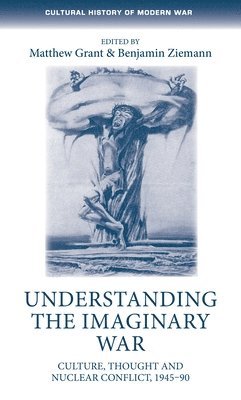
    Understanding the Imaginary War

    Culture, Thought and Nuclear Conflict, 1945–90

    AvMatthew Grant,Benjamin Ziemann

    Häftad, Engelska, 2018

    Del i serien Cultural History of Modern War

    371 kr

    Beställningsvara. Skickas inom 5-8 vardagar. Fri frakt över 249 kr.

    Beskrivning

    Understanding the imaginary war offers a fresh interpretation of the Cold War as an imaginary war, a conflict that had imaginations of nuclear devastation as one of its main battlegrounds. The book includes survey chapters and case studies on Western Europe, the USSR, Japan and the USA. Looking at various strands of intellectual debate and at different media, from documentary film to fiction, the chapters demonstrate the difficulties to make the unthinkable and unimaginable - nuclear apocalypse - imaginable. The book will be required reading for everyone who wants to understand the cultural dynamics of the Cold War through the angle of its core ingredient, nuclear weapons.

    Produktinformation

    • Utgivningsdatum:2018-07-31
    • Mått:138 x 216 x 17 mm
    • Vikt:367 g
    • Format:Häftad
    • Språk:Engelska
    • Serie:Cultural History of Modern War
    • Antal sidor:320
    • Förlag:Manchester University Press
    • ISBN:9781526131904

    Utforska kategorier

    • Kalla krig och ombudskrig inom Historia och arkeologi
    • Allmän historia och världshistoria inom Historia och arkeologi

    Mer om författaren

    Matthew Grant is Senior Lecturer in History at the University of EssexBenjamin Ziemann is Professor of Modern German History at the University of Sheffield

    Recensioner i media

    ‘Understanding the Imaginary War is useful both as a historical tool, but also as a reminder that nuclear weapons still exist, and that nuclear war is still a very real possibility. If anything, the current political situation between Russia and the United States, and especially the inclusion of Article 27 in Russia’s 2014 Military Doctrine relating to the possibility of using nuclear weapons to respond to a conventional attack, shows that emotions felt during the Cold War still affect contemporary relations.’April Curtis‘The book’s fresh approach to the topic and wide range of perspectives will be welcomed by all with an interest in history, political science and cultural studies, and in particular by those of us interested in the Cold War and the history of nuclear weapons.’Dr Mattias Eken, University of St Andrews, Reviews in History‘The volume succeeds in providing a deeper understanding of the cultural responses to nuclear weapons and is an important entry in Cold War historiography, bridging the gap between political, cultural, psychological, and emotional interpretations of nuclear weapons.’Emily Gibbs, University of Liverpool, Journal of Contemporary History

    Innehållsförteckning

    • Introduction: The cold war as an imaginary war - Matthew Grant and Benjamin Ziemann1. The apocalyptic fiction: shaping the future in the cold war - Eva Horn 2. Building peace, fearing the apocalypse: Nuclear danger in Soviet cold war culture, 1945-91 - Miriam Dobson 3. Nuclear themes in American culture, 1945 to the present - Paul Boyer 4. The imaginative landscape of nuclear war in Britain, 1945-65 - Matthew Grant 5. German angst? Debating cold war anxieties in West Germany, 1945-90 - Benjamin Ziemann 6. After Hiroshima. Günther Anders and the history of anti-nuclear critique - Jason Dawsey 7. Hiroshima/Nagasaki, civil rights and anti-war protest in Japan's cold war - Ann Sheriff 8. Catholic anti-communism, the bomb and perceptions of apocalypse in West Germany and the USA, 1945-90 - Daniel Gerster9. 'The nuclear arms race is psychological at its roots.' Physicians and their therapies for the Cold War - Claudia Kemper 10. Imagining the apocalypse: nuclear winter in science and the world - Paul Rubinson 11. Images of nuclear war in U.S. government films from the early cold war - Lars Nowak Index