• Fri frakt över 249 kr
  • •
  • Snabba leveranser
  • •
  • Billiga böcker
Kundservice

Du är på sajten för privatpersoner.

Företag, bibliotek eller offentlig verksamhet?

Du handlar på classic.bokus.com, där alla dina funktioner finns intakta.
Till classic.bokus.com
Bokus logotyp. Gå till startsidan.
  • Erbjudanden
  • Nyheter
  • Student
  • Topplistor
  • Barn & ungdom
  • Bokus Play
  • E-böcker
  • Pocketböcker
  • Spel & pussel

10% rabatt på allt med kod: NYSTART10 →

Sidfot

Mina sidor

    Hjälp

    • Kundservice
    • Vanliga frågor och svar
    • Frakt och leverans
    • Retur vid ångerrätt
    • Reklamera vara
    • Betalning
    • Köpvillkor
    • Allmänna villkor
    • Information om webbplatsens tillgänglighet

    Om Bokus

    • Om oss
    • Pressrum
    • För studenter
    • För företag
    • För bibliotek och offentlig verksamhet
    • För leverantörer
    • Hållbarhet

    Populärt

    • Aktuella erbjudanden
    • Presentkort
    • Studentlitteratur
    • Nya böcker
    • Topplistor
    • Signerade böcker
    • Engelska böcker

    Inspiration

    • Boktips
    • BookTok
    • Populära bokserier
    • Barnbokskaraktärer
    • Populära författare
    Logotyp för Bokus
    Följ oss på Facebook (extern länk)Följ oss på Instagram (extern länk)Följ oss på YouTube (extern länk)Följ oss på TikTok (extern länk)
    bokus @ CookiesAnpassa cookiesIntegritetspolicyKöpvillkor
    Till Citymail hemsida (extern länk)Till Budbee hemsida (extern länk)Till Postnord hemsida (extern länk)Till Schenker hemsida (extern länk)Till Early Bird hemsida (extern länk)Till Walleys hemsida (extern länk)
    1. Samhälle och politik
    2. Politik och statsskick
    3. Politiskt förtryck

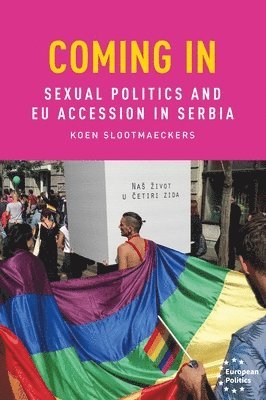
    Coming in

    Sexual Politics and Eu Accession in Serbia

    AvKoen Slootmaeckers

    Häftad, Engelska, 2025

    Del i serien European Politics

    349 kr

    Beställningsvara. Skickas inom 5-8 vardagar. Fri frakt över 249 kr.

    Fler format och utgåvor

    Inbunden

    1 181 kr

    Beskrivning

    LGBT rights have become increasingly salient within the EU enlargement process as a litmus test for Europeanness. But the promotion of these norms has provided a basis for political contestation. This book interrogates the normative dimensions of the EU enlargement process, with special reference to LGBT politics. Reconceptualising Europeanisation, it argues that EU enlargement is a process of negotiated transformation in which EU policies and norms are (re)defined, translated and transformed. Empirically, it analyses the promotion of and resistance to LGBT equality norms in Serbia’s EU integration process, but it looks beyond policies to the impact of the negotiated transitions on lived experiences. Overall, the book raises important questions about the political and social consequences of Europeanisation. At its heart is one crucial question: what do we consider progress?

    Produktinformation

    • Utgivningsdatum:2025-06-03
    • Mått:234 x 13 x 156 mm
    • Vikt:357 g
    • Format:Häftad
    • Språk:Engelska
    • Serie:European Politics
    • Antal sidor:248
    • Förlag:Manchester University Press
    • ISBN:9781526191281

    Utforska kategorier

    • Politiskt förtryck inom Samhälle och politik
    • Internationella relationer inom Samhälle och politik

    Mer om författaren

    Koen Slootmaeckers is a Senior Lecturer in International Politics at City, University of London

    Recensioner i media

    WINNER of the 2025 EUSA Best Book in European Union Studies AwardShortlisted for UACES Best Book Prize 2024‘Coming in is an exceptional book, one that stitches together insights on Western Balkan queer politics and Europeanisation theory to deliver comprehensive rejoinders to both fields. It is impressive just how much Slootmaeckers's Serbian case teaches us about the intricacies of the complicated relationship – both in its potentialities and pitfalls – between the European Union and its candidate countries. Most importantly, Slootmaeckers goes beyond asking “why” some states adopt rights to normatively question what these rights mean for the people who experience them. This is a resoundingly successful effort that will benefit the literatures on tactical Europeanisation and the Western Balkans for the decisive years ahead.’Phillip Ayoub, Professor of International Relations, University College London‘Coming in provides an original and thought-provoking analysis of the promotion of LGBT rights by the EU during the long and winding road of accession preparations in Serbia. The EU is often regarded as a leader in promoting such rights, but as Slootmaeckers reveals, its values are not fixed – rather they are negotiated during the accession process between the EU and candidate countries. This book calls for a reconceptualisation of the EU’s behaviour during accession preparations and is essential reading for everyone in the field.’Paul Copeland, Reader in Public Policy, Queen Mary University of London‘This meticulous and subtle work looks at campaigns for LGBT equality and recognition, but it sheds light on a broader phenomenon known to people studying EU conditionality in prospective member states: when the EU makes a goal look like a condition, governments respond with gestures that are designed to look like compliance. Is this a step forwards for equality or not? Koen Slootmaeckers constructs a solid empirical case to guide readers through this enigma, weaving his narrative with substance, detail and sophistication.’Eric Gordy, Professor of Political and Cultural Sociology, University College London‘In Coming in, Koen Slootmaeckers traces the manifold ways in which the sexual politics and fight for LGBTQ rights in Serbia simultaneously influenced and were influenced by Serbia’s tumultuous and still unresolved accession to the European Union. Theoretically innovative and empirically rich, this book is an essential contribution to the study of both LGBTQ politics and the fraught politics of European Union enlargement.’Jelena Subotic, Professor of Political Science, Georgia State University'Coming In provides a much-needed critical reappraisal of the Europeanisation of LGBT rights and EU enlargement policies, urging us to always interrogate the political motives behind legal change and whether “progress” translates into real-life improvements or further levels of exclusion for marginalised communities. At a time when geopolitical rhetoric and civilisational binaries appear to have been further normalised, Slootmaeckers’ call for self-reflexivity in EU foreign policy resonates and has implications that go well beyond the specific policy-area and geographical focus of this book.'Laura Luciani, LSE Review of Books'A valuable addition to the growing literature on LGBTIQ+ communities in Southeastern Europe. [...]Slootmaeckers’ newest contribution is unique because it offers a comprehensive yet succinct analysis of sexual politics, Europeanization, and policy making in relation to Serbia’s path towards European Union membership.' Aleksandar Rankovic, CEU Review of Books 'A valuable source for scholars and practitioners of both European integration and global queer politics.'Comparative Southeast European Studies'Drawing on an impressive mix of interviews, document analysis, and participant observation in Serbia, and by addressing the multi-layered nature of Europeanization and its impact on LGBT rights, Slootmaeckers creates a nuanced framework that reveals the strategic interplay between Serbia's nationalist politics and its commitment to Europeanization, reflected in its instrumental approach to LGBT rights. In doing so, Slootmaeckers convincingly demonstrates that the facade of progress fails to take into account the realities of life for marginalized individuals in a homophobic society.'Roman Kuhar, Slavic Review

    Innehållsförteckning

    • IntroductionPart I: rethinking Europeanisation and EU-Serbia relations1 Europeanisation as negotiated transitions: Towards a relational and transnational approach to EU enlargement2 Mapping the multi-layered normative structure of Serbia-EU relationsPart II: Adopting, resisting, and transforming law and practices3 Anti-discrimination policies: From the margins to differentiated politicisations4 Taking it to the streets: Belgrade Pride as a litmus test for Serbia’s EuropeanisationPart III: Looking beyond policy towards lived experiences5 The attitudinal panopticon and the limited implementation of the anti-discrimination framework6 The emergence of the Ghost Pride and the transnational dislocation of LGBT politicsConclusionEpilogueIndex