• Fri frakt över 249 kr
  • •
  • Snabba leveranser
  • •
  • Billiga böcker
Kundservice

Du är på sajten för privatpersoner.

Företag, bibliotek eller offentlig verksamhet?

Du handlar på classic.bokus.com, där alla dina funktioner finns intakta.
Till classic.bokus.com
Bokus logotyp. Gå till startsidan.
  • Erbjudanden
  • Nyheter
  • Student
  • Topplistor
  • Barn & ungdom
  • Bokus Play
  • E-böcker
  • Pocketböcker
  • Spel & pussel

10% rabatt på allt med kod: NYSTART10 →

Sidfot

Mina sidor

    Hjälp

    • Kundservice
    • Vanliga frågor och svar
    • Frakt och leverans
    • Retur vid ångerrätt
    • Reklamera vara
    • Betalning
    • Köpvillkor
    • Allmänna villkor
    • Information om webbplatsens tillgänglighet

    Om Bokus

    • Om oss
    • Pressrum
    • För studenter
    • För företag
    • För bibliotek och offentlig verksamhet
    • För leverantörer
    • Hållbarhet

    Populärt

    • Aktuella erbjudanden
    • Presentkort
    • Studentlitteratur
    • Nya böcker
    • Topplistor
    • Signerade böcker
    • Engelska böcker

    Inspiration

    • Boktips
    • BookTok
    • Populära bokserier
    • Barnbokskaraktärer
    • Populära författare
    Logotyp för Bokus
    Följ oss på Facebook (extern länk)Följ oss på Instagram (extern länk)Följ oss på YouTube (extern länk)Följ oss på TikTok (extern länk)
    bokus @ CookiesAnpassa cookiesIntegritetspolicyKöpvillkor
    Till Citymail hemsida (extern länk)Till Budbee hemsida (extern länk)Till Postnord hemsida (extern länk)Till Schenker hemsida (extern länk)Till Early Bird hemsida (extern länk)Till Walleys hemsida (extern länk)
    1. Samhälle och politik
    2. Sociologi och antropologi
    3. Sociologi

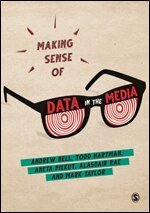
    Making Sense of Data in the Media

    AvAndrew Bell,Todd Hartman

    Häftad, Engelska, 2019

    658 kr

    Skickas . Fri frakt över 249 kr.

    Fler format och utgåvor

    Inbunden

    2 373 kr

    Beskrivning

    The amount of data produced, captured and transmitted through the media has never been greater. But for this data to be useful, it needs to be properly understood and claims made about or with data need to be properly scrutinized.

    Through a series of examples of statistics in the media, this book shows you how to critically assess the presentation of data in the media, to identify what is significant and to sort verifiable conclusions from misleading claims. How accurate are polls, and how should we know? How should league tables be read? Are numbers presented as ‘large’ really as big as they may seem at first glance?

    By answering these questions and more, readers will learn a number of statistical concepts central to many undergraduate social science statistics courses. By tying them in to real life examples, the importance and relevance of these concepts comes to life. As such, this book does more than teaches techniques needed for a statistics course; it teaches you life skills that we need to use every single day.


    Produktinformation

    • Utgivningsdatum:2019-11-22
    • Mått:170 x 242 x 15 mm
    • Vikt:470 g
    • Format:Häftad
    • Språk:Engelska
    • Antal sidor:272
    • Upplaga:1
    • Förlag:SAGE Publications
    • ISBN:9781526447203

    Utforska kategorier

    • Sociologi inom Samhälle och politik

    Mer om författaren

    Andrew Bell is a Lecturer at the Sheffield Methods Institute, University of Sheffield. His research spans a wide range of social sciences and beyond, with work on social inequalities, segregation, mental health, education and more. He also investigates the performance of different quantitative methods for use in the social sciences, with a focus on multilevel models. His twitter is @andrewjdbell.Todd Hartman is Senior Lecturer in Quantitative Social Sciences at the Sheffield Methods Institute. His research focuses on political psychology, especially political attitudes and inter-group relations. He has extensive experience conducting surveys and experiments. His twitter is @tkhartmanAneta Piekut is a Lecturer at the Sheffield Methods Institute, the University of Sheffield. Her research focuses on the relationship between ethnic diversity and social cohesion, attitudes towards immigration and ethnic minorities, as well as integration and socio-spatial segregation. She teaches undergraduate students how to design a survey, do a mixed-methods research and how to replicate a scientific paper. Her twitter is @anetapiekut Alasdair Rae is the founder of Automatic Knowledge Ltd, a UK-based data and insights company, focusing on spatial data analysis and the built environment. Prior to that, he was a Professor of Urban Studies and Planning at the University of Sheffield. He is a Fellow of the Royal Scottish Geographical Society, a recipient of the Royal Town Planning Institute′s Sir Peter Hall award for Wider Engagement, a former Commissioner of the UK2070 Commission, and a winner of the Royal Statistical Society’s ‘Stat of the Year’. His most recent academic work has focused on spatial analysis, deprivation, housing markets and megaregions, and his work frequently appears in the national and international media. He has a PhD from the University of Liverpool, an MA from The Ohio State University and a BA from the University of Strathclyde.  Mark Taylor is Senior Lecturer in Quantitative Methods (Sociology) at the Sheffield Methods Institute, University of Sheffield, and is AHRC Leadership Fellow (Creative Economy) until 2021. His research interests are in the sociology of culture: in consumption, production, and education, and its relationship to inequality. He spends a lot of time visualising data, and wrangling data into a shape where it can be visualised. His twitter is @markrt

    Recensioner i media

    What a timely book. In a world drowning in data we all need to know how to critically evaluate the numbers we confront every day. This book will help you ask those all-important questions and demystify statistics. From ‘is that a lot?’ to ‘is that possible?’ the authors guide you through statistical techniques that are easy to understand and simple to apply. Read it, learn the techniques and use them to become a critical data consumer.

    Innehållsförteckning

    • Chapter 1 IntroductionChapter 2 How to make numbers sound big, or small, even when they aren’t: “Is that a lot?”Chapter 3 Recognizing which numbers you should trust: “Where is the data from?”Chapter 4 Making surveys representative: “Who you gonna call?”Chapter 5 Graphics in the media and how to read them: “What does this mean?Chapter 6 Maps in the media: “Where is this happening?"Chapter 7 Mapping patterns and people: why does geography matter?Chapter 8 Understanding uncertainty in estimation: “are you sure?”Chapter 9 Ranking with league tables: “What′s the best?"Chapter 10 When a relationship (doesn’t) mean causality: “How did that happen?"Chapter 11 Surprising quirks in the media: “Is that possible?"Chapter 12 Conclusion