• Fri frakt över 249 kr
  • •
  • Snabba leveranser
  • •
  • Billiga böcker
Kundservice

Du är på sajten för privatpersoner.

Företag, bibliotek eller offentlig verksamhet?

Du handlar på classic.bokus.com, där alla dina funktioner finns intakta.
Till classic.bokus.com
Bokus logotyp. Gå till startsidan.
  • Erbjudanden
  • Nyheter
  • Student
  • Topplistor
  • Barn & ungdom
  • Bokus Play
  • E-böcker
  • Pocketböcker
  • Spel & pussel

10% rabatt på allt med kod: NYSTART10 →

Sidfot

Mina sidor

    Hjälp

    • Kundservice
    • Vanliga frågor och svar
    • Frakt och leverans
    • Retur vid ångerrätt
    • Reklamera vara
    • Betalning
    • Köpvillkor
    • Allmänna villkor
    • Information om webbplatsens tillgänglighet

    Om Bokus

    • Om oss
    • Pressrum
    • För studenter
    • För företag
    • För bibliotek och offentlig verksamhet
    • För leverantörer
    • Hållbarhet

    Populärt

    • Aktuella erbjudanden
    • Presentkort
    • Studentlitteratur
    • Nya böcker
    • Topplistor
    • Signerade böcker
    • Engelska böcker

    Inspiration

    • Boktips
    • BookTok
    • Populära bokserier
    • Barnbokskaraktärer
    • Populära författare
    Logotyp för Bokus
    Följ oss på Facebook (extern länk)Följ oss på Instagram (extern länk)Följ oss på YouTube (extern länk)Följ oss på TikTok (extern länk)
    bokus @ CookiesAnpassa cookiesIntegritetspolicyKöpvillkor
    Till Citymail hemsida (extern länk)Till Budbee hemsida (extern länk)Till Postnord hemsida (extern länk)Till Schenker hemsida (extern länk)Till Early Bird hemsida (extern länk)Till Walleys hemsida (extern länk)
    1. Samhälle och politik
    2. Samhälle och kultur
    3. Kultur och medier
    4. Referensverk och tvärvetenskap

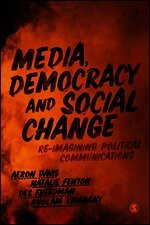
    Media, Democracy and Social Change

    Re-imagining Political Communications

    AvAeron Davis,Natalie Fenton

    Inbunden, Engelska, 2020

    1 723 kr

    Skickas . Fri frakt över 249 kr.

    Fler format och utgåvor

    Häftad

    1 218 kr

    Beskrivning

    When we are told so regularly that we live in a ‘post truth’ age and are surrounded by ‘fake news’, it can be tempting to think of politics as primarily mediated. Discussion and analysis of public affairs is preoccupied with the power and reach of platforms or the passion and rage of social media exchanges. As important as these issues may be, a focus on the communicative risks downgrading the political.

    Media, Democracy and Social Change puts politics back into political communications. It shows how within a digital media ecology, the wider context of neoliberal capitalism remains essential for understanding what political communications is, and can hope to be.

    Tackling broad themes of structural inequality, technological change, political realignment and social transformation, the book explores political communications as it relates to debates around the state, infrastructures, elites, populism, political parties, activism, the legacies of colonialism, and more.

    It is both an expert introduction to the field of political communications, and a critical intervention to help re-imagine what a democratic politics might mean in a digital age. It will be essential reading for students, researchers and activists. 

    Aeron Davis, Natalie Fenton, Des Freedman and Gholam Khiabany all work at the Department of Media and Communication at Goldsmiths, University of London, where they teach together on the MA in Political Communications. 

    Produktinformation

    • Utgivningsdatum:2020-10-07
    • Mått:156 x 234 x 21 mm
    • Vikt:470 g
    • Format:Inbunden
    • Språk:Engelska
    • Antal sidor:208
    • Upplaga:1
    • Förlag:SAGE Publications
    • ISBN:9781526456953

    Utforska kategorier

    • Referensverk och tvärvetenskap inom Samhälle och politik
    • Politik och statsskick inom Samhälle och politik

    Mer om författaren

    Aeron Davis is Professor of Political Communication at Victoria University of Wellington. He was formerly Professor of Political Communication and Co-Head of the Department of Media, Communications and Cultural Studies at Goldsmiths, University of London where he was also the Co-founder and Co-Director of Goldsmiths’ Political Economy Research Centre (PERC). He has researched and published across the disciplines of Media, Journalism Studies, Politics and Sociology. His research interests also include the promotional industries, elites, financialization and economic policy.He is the author of two edited collections and six books: Public Relations Democracy (MUP, 2002), The Mediation of Power (Routledge, 2007), Political Communication and Social Theory (Routledge, 2010), Promotional Cultures (Polity, 2013), Reckless Opportunists: Elites at the End of the Establishment (MUP, 2018) and Political Communication: A New Introduction for Crisis Times (Polity, 2019). He has also published some 50 other academic pieces as well as a number of reports and news opinion pieces. Natalie Fenton is a Professor of Media and Communications and Co-Head of the Department of Media, Communications and Cultural Studies at Goldsmiths, University of London. She is also Co-Director of the Centre for the Study of Global Media and Democracy. She has published widely on issues relating to civil society, radical politics, digital media, news and journalism and is particularly interested in issues of political transformation, radical media reform and re-imagining democracy. She was Vice-chair of the Board of Directors of the campaign group Hacked Off for 7 years and is currently Chair of the UK Media Reform Coalition. Her books include New Media: Old News: Journalism and Democracy in the Digital Age (Sage, 2010); Misunderstanding the Internet co-authored with James Curran and Des Freedman (Routledge, 2016); Digital, Political, Radical (2016, Polity); Media, Democracy and Social Change: Re-imagining Political Communications co-authored with Des Freedman, Gholam Khiabany and Aeron Davis (Sage, 2020) and The Media Manifesto co-authored with Lina Des Freedman and Justin Schlosberg and Lina Dencik (Polity, 2020). Des Freedman is Professor of Media and Communications in the Department of Media, Communications and Cultural Studies at Goldsmiths, University of London. He is co-director of the Goldsmiths Leverhulme Media Research Centre and a founding member of the Media Reform Coalition.His publications include, as editor, Capitalism’s Conscience: 200 Years of the Guardian (Pluto, 2021) and, as author, The Contradictions of Media Power (Bloomsbury, 2014), The Politics of Media Policy (Polity 2008), Misunderstanding the Internet (Routledge, 2016, co-authored with James Curran and Natalie Fenton) and The Media Manifesto (Polity, 2020, co-authored with Natalie Fenton, Justin Schlosberg and Lina Dencik). He has co-edited books on a wide range of themes including media, racism and terrorism, the politics of higher education, media reform and the future of television.Gholam Khiabany teaches in the Department of Media, Communication and Cultural Studies at Goldsmiths, University of London. He is a member of council of management of the Institute of Race Relations, and Editorial Working Committee of Race and Class. His publications include Iranian Media: The Paradox of Modernity (Routledge, 2010); Blogistan co-authored with Annabelle Sreberny (I.B.Tauris, 2010); and two co-edited collections:  Liberalism in Neoliberal Times: Dimensions, Contradictions, Limits (Goldsmiths Press, 2017), and After Charlie Hebdo: Terror, Racism and Free Speech (Zed, 2017).

    Recensioner i media

    A valuable addition to the MCS units from recognised authors in the field

    Innehållsförteckning

    • Chapter 1. Putting Politics Back Into Political CommunicationsChapter 2. Infrastructures of Political CommunicationsChapter 3. The State of Political CommunicationsChapter 4. Elites, Experts, Power and DemocracyChapter 5. Democracy without Political Parties?Chapter 6. The Violence of an Illiberal LiberalismChapter 7. Political Communications, Civil Society and the CommonsChapter 8. Intellectuals and the Re-imagining of Political Communications