• Fri frakt över 249 kr
  • •
  • Snabba leveranser
  • •
  • Billiga böcker
Kundservice

Du är på sajten för privatpersoner.

Företag, bibliotek eller offentlig verksamhet?

Du handlar på classic.bokus.com, där alla dina funktioner finns intakta.
Till classic.bokus.com
Bokus logotyp. Gå till startsidan.
  • Erbjudanden
  • Student
  • Topplistor
  • Barn & ungdom
  • Bokus Play
  • E-böcker
  • Ljudböcker
  • Pocketböcker
  • Spel och pussel

Pocketfynda! Hundratals böcker för 49 kr/st →

Sidfot

Mina sidor

    Hjälp

    • Kundservice
    • Vanliga frågor och svar
    • Frakt och leverans
    • Retur vid ångerrätt
    • Reklamera vara
    • Betalning
    • Köpvillkor
    • Allmänna villkor
    • Information om webbplatsens tillgänglighet

    Om Bokus

    • Om oss
    • Pressrum
    • För studenter
    • För företag
    • För bibliotek och offentlig verksamhet
    • För leverantörer
    • Hållbarhet

    Populärt

    • Aktuella erbjudanden
    • Presentkort
    • Studentlitteratur
    • Nya böcker
    • Topplistor
    • Signerade böcker
    • Engelska böcker

    Inspiration

    • Boktips
    • BookTok
    • Barnbokskaraktärer
    • Populära författare
    Logotyp för Bokus
    Följ oss på Facebook (extern länk)Följ oss på Instagram (extern länk)Följ oss på YouTube (extern länk)Följ oss på TikTok (extern länk)
    bokus @ CookiesAnpassa cookiesIntegritetspolicyKöpvillkor
    Till Citymail hemsida (extern länk)Till Budbee hemsida (extern länk)Till Postnord hemsida (extern länk)Till Schenker hemsida (extern länk)Till Early Bird hemsida (extern länk)Till Walleys hemsida (extern länk)
    1. Naturvetenskap och teknik
    2. Geovetenskap
    3. Geografi

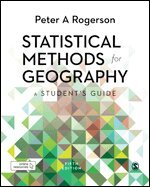
    Statistical Methods for Geography

    A Student’s Guide

    AvPeter A. Rogerson

    Häftad, Engelska, 2019

    751 kr

    Beställningsvara. Skickas inom 5-8 vardagar. Fri frakt över 249 kr.

    Fler format och utgåvor

    Inbunden

    2 507 kr

    E-bok

    710 kr

    Beskrivning

    Statistical Methods for Geography is the essential introduction for geography students looking to fully understand and apply key statistical concepts and techniques. Now in its fifth edition, this text is an accessible statistics ‘101’ focused on student learning, and includes definitions, examples, and exercises throughout. Fully integrated with online self-assessment exercises and video overviews, it explains everything required to get full credits for any undergraduate statistics module.


    The fifth edition of this bestselling text includes:

    ·        Coverage of descriptive statistics, probability, inferential statistics, hypothesis testing and sampling, variance, correlation, regression analysis, spatial patterns, spatial data reduction using factor analysis and cluster analysis.

    ·        New examples from physical geography and additional real-world examples.

    ·        Updated in-text and online exercises along with downloadable datasets.


    This is the only text you’ll need for undergraduate courses in statistical analysis, statistical methods, and quantitative geography.


    Produktinformation

    • Utgivningsdatum:2019-12-18
    • Mått:186 x 232 x 22 mm
    • Vikt:1 000 g
    • Format:Häftad
    • Språk:Engelska
    • Antal sidor:432
    • Upplaga:5
    • Förlag:SAGE Publications
    • ISBN:9781526498809

    Utforska kategorier

    • Geografi inom Naturvetenskap och teknik
    • Sociologi inom Samhälle och politik

    Mer om författaren

    Peter A. Rogerson is SUNY (State University of New York) Distinguished Professor in the Department of Geography at the University at Buffalo, Buffalo, New York, USA. He also holds an adjunct appointment in the Department of Biostatistics.

    Recensioner i media

    This book has become the gold standard for teaching statistical methods to geographers. With a friendly and accessible manner, the author covers introductory statistics while revealing the quirkiness of spatial data. It is suitable for a one-year undergraduate class in geography, and there is no better reference for students transitioning to graduate studies. While always including rich examples form human geography, this new edition includes more examples from physical geography that will appeal to a wider audience.

    Innehållsförteckning

    • 1INTRODUCTION TO STATISTICAL METHODS FOR GEOGRAPHY1.1Introduction1.2The scientific method1.3Exploratory and confirmatory approaches in geography1.4Probability and statistics1.5Descriptive and inferential methods1.6The nature of statistical thinking1.7Special considerations for spatial data1.8The structure of the book1.9Datasets2DESCRIPTIVE STATISTICS2.1Types of data2.2Visual descriptive methods2.3Measures of central tendency2.4Measures of variability2.5Other numerical measures for describing data2.6Descriptive spatial statistics2.7Descriptive statistics in SPSS 25 for WindowsSolved exercisesExercises3PROBABILITY AND DISCRETE PROBABILITY DISTRIBUTIONS3.1Introduction3.2Sample spaces, random variables, and probabilities3.3Binomial processes and the binomial distribution3.4The geometric distribution3.5The Poisson distribution3.6The hypergeometric distribution3.7Binomial tests in SPSS 25 for WindowsSolved exercisesExercises4CONTINUOUS PROBABILITY DISTRIBUTIONS AND PROBABILITY MODELS4.1Introduction4.2The uniform or rectangular distribution4.3The normal distribution4.4The exponential distribution4.5Summary of discrete and continuous distributions4.6Probability modelsSolved exercisesExercises5INFERENTIAL STATISTICS: CONFIDENCE INTERVALS, HYPOTHESIS TESTING, AND SAMPLING5.1Introduction to inferential statistics5.2Confidence intervals5.3Hypothesis testing5.4Distributions of the random variable and distributions of the test statistic5.5Spatial data and the implications of nonindependence5.6Further discussion of the effects of deviations from the assumptions5.7Sampling5.8Some tests for spatial measures of central tendency and variability5.9One-sample tests of means in SPSS 25 for Windows5.10 Two-sample t-tests in SPSS 25 for WindowsSolved exercisesExercises6ANALYSIS OF VARIANCE6.1Introduction6.2Illustrations6.3Analysis of variance with two categories6.4Testing the assumptions6.5Consequences of failure to meet assumptions6.6 The nonparametric Kruskal–Wallis test6.7 The nonparametric median test6.8 Contrasts6.9 One-way ANOVA in SPSS 25 for Windows6.10 One-way ANOVA in ExcelSolved exercisesExercises7CORRELATION7.1Introduction and examples of correlation7.2More illustrations7.3A significance test for r7.4The correlation coefficient and sample size7.5Spearman’s rank correlation coefficient7.6Additional topics7.7Correlation in SPSS 25 for Windows7.8Correlation in ExcelSolved exercisesExercises8DATA REDUCTION: FACTOR ANALYSIS AND CLUSTER ANALYSIS8.1 Introduction8.2 Factor analysis and principal components analysis8.3 Cluster analysis8.4 Data reduction methods in SPSS 25 for WindowsExercises9INTRODUCTION TO REGRESSION ANALYSIS9.1 Introduction9.2 Fitting a regression line to a set of bivariate data9.3 Regression in terms of explained and unexplained sums of squares9.4 Assumptions of regression9.5 Standard error of the estimate9.6 Tests for ß9.7Illustration: state aid to secondary schools9.8 Linear versus nonlinear models9.9 Regression in SPSS 25 for Windows9.10 Regression in ExcelSolved exercisesExercises10MORE ON REGRESSION10.1 Multiple regression10.2 Misspecification error10.3 Dummy variables10.4 Multiple regression illustration: species in the Galápagos Islands10.5 Variable selection10.6 Regression analysis on component scores10.7 Categorical dependent variable10.8 A summary of some problems that can arise in regression analysis10.9 Multiple and logistic regression in SPSS 25 for WindowsExercises11SPATIAL DATA, SPATIAL PATTERNS, AND SPATIAL REGRESSION11.1 Introduction11.2 The analysis of point patterns11.3 Geographic patterns in areal data11.4 Local statistics11.5 Introduction to spatial aspects of regression11.6 Spatial lag model and neighborhood-based explanatory variables11.7 Spatial regression: autocorrelated errors11.8 Geographically weighted regression11.9 Illustration11.10 Finding Moran’s I using SPSS 25 for Windows11.11 Finding Moran’s I using GeoDa11.12 Spatial Regression with GeoDa 1.4.6ExercisesEPILOGUEANSWERS FOR SELECTED EXERCISESAPPENDIX A: STATISTICAL TABLESAPPENDIX B: MATHEMATICAL CONVENTIONS AND NOTATIONBibliographyIndex