• Fri frakt över 249 kr
  • •
  • Snabba leveranser
  • •
  • Billiga böcker
Kundservice

Du är på sajten för privatpersoner.

Företag, bibliotek eller offentlig verksamhet?

Du handlar på classic.bokus.com, där alla dina funktioner finns intakta.
Till classic.bokus.com
Bokus logotyp. Gå till startsidan.
  • Erbjudanden
  • Nyheter
  • Student
  • Topplistor
  • Barn & ungdom
  • Bokus Play
  • E-böcker
  • Pocketböcker
  • Spel & pussel

10% rabatt på allt med kod: NYSTART10 →

Sidfot

Mina sidor

    Hjälp

    • Kundservice
    • Vanliga frågor och svar
    • Frakt och leverans
    • Retur vid ångerrätt
    • Reklamera vara
    • Betalning
    • Köpvillkor
    • Allmänna villkor
    • Information om webbplatsens tillgänglighet

    Om Bokus

    • Om oss
    • Pressrum
    • För studenter
    • För företag
    • För bibliotek och offentlig verksamhet
    • För leverantörer
    • Hållbarhet

    Populärt

    • Aktuella erbjudanden
    • Presentkort
    • Studentlitteratur
    • Nya böcker
    • Topplistor
    • Signerade böcker
    • Engelska böcker

    Inspiration

    • Boktips
    • BookTok
    • Populära bokserier
    • Barnbokskaraktärer
    • Populära författare
    Logotyp för Bokus
    Följ oss på Facebook (extern länk)Följ oss på Instagram (extern länk)Följ oss på YouTube (extern länk)Följ oss på TikTok (extern länk)
    bokus @ CookiesAnpassa cookiesIntegritetspolicyKöpvillkor
    Till Citymail hemsida (extern länk)Till Budbee hemsida (extern länk)Till Postnord hemsida (extern länk)Till Schenker hemsida (extern länk)Till Early Bird hemsida (extern länk)Till Walleys hemsida (extern länk)
    1. Psykologi och pedagogik
    2. Psykologi
    3. Biologisk psykologi och neuropsykologi

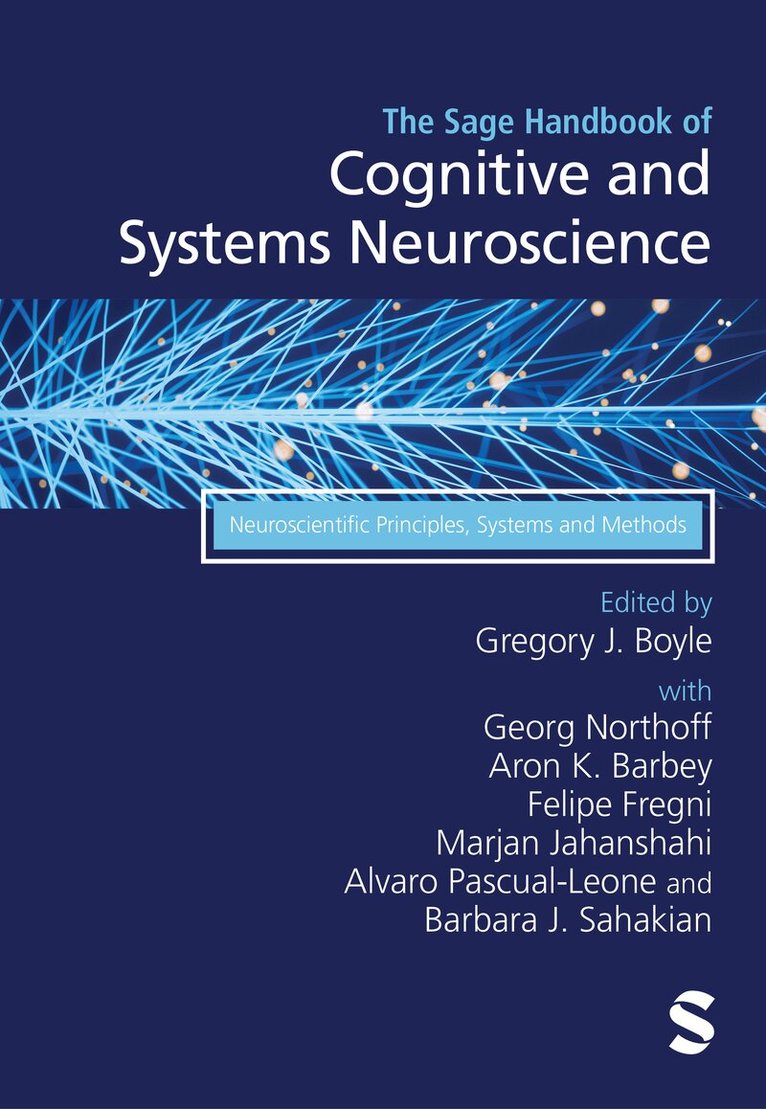
    The Sage Handbook of Cognitive and Systems Neuroscience

    Neuroscientific Principles, Systems and Methods

    AvGregory J. Boyle,Georg Northoff

    Inbunden, Engelska, 2023

    2 991 kr

    Beställningsvara. Skickas inom 3-6 vardagar. Fri frakt över 249 kr.

    Beskrivning

    Cognitive neuroscience is the interdisciplinary study of how cognitive and intellectual functions are processed and represented within the brain, which is critical to building understanding of core psychological and behavioural processes such as learning, memory, behaviour, perception, and consciousness. Understanding these processes not only offers relevant fundamental insights into brain-behavioural relations, but may also lead to actionable knowledge that can be applied in the clinical treatment of patients with various brain-related disabilities.

    This Handbook focusses on the foundational principles, methods, and underlying systems in cognitive and systems neuroscience, as well as examining cutting-edge methodological advances and innovations.

    Containing 34 original, state of the art contributions from leading experts in the field, this Handbook is essential reading for researchers and students of cognitive psychology, as well as scholars across the fields of neuroscientific, behavioural and health sciences.

    Part 1: Background Considerations

    Part 2: Neuroscientific Substrates and Principles

    Part 3: Neuroanatomical Brain Systems

    Part 4: Neural Dynamics and Processes

    Part 5: Sensory-Perceptual Systems and Cognition

    Part 6: Methodological Advances

    Produktinformation

    • Utgivningsdatum:2023-11-17
    • Mått:174 x 246 x 38 mm
    • Vikt:1 200 g
    • Format:Inbunden
    • Språk:Engelska
    • Antal sidor:632
    • Upplaga:1
    • Förlag:SAGE Publications
    • ISBN:9781529753554

    Utforska kategorier

    • Biologisk psykologi och neuropsykologi inom Psykologi och pedagogik
    • Referensverk och tvärvetenskap inom Samhälle och politik
    • Psykologiska teorier och skolor inom Psykologi och pedagogik

    Mer om författaren

    Professor Boyle has spent over three decades undertaking quantitative research in the field of psychometrics, as related to the measurement of individual differences inpersonality, intelligence, and motivation, as well as undertaking studies within the fields of neuropsychology, clinical psychology, and educational psychology. In more recent years, he has applied his extensive research skills to studies within the broad fields of medical/health psychology, and has undertaken many studies within thearea of women′s health. Lately, he has focused his attention more on research topics pertaining to men′s health. Georg Northoff is Canada Research Chair for Mind, Brain Imaging and Neuroethics at the University of Ottawa/Canada. He made major contribution in neuroscience on the neural correlates of mental features like consciousness, self, mind wandering and mental disorders having discovered their spatiotemporal mechanisms bridging the gap of neural and mental activity. This led him to develop an integrated brain-mind model for which Spatiotemporal Neuroscience is the key discipline.Aron K. Barbey is Professor of Psychology, Neuroscience, and Bioengineering at the University of Illinois at Urbana-Champaign. He is chair of the Intelligent Systems Research Theme, leader of the Intelligence, Learning, and Plasticity Initiative, and director of the Decision Neuroscience Laboratory at the Beckman Institute for Advanced Science and Technology. Dr. Barbey’s research investigates the neural mechanisms of human intelligence and decision making, with particular emphasis on enhancing these functions through cognitive neuroscience, physical fitness, and nutritional intervention. His research has been supported by the Office of the Director of National Intelligence, the Department of Defense, the White House BRAIN Initiative, the National Institutes of Health, the National Science Foundation, and private industry (Abbott Nutrition, Google Brain, and PepsiCo). Dr. Barbey has received multiple research awards and is editor of the Cambridge Handbook of Intelligence and Cognitive Neuroscience and the forthcoming Oxford Handbook of Cognitive Enhancement and Brain Plasticity. He earned his doctorate in Psychology from Emory University and completed a research fellowship in Cognitive Neuroscience at the National Institutes of Health. Felipe Fregni, MD, PhD, MMSc, MPH is the director of Spaulding Neuromodulation Center. He is an Associate Professor of PM&R at Harvard Medical School and an Associate Professor of Epidemiology. He is also the course director for the HMS continuing medical education course, Principles and Practice of Clinical Research, a 6-month distance learning course. It focuses on promoting collaboration and bringing clinical research education to practicing clinicians worldwide. Currently, his research is focused on understanding neuroplastic changes associated with conditions such as chronic pain, Parkinson’s disease, and stroke, using non-invasive brain stimulation as an investigative tool for such aims. In addition, his laboratory is comprised of about 15 research fellows and staff, and is a trai ning center for clinical research and neuromodulation methodology. Dr. Fregni’s laboratory is funded by several sponsors including NIH, the Christopher and Dana Reeve Foundation, CIMIT, and the RJG Foundation. Barbara J Sahakian is Professor of Clinical Neuropsychology at the University of Cambridge Department of Psychiatry and Behavioural and Clinical Neuroscience Institute. She is also an Honorary Clinical Psychologist at Addenbrooke’s Hospital, Cambridge. She holds a PhD and a DSc from the University of Cambridge. She is a Fellow of the Academy of Medical Sciences and was President of the International Neuroethics Society (2014-2016) and the British Association for Psychopharmacology (2012-2014). In 2016, she was recipient of the Robert Sommer Award and the International College of Neuropsychopharmacology (CINP) Ethics Prize. Sahakian is also a Member of the International Expert Jury for the 2017 Else Kröner-Fresenius-Stiftung Prize dedicated to the biological basis of psychiatric disorders. She is co-author of ‘Bad Moves: How decision making goes wrong and the ethics of smart drugs’ (Oxford University Press, 2013) and of ‘Sex, Lies and Brain Scans. How fMRI reveals what really goes on in our minds’ (OUP, 2017). She is co-editor of The Oxford Handbook of Neuroethics (OUP, 2011) and Translational Neuropsychopharmacology (Current Topics in Behavioral Neurosciences) (Springer International Publishing, 2016).Sahakian has an international reputation in the fields of psychopharmacology, neuropsychology, neuropsychiatry, neuroimaging and neuroethics. She is perhaps best known for her work on ‘hot’ and ‘cold’ cognitive deficits in depression and early detection and early treatment with cholinesterase inhibitors in Alzheimer’s disease. She has over 400 publications in high impact scientific journals. Sahakian co-invented the neuropsychological CANTAB tests. Sahakian has contributed to Neuroscience and Mental Health Government Policy and has spoken on resilience, brain health, neuroscience and mental health at the World Economic Forum, Davos, 2014. She is a member of the World Economic Forum Global Agenda Council on Brain Research.

    Innehållsförteckning

    • Chapter 1: Cognitive Neuroscience: Basic principles, systems and methods - Gregory J. Boyle, Georg Northoff, Nadia Bolognini, Aron K. Barbey, Marjan Jahanshahi, Álvaro Pascual-Leone, and Barbara J. SahakianPART I BACKGROUND CONSIDERATIONSChapter 2: Historical, empirical, and philosophical bases for cognitive neuroscience - Georg Northoff, Philipp KlarChapter 3: Aging brain changes across the lifespan - Lídia Vaqué-Alcázar, Anja Soldan, David Bartrés-FazChapter 4: Innovation pathways, real-life neuroscience startups and their applications - Tiago Lazzaretti, Paulo Ricardo de Melo, Anna Marduy, Rafaella RogattoPART II NEUROSCIENTIFIC SUBSTRATES AND PRINCIPLESChapter 5: Neural processes and activity: Cultural neuroscience - Joan Y. ChiaoChapter 6: Role of neuroglia in cognition - Alexei Verkhratsky, Alexey Semyanov, Arthur Butt, Olga GaraschukChapter 7: Cognitive Neurogenetics - Jack van Honk, Zhang Li, Norihiro Sadato, Joan Y. ChiaoChapter 8: Dopamine system and cognitive functioning across adult lifespan - Saana M. Korkki, Lars Nyberg, Marc Guitart-Masip, Goran Papenberg, Alireza Salami, Nina Karalija, Lars BäckmanChapter 9: Neurotransmission and neuromodulation of recognition memory: Novelty vs. familiarity - Daniel Osorio-Gómez, María-Isabel Miranda, Federico Bermúdez-Rattoni, Kioko Guzmán-Ramos,Chapter 10: Neurotransmission and neuromodulation of memory: Intensity and valence - María-Isabel Miranda, Kioko Guzmán-Ramos, Daniel Osorio-Gómez, Federico Bermúdez-RattoniChapter 11: Neuromodulator adenosine A2A receptor control of cognition - Jiang-Fan Chen, Yan LiChapter 12: Hormonal influences on cognition - Linda Becker, Nicolas RohlederPART III NEUROANATOMICAL BRAIN SYSTEMSChapter 13: Modeling of basal ganglia structure and function - Anneke Alkemade, Bernadette C. M. van Wijk, Birte U. ForstmannChapter 14: Cerebellum: Advances in Understanding of Cerebellar Functions - Mario MantoChapter 15: Amygdaloid complex - Hans Joachim Markowitsch, Jens Borgelt, Angelica StaniloiuChapter 16: Hippocampal formation - Rosanna Olsen, Mrinmayi KulkarniChapter 17: Cerebral lateralization and hemispheric specialization - Luis M. García Marín, Zuriel Ceja, Miguel E. Rentería, Albert GalaburdaPART IV NEURAL DYNAMICS AND PROCESSESChapter 18: Mirror Mechanism in Cognition - Giacomo Rizzolatti, Leonardo FogassiChapter 19: Spatio-Temporal Dynamics of Brain Rhythms - Martin Seeber, Thomas Koenig, Christoph M. MichelChapter 20: Sleep and Circadian Rhythms: Alpha Rhythm and Alertness/Sleepiness - Arcady PutilovPART V SENSORY-PERCEPTUAL SYSTEMS AND COGNITIONChapter 21: Auditory processing - Erich Schröger, Alexandra BendixenChapter 22: Vestibular processing in cognition - Paul C. J. TaylorChapter 23: Somatosensory processing - Jon H. Kaas, Leah A. Krubitzer, Hui-Xin Qi, Jamie ReedChapter 24: Motor control: Response preparation, initiation and inhibition - Vishal Rawji, John Rothwell, Marjan JahanshahiChapter 25: Olfactory and Gustatory Sensation-Perception - Anna Kristina Hernandez, Laiquan Zou, Thomas HummelChapter 26: Interoception and thermoreception - Hugo Critchley, Yoko Nagai, Lisa QuadtChapter 27: Peripersonal Space Representation: Neural Bases, Properties and Functional Significance - Claudio Brozzoli, Nadia Bolognini, Alessandro Zanini, Alessandro FarnèPART VI METHODOLOGICAL ADVANCESChapter 28: Neural recordings and time series analyses - Randolph F. Helfrich, Robert T. KnightChapter 29: Advances in Psychophysical techniques - Irina G. Skotnikova, Alexei N. Gusev, Alexander M. ChernorizovChapter 30: Revolutions in "wet" neurobiology - John Bickle, David J. ParkerChapter 31: Human Brain Project and Beyond - Jorge Mejias, Katrin Amunts, Jan G. Bjaalie, Sander M. Bohte, Alain Destexhe, Lars Muckli, Pier S. Paolucci, Martin Pearson, Cyriel M. A. PennartzChapter 32: Advances in brain imaging - Sicong Tu, William Huynh, Matthew KiernanChapter 33: Novel approaches to large-scale data in neuroimaging studies - Matt Tharp, Shannon L. Risacher, Paula Bice, Paul M. Thompson, Andrew J. Saykin, Meichen YuChapter 34: Advancing cognitive neuroscience - Rotem Botvinik-Nezer, Tor D. Wager