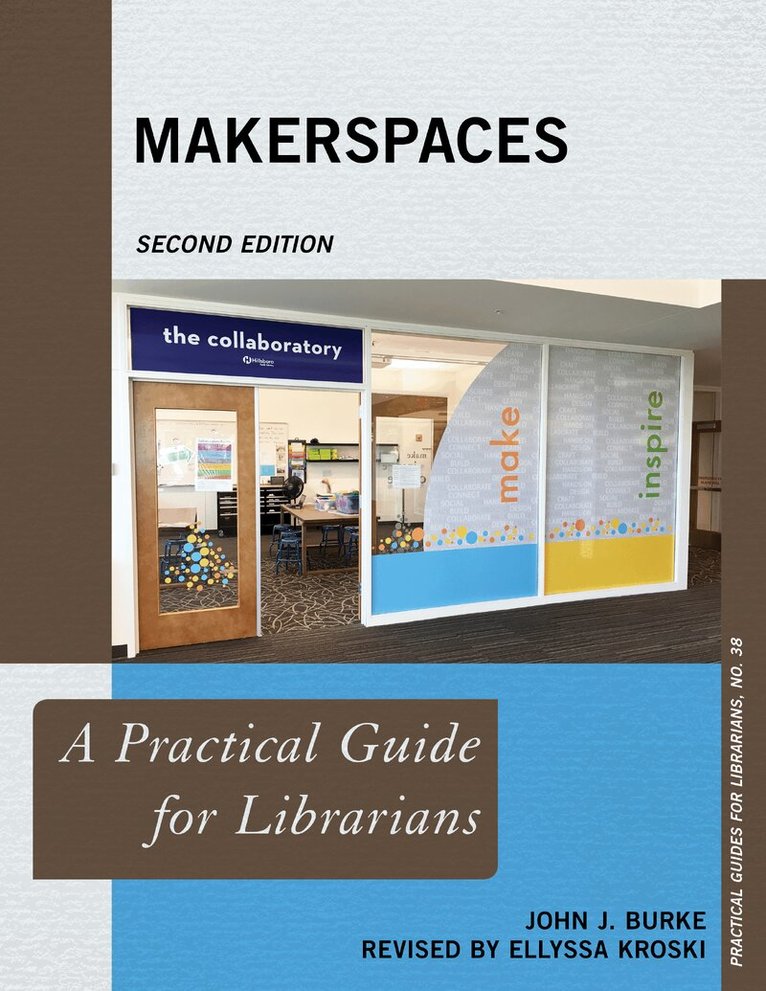
Makerspaces
A Practical Guide for Librarians
899 kr
Beställningsvara. Skickas inom 10-15 vardagar. Fri frakt över 249 kr.
Du är på sajten för privatpersoner.
899 kr
Beställningsvara. Skickas inom 10-15 vardagar. Fri frakt över 249 kr.
John J. Burke is principal librarian and director of the Gardner-Harvey Library on the Middletown regional campus of Miami University of Ohio. He is former president of the Academic Library Association of Ohio and former chair of the Southwest Ohio Council on Higher Education Library Council.Ellyssa Kroski is director of information technology at the New York Law Institute as well as an award-winning editor and author of thirty-six books. She is a librarian, an adjunct faculty member at Drexel and San Jose State universities, and an international conference speaker. She was just named the winner of the 2017 Library Hi Tech Award from the American Library Association and the Library Information Technology Association for her long-term contributions in the area of library and information science technology and its application.
The modern maker movement has gained momentum over the last two decades by infusing the creative spirit and shared infrastructure/resources of artisan cooperatives with the discovery/educational nature of libraries. As did the first edition (2014), this updated version of Burke’s guide introduces librarians to the maker concept and to helps them determine whether such spaces are a good fit for their organizations. After a brief review of maker history and how libraries became involved in the movement, readers are introduced to the practical assessment and planning steps to take before implementation. Everything from space, resources, and talent needs to the types of programs, services, and equipment to offer is addressed without being prescriptive because a makerspace should align with the interests of a library’s constituents. Makers work in all socioeconomic sectors and in a variety of environments, so the steps outlined apply to all library types, as illustrated through profiles of 18 different makerspaces throughout the country. Though the presentation and language are readily accessible to all readers, the text is clearly oriented toward professional librarians responsible for designing programs and services for their institutions.Summing Up: Recommended. Researchers, faculty, and professionals.
Julia K. Nims, Paula Storm, Robert Stevens
Häftad, 2013
1 011 kr
Eva H. Dodsworth, L. W. Laliberté
Häftad, 2014
1 011 kr
Volker Weiss, John J. Burke
1 427 kr
Du är på sajten för privatpersoner.
899 kr
Beställningsvara. Skickas inom 10-15 vardagar. Fri frakt över 249 kr.
John J. Burke is principal librarian and director of the Gardner-Harvey Library on the Middletown regional campus of Miami University of Ohio. He is former president of the Academic Library Association of Ohio and former chair of the Southwest Ohio Council on Higher Education Library Council.Ellyssa Kroski is director of information technology at the New York Law Institute as well as an award-winning editor and author of thirty-six books. She is a librarian, an adjunct faculty member at Drexel and San Jose State universities, and an international conference speaker. She was just named the winner of the 2017 Library Hi Tech Award from the American Library Association and the Library Information Technology Association for her long-term contributions in the area of library and information science technology and its application.
The modern maker movement has gained momentum over the last two decades by infusing the creative spirit and shared infrastructure/resources of artisan cooperatives with the discovery/educational nature of libraries. As did the first edition (2014), this updated version of Burke’s guide introduces librarians to the maker concept and to helps them determine whether such spaces are a good fit for their organizations. After a brief review of maker history and how libraries became involved in the movement, readers are introduced to the practical assessment and planning steps to take before implementation. Everything from space, resources, and talent needs to the types of programs, services, and equipment to offer is addressed without being prescriptive because a makerspace should align with the interests of a library’s constituents. Makers work in all socioeconomic sectors and in a variety of environments, so the steps outlined apply to all library types, as illustrated through profiles of 18 different makerspaces throughout the country. Though the presentation and language are readily accessible to all readers, the text is clearly oriented toward professional librarians responsible for designing programs and services for their institutions.Summing Up: Recommended. Researchers, faculty, and professionals.
Julia K. Nims, Paula Storm, Robert Stevens
Häftad, 2013
1 011 kr
Eva H. Dodsworth, L. W. Laliberté
Häftad, 2014
1 011 kr
Volker Weiss, John J. Burke
1 427 kr