• Fri frakt över 249 kr
  • •
  • Snabba leveranser
  • •
  • Billiga böcker
Kundservice

Du är på sajten för privatpersoner.

Företag, bibliotek eller offentlig verksamhet?

Du handlar på classic.bokus.com, där alla dina funktioner finns intakta.
Till classic.bokus.com
Bokus logotyp. Gå till startsidan.
  • Erbjudanden
  • Nyheter
  • Student
  • Topplistor
  • Barn & ungdom
  • Bokus Play
  • E-böcker
  • Pocketböcker
  • Spel & pussel

10% rabatt på allt med kod: NYSTART10 →

Sidfot

Mina sidor

    Hjälp

    • Kundservice
    • Vanliga frågor och svar
    • Frakt och leverans
    • Retur vid ångerrätt
    • Reklamera vara
    • Betalning
    • Köpvillkor
    • Allmänna villkor
    • Information om webbplatsens tillgänglighet

    Om Bokus

    • Om oss
    • Pressrum
    • För studenter
    • För företag
    • För bibliotek och offentlig verksamhet
    • För leverantörer
    • Hållbarhet

    Populärt

    • Aktuella erbjudanden
    • Presentkort
    • Studentlitteratur
    • Nya böcker
    • Topplistor
    • Signerade böcker
    • Engelska böcker

    Inspiration

    • Boktips
    • BookTok
    • Populära bokserier
    • Barnbokskaraktärer
    • Populära författare
    Logotyp för Bokus
    Följ oss på Facebook (extern länk)Följ oss på Instagram (extern länk)Följ oss på YouTube (extern länk)Följ oss på TikTok (extern länk)
    bokus @ CookiesAnpassa cookiesIntegritetspolicyKöpvillkor
    Till Citymail hemsida (extern länk)Till Budbee hemsida (extern länk)Till Postnord hemsida (extern länk)Till Schenker hemsida (extern länk)Till Early Bird hemsida (extern länk)Till Walleys hemsida (extern länk)
    1. Historia och arkeologi
    2. Historia
    3. Amerikas historia

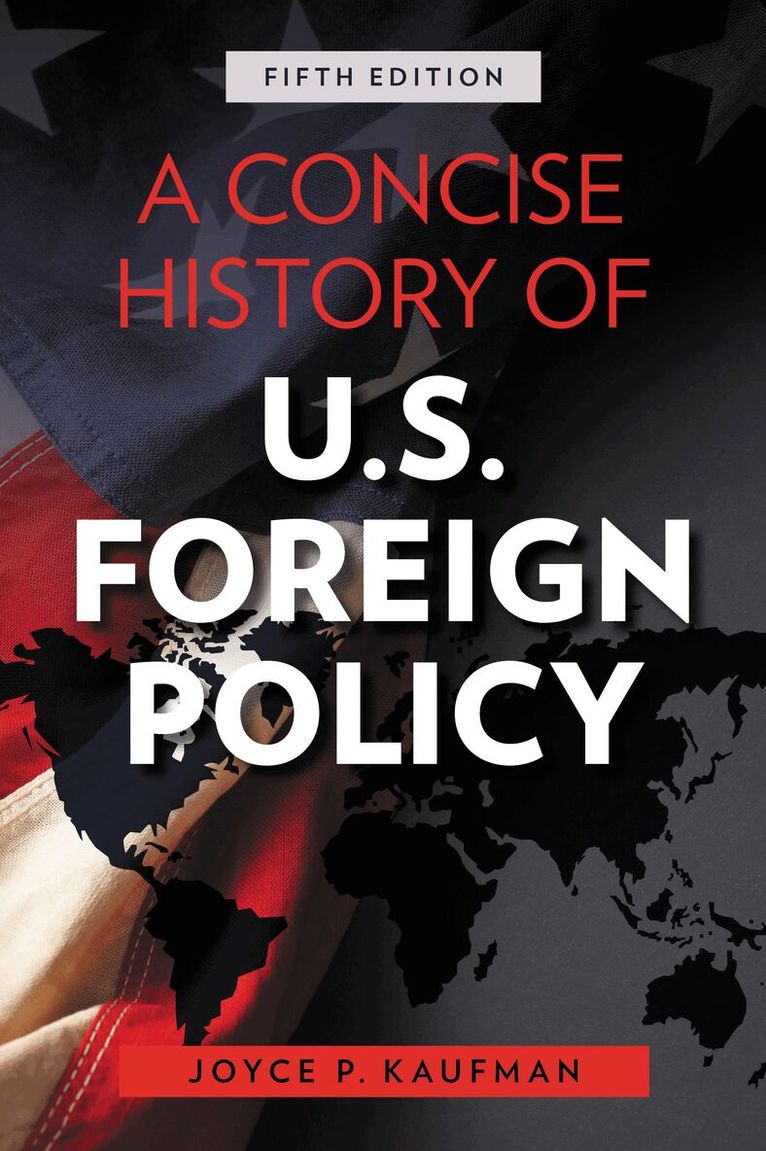
    Concise History of U.S. Foreign Policy

    AvJoyce P. Kaufman

    Häftad, Engelska, 2021

    522 kr

    Beställningsvara. Skickas inom 10-15 vardagar. Fri frakt över 249 kr.

    Fler format och utgåvor

    Inbunden

    1 222 kr

    Inbunden

    1 003 kr

    Häftad

    416 kr

    Beskrivning

    Now in a fully updated edition that goes through the Trump administration and the election and formative period of the Biden administration, this compact and accessible introduction offers a historical perspective on the evolution of U.S. foreign policy from the founding of the country to the present. Joyce P. Kaufman provides students and general readers with a clear and concise understanding of key foreign-policy decisions and why they were made. She identifies the major themes that have guided foreign policy and the reasons that the United States pursued certain policies in the context of specific periods in the nation’s history. Kaufman focuses on the major actors involved in the making of foreign policy and the changing relationships among them. She also explains the major theoretical perspectives within international relations and contextualizes key foreign policy decisions as they fit these frameworks. This edition puts a particular focus on the creation of Cold War foreign policy, and why the end of the Cold War has continued to be such a challenge to the United States. Kaufman concludes with a look at the challenges the United States will continue to face, including existential threats such as climate change and disease, and how Americans can be prepared to address them.

    Produktinformation

    • Utgivningsdatum:2021-07-06
    • Mått:153 x 231 x 20 mm
    • Vikt:499 g
    • Format:Häftad
    • Språk:Engelska
    • Antal sidor:368
    • Upplaga:5
    • Förlag:Bloomsbury Publishing Plc
    • ISBN:9781538151365

    Utforska kategorier

    • Amerikas historia inom Historia och arkeologi
    • Internationella relationer inom Samhälle och politik

    Mer om författaren

    Joyce P. Kaufman is professor emerita of political science at Whittier College. Her books include Introduction to International Relations: Theory and Practice.

    Recensioner i media

    More than simply a summary of key events, Kaufman’s book offers a readable, comprehensive, and analytically sound interpretation of the events and themes that have characterized the history and politics of American foreign policy since this country’s founding. Among other revisions, the new edition provides a sobering description of the human costs of continental expansion by adding a section on the government’s forced relocation of Native Americans in the Southeast to territories west of the Mississippi River. Updated to include Biden’s first one hundred days in office, the book includes an unsparing account of the Trump presidency—from Russian involvement in the 2016 election to Trump’s upending of policies and policy-making processes that had governed American foreign policy since the end of World War II. The new edition includes chronologies of key events and links to important primary documents, both of which will prove useful to undergraduates—as will the rest of this excellent volume.

    Innehållsförteckning

    • Preface to the Fifth Edition Part I: The Framework1 Setting the Stage for Understanding U.S. Foreign Policy Introduction to U.S. Foreign Policy What Is Foreign Policy? National Interest Foreign Policy Orientations Unilateralism and Isolationism Engagement/Internationalism Theory and Context Identifying Themes Who Makes Foreign Policy, and Why Are Particular Decisions Made? The Actors Role of Economics Role of Domestic Politics and Factors Who Is Affected by U.S. Foreign Policy Decisions? Impact of U.S. Foreign Policy Decisions on Other Countries Domestic Constituencies The “Powerless”: The Feminist Perspective Setting the Stage Primary Sources Part II: The Formative Years2 Unilateralism to Engagement: The Founding to the End of World War I, 1777–1920 The Beginning Creating a Foreign Policy Framework Beware of Entangling Alliances Manifest Destiny, the Monroe Doctrine, and Westward Expansion The War of 1812 The Monroe Doctrine Continued Expansion Mexican-American War The American Genocide Expansion into the Pacific The Civil War The Spanish-American War Implications of the Spanish-American War The Scramble for Concessions The Roosevelt Corollary to the Monroe Doctrine March to World War I Wilsonian Idealism and U.S. Foreign Policy Wilson’s Fourteen Points U.S. Involvement in Russia Domestic Issues: The Executive and Legislative Branches The Shifting National Interest Chronology from the Founding to the End of World War I Selected Primary Sources 3 From Isolationism to Superpower: The Interwar Years through World War II, 1920–1945 Interwar America U.S. Foreign Policy, 1920–1930 Escalation to World War II: 1930–1941 Neutrality Acts From Neutrality to Nonbelligerency War Executive Order 9066 Preparing for Peace The Impact of World War II Technology and World War II The Decision to Bomb Hiroshima and Nagasaki The United Nations: Defining the Postwar World Creation of the United Nations From Isolationism to Engagement The Domestic Context for the Postwar Period Chronology, 1920–1945 Selected Primary Sources Part III: The Cold War4 The Making of a Superpower: The Evolution of U.S. Cold War Policy, 1945–1968 Background of the Cold War The Early Years of the Cold War George Kennan and Early Cold War Policy 1947: Outlining U.S. Cold War Policy The Truman Doctrine The National Security Act of 1947 The Marshall Plan The Escalation of the Cold War: Berlin to Korea The Creation of NATO The End of the Decade NSC 68 War in Korea The Cold War at Home The Domino Theory Eisenhower Doctrine of Massive Retaliation The U-2 Incident The Kennedy Years Berlin Cuba Vietnam Johnson: Vietnam, and the Great Society The Tonkin Gulf Resolution The Great Society The End of the Decade: Changes in U.S. Policy The 1960s into the 1970s Chronology, 1946–1968 Selected Primary Sources 5 The Cold War Continued: Nixon through Reagan, 1969–1989 Nixon Nixon and Vietnam War Powers The Soviet Union, Détente, and Arms Control Nixon and Europe China and Normalization Gerald Ford Carter The Carter Administration: Successes and Failures Reagan From Cold War to Democratic Revolutions Continuing the Arms Control Process Iran-Contra The Cold War and Beyond Chronology, 1969–1988 Selected Primary Sources Part IV: The Post–Cold War Period6 The Period of American Hegemony: Bush-Clinton-Bush (1989–2009) George H. W. Bush and the “New World Order” The Persian Gulf War The End of the Soviet Union The Balkans and Ethnic Conflict The Clinton Years SomaliaHaiti The Balkans NATO Enlargement Economics: Trade and Globalization The Environment: The Kyoto Protocol Terrorism Rethinking U.S. Foreign Policy under Clinton George W. Bush: From Election to 9/11 Contested Election and Implications for U.S. Foreign Policy September 11 and the Responses War with Afghanistan The Bush Doctrine and the War with Iraq The War with Iraq and Its Aftermath Freedom and Democracy for All President Bush and Wilsonian Idealism The Iraq War: A Postscript Chronology 1989–2009 Selected Primary Sources 7 Obama and Trump: 2009 to 2021 President Obama and his Foreign Policy Direction The Obama Administration in Retrospect Challenges Facing the Obama AdministrationObama and Iraq and Afghanistan Relations with the Middle East Ties to the Islamic World Iran and the Nuclear Arms Deal The United States and Israel The “Arab Spring” and Civil War in Syria U.S. Relations with Other Parts of the World under Obama Relations with Russia U.S. Relations with Europe “Pivot to the Pacific” U.S. Relations with Africa Other Challenges to the United States under Obama Obama’s Legacy The Election of Donald Trump An “America First” Foreign Policy The Early Outlines for a Trump Foreign Policy The Political Emergence of Donald J. Trump Coronavirus Pandemic U.S. Relations with Russia U.S. Relations with the Western Allies U.S. Relations with China under Trump North Korea The Middle East Other Noteworthy Foreign Policy Issues U.S. Foreign Policy Post-Trump Chronology 2009–present Selected Primary Sources 8 Biden and Beyond: The Future of U.S. Foreign Policy The Election of 2020 and the Transition The Challenges and Threats U.S. Relations with other Nations Relations with ChinaThe United States and the Iran Nuclear Agreement The United States, Russia, and Arms Control Relations with Europe Other Threats Threats from Disease: PandemicsClimate Change The Future of U.S. Foreign Policy: Returning to First Principles The Cold War as a Framework for U.S. Foreign PolicyThe Changing Notion of PowerU.S. Power and National Interest The Changing Notion of Threat The Actors and the Domestic Balance of Power Challenges to U.S. Foreign Policy in the Future Selected Primary Sources Notes Index About the Author