• Fri frakt över 249 kr
  • •
  • Snabba leveranser
  • •
  • Billiga böcker
Kundservice

Du är på sajten för privatpersoner.

Företag, bibliotek eller offentlig verksamhet?

Du handlar på classic.bokus.com, där alla dina funktioner finns intakta.
Till classic.bokus.com
Bokus logotyp. Gå till startsidan.
  • Erbjudanden
  • Nyheter
  • Student
  • Topplistor
  • Barn & ungdom
  • Bokus Play
  • E-böcker
  • Pocketböcker
  • Spel & pussel

10% rabatt på allt med kod: NYSTART10 →

Sidfot

Mina sidor

    Hjälp

    • Kundservice
    • Vanliga frågor och svar
    • Frakt och leverans
    • Retur vid ångerrätt
    • Reklamera vara
    • Betalning
    • Köpvillkor
    • Allmänna villkor
    • Information om webbplatsens tillgänglighet

    Om Bokus

    • Om oss
    • Pressrum
    • För studenter
    • För företag
    • För bibliotek och offentlig verksamhet
    • För leverantörer
    • Hållbarhet

    Populärt

    • Aktuella erbjudanden
    • Presentkort
    • Studentlitteratur
    • Nya böcker
    • Topplistor
    • Signerade böcker
    • Engelska böcker

    Inspiration

    • Boktips
    • BookTok
    • Populära bokserier
    • Barnbokskaraktärer
    • Populära författare
    Logotyp för Bokus
    Följ oss på Facebook (extern länk)Följ oss på Instagram (extern länk)Följ oss på YouTube (extern länk)Följ oss på TikTok (extern länk)
    bokus @ CookiesAnpassa cookiesIntegritetspolicyKöpvillkor
    Till Citymail hemsida (extern länk)Till Budbee hemsida (extern länk)Till Postnord hemsida (extern länk)Till Schenker hemsida (extern länk)Till Early Bird hemsida (extern länk)Till Walleys hemsida (extern länk)
    1. Samhälle och politik
    2. Samhälle och kultur
    3. Kultur och medier
    4. Referensverk och tvärvetenskap

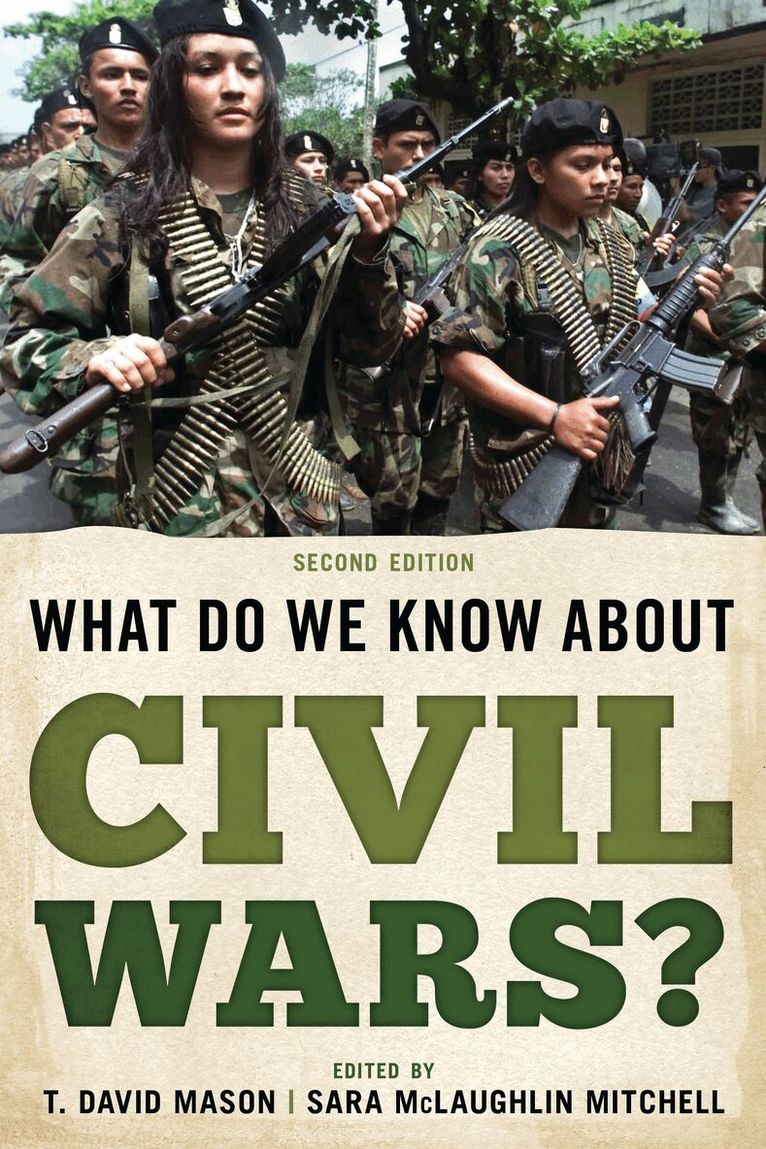
    What Do We Know about Civil Wars?

    AvT. David Mason,Sara McLaughlin Mitchell

    Inbunden, Engelska, 2023

    1 366 kr

    Beställningsvara. Skickas inom 10-15 vardagar. Fri frakt över 249 kr.

    Beskrivning

    Since World War II, civil wars have replaced interstate wars as the most frequent and deadly form of armed conflict globally. How do we account for when and where civil wars are likely to occur, when and how they are likely to end, and whether or not they will recur? In this timely book, leading scholars accessibly guide students through cutting-edge research on the onset, duration, outcomes, and recurrence of civil wars, as well as the ongoing consequences of conflicts in war-torn countries such as Syria, Sudan, and Rwanda. In mapping out the current state of our knowledge about civil conflicts, the authors also identify what we do not know about civil wars. With a consistent approach across chapters and through a wide variety of cases, the contributors collectively help readers understand some of the most pressing questions in conflict and security studies and illustrates how scholars answer them. This authoritative text offers both an accessible and current overview of the state of the field and an agenda for future research.The second features: An entirely new chapter on pro-government militias and rebels as criminal groups (Chapter 16)Analysis of new trends in civil war data collection that have enabled us to understand geographic and temporal patterns of armed conflictNew directions in transitional justice institutions in post-conflict environments, the “resource curse,” the role of women, and the relationship between the environment and civil conflictNew material on mediation of conflict and peace agreement implementation, and peacekeeping Examples drawn from the Russia-Ukraine conflict.

    Produktinformation

    • Utgivningsdatum:2023-02-22
    • Mått:152 x 229 x 31 mm
    • Vikt:764 g
    • Format:Inbunden
    • Språk:Engelska
    • Antal sidor:422
    • Upplaga:2
    • Förlag:Bloomsbury Publishing Plc
    • ISBN:9781538169155

    Utforska kategorier

    • Referensverk och tvärvetenskap inom Samhälle och politik
    • Krig och försvar inom Samhälle och politik
    • Inbördeskrig inom Historia och arkeologi

    Mer om författaren

    T. David Mason is the Johnie Christian Family Professor of Peace Studies Emeritus and Regents Professor of Political Science Emeritus at the University of North Texas. He co-founded UNT's Castleberry Peace Institute, which he directed from its inception in 2009 until 2014. He earned his Ph.D. degree from the University of Georgia in 1982. Mason served on the faculty of Mississippi State University from 1981 to 1992 and University of Memphis from 1992 to 2002, where he was a co-founder of that university's Benjamin Hooks Institute for Social Change. He served as Associate Editor of International Studies Quarterly (2004-2007) and then Editor-in-Chief (2007-2008) of that journal. Mason served on the American Political Science Association's Task Force on Political Violence and was primary author of that group's final report chapter on how civil wars end. He is the author of Caught in the Crossfire: Revolution, Repression and the Rational Peasant (2004), Sustaining the Peace After Civil War (2007) and co-editor of Conflict Prevention and Peace-building in Post-War Societies: Sustaining the Peace (with James Meernik, 2006). His research on the politics of reform, repression, and civil conflict has appeared American Political Science Review, Journal of Politics, Social Science Quarterly, International Studies Quarterly, Journal of Conflict Resolution, Journal of Peace Research and other journals.Sara McLaughlin Mitchell is the F. Wendell Miller Professor of Political Science and the College of Law (courtesy appointment) at the University of Iowa. She received her Ph.D. in Political Science at Michigan State University in 1997. She is author of six books including Domestic Law Goes Global: Legal Traditions and International Courts (2011) and What Do We Know About War? (2021) and she has published more than sixty journal articles and book chapters. She is the recipient of several major research awards from the Department of Defense, National Science Foundation, and USAID. Her areas of expertise include international conflict, political methodology, and gender issues in academia. Professor Mitchell is co-founder of the Journeys in World Politics workshop, a mentoring workshop for junior women studying international relations. She is the recipient of several research, teaching, and graduate mentoring awards from the University of Iowa, the Regents Award for Faculty Excellence (2022), the Quincy Wright Distinguished Scholar Award (2015) from the International Studies Association, a distinguished alumni award from Iowa State University, and she served as President of the Peace Science Society.

    Recensioner i media

    Students always ask me, ‘What should I read to understand civil wars?’ Mitchell and Mason's updated book is the best one-stop primer on the subject. In it, top civil war scholars summarize the state of our knowledge on why civil wars start, last as long as they do, and are so difficult to end, highlighting the emerging trends we are beginning to see in the 21st century. This is a tremendously valuable book for students and scholars alike.

    Innehållsförteckning

    • List of FiguresList of TablesPrefaceAcknowledgmentsIntroduction: What Do We Know About Civil Wars?Part I. Factors That Bring About Civil WarChapter 1. Introduction: Patterns of Armed Conflict since 1945Chapter 2. Antecedents of Civil War Onset: Greed, Grievance, and State RepressionChapter 3. Identity and Civil War: Ethnic and Religious DivisionsChapter 4. State Capacity, Regime Type, and Civil WarChapter 5. Transnational Dimensions of Civil Wars: Clustering, Contagion, and ConnectednessPart II. Factors That End Civil Wars and Promote PeaceChapter 6. Third Party Intervention, Duration, and Outcome of Civil WarsChapter 7. Ripe for Resolution: Third Party Mediation and Negotiating Peace AgreementsChapter 8. Negotiated Peace: Power Sharing in Peace AgreementsChapter 9. Breaking the Conflict Trap: The Impact of Peacekeeping on Violence and Democratization in the Post-Conflict ContextChapter 10. The Legacies of Civil War: Health, Education, and Economic DevelopmentPart III. Emerging Trends in Civil War ResearchChapter 11. Transitional Justice: Prospects for Post-War Peace and Human RightsChapter 12. Gender and Civil WarsChapter 13. Resource Wealth and Civil ConflictChapter 14. Environment and ConflictChapter 15. Trends in Civil War Data: Geography, Organizations, and EventsChapter 16. Militias, Criminality, and ConflictBibliographyAbout the EditorsIndex