• Fri frakt över 249 kr
  • •
  • Snabba leveranser
  • •
  • Billiga böcker
Kundservice

Du är på sajten för privatpersoner.

Företag, bibliotek eller offentlig verksamhet?

Du handlar på classic.bokus.com, där alla dina funktioner finns intakta.
Till classic.bokus.com
Bokus logotyp. Gå till startsidan.
  • Erbjudanden
  • Nyheter
  • Student
  • Topplistor
  • Barn & ungdom
  • Bokus Play
  • E-böcker
  • Pocketböcker
  • Spel & pussel

10% rabatt på allt med kod: NYSTART10 →

Sidfot

Mina sidor

    Hjälp

    • Kundservice
    • Vanliga frågor och svar
    • Frakt och leverans
    • Retur vid ångerrätt
    • Reklamera vara
    • Betalning
    • Köpvillkor
    • Allmänna villkor
    • Information om webbplatsens tillgänglighet

    Om Bokus

    • Om oss
    • Pressrum
    • För studenter
    • För företag
    • För bibliotek och offentlig verksamhet
    • För leverantörer
    • Hållbarhet

    Populärt

    • Aktuella erbjudanden
    • Presentkort
    • Studentlitteratur
    • Nya böcker
    • Topplistor
    • Signerade böcker
    • Engelska böcker

    Inspiration

    • Boktips
    • BookTok
    • Populära bokserier
    • Barnbokskaraktärer
    • Populära författare
    Logotyp för Bokus
    Följ oss på Facebook (extern länk)Följ oss på Instagram (extern länk)Följ oss på YouTube (extern länk)Följ oss på TikTok (extern länk)
    bokus @ CookiesAnpassa cookiesIntegritetspolicyKöpvillkor
    Till Citymail hemsida (extern länk)Till Budbee hemsida (extern länk)Till Postnord hemsida (extern länk)Till Schenker hemsida (extern länk)Till Early Bird hemsida (extern länk)Till Walleys hemsida (extern länk)
    1. Kultur
    2. Scenkonst och film
    3. Film

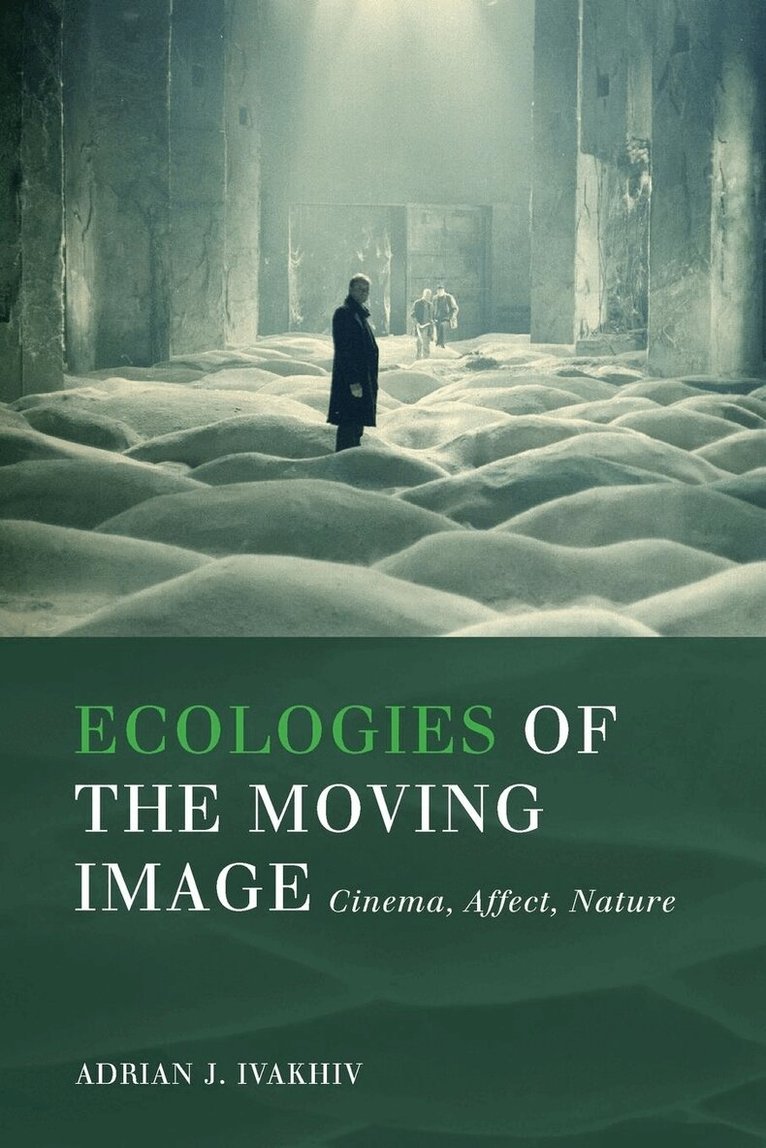
    Ecologies of the Moving Image

    Cinema, Affect, Nature

    AvAdrian J. Ivakhiv

    Häftad, Engelska, 2013

    Del i serien Environmental Humanities

    633 kr

    Beställningsvara. Skickas inom 5-8 vardagar. Fri frakt över 249 kr.

    Beskrivning

    This book presents an ecophilosophy of cinema: an account of the moving image in relation to the lived ecologies - material, social, and perceptual relations - within which movies are produced, consumed, and incorporated into cultural life. If cinema takes us on mental and emotional journeys, the author argues that those journeys that have reshaped our understanding of ourselves, life, and the Earth and universe. A range of styles are examined, from ethnographic and wildlife documentaries, westerns and road movies, sci-fi blockbusters and eco-disaster films to the experimental and art films of Tarkovsky, Herzog, Malick, and Brakhage, to YouTube's expanding audio-visual universe.

    Produktinformation

    • Utgivningsdatum:2013-07-25
    • Mått:152 x 229 x 25 mm
    • Vikt:650 g
    • Format:Häftad
    • Språk:Engelska
    • Serie:Environmental Humanities
    • Antal sidor:435
    • Förlag:Wilfrid Laurier University Press
    • ISBN:9781554589050

    Utforska kategorier

    • Film inom Kultur

    Mer om författaren

    Adrian Ivakhiv is a professor of environmental studies at the Rubenstein School of Environment and Natural Resources, University of Vermont, where he coordinates the graduate concentration in Environmental Thought and Culture. He is the author of Claiming Sacred Ground: Pilgrims and Politics at Glastonbury and Sedona (2001), and of numerous articles in geography, environmental studies, film and cultural studies, and religious studies. His blog, Immanence, can be found at http://blog.uvm.edu/aivakhiv/.

    Recensioner i media

    "'Ecologies of the Moving Image' is an ambitious book, and a capacious and satisfying one. In addressing 'the wild phantasmagoria of images' among which we live today, Ivakhiv gives us an account that is at once systematic and brimming with rich detail. Moving-image forms both render imaginative worlds to us and help to constitute the world we live in; this book gives us a brilliant process-relational account of both of these dimensions of media experiences." -- Steven Shaviro, -- DeRoy Professor of English, Wayne State University

    Innehållsförteckning

    • Table of Contents for Ecologies of the Moving Image: Cinema, Affect, Nature, by Adrian J. IvakhivPrefaceAcknowledgements1. Introduction: Journeys into the Zone of CinemaTwo perspectives on the visual The cinema as cosmomorphic, or world making: geomorphic, biomorphic, and anthropomorphic Stalker as paradigm: Tracking the cinema, stalking the psyche The argument Overview of the chapters 2. Ecology, Morphology, Semiosis: A Process-Relational Account of CinemaThe three ecologies of images: material, social, perceptual Process-relational ontology Perceptual ecologies: How we get drawn into the cinematic world Peircean semiosis: firstness, secondness, and thirdness Spectacle, narrativity, and signness Scenes, episodes, and cinematic impact 3. Territory: The Geomorphology of the VisibleGeomorphism in life and in image An initial typology Picturing ""nature"": Landscape aesthetics as socio-natural production Anchoring the filmic world Staking claims and territorializing identities: Making the West Dovzhenko's cinematic pantheism Nature, holism, and the eco-administrative state Industry, existential landscapes, and the firstness of things Post-westerns, pantheism, and the ecological sublime Kinetic landscapes, the exhilaration of movement, and the differentiation of space Cinematic tourism, object fetishism, and the global landscape Enframing the world, or expanding perception? ""Burn but his books"": Deconstructing the gaze from both ends 4. Encounter: First Contact, Utopia, and the Becoming of AnotherThe ethnographic paradigm Nanook/Allakariallak and the two-way gaze King Kong's imperial gaze: From ethnographic to cinematic spectacle Upriver journeys, hearts of darkness, and contact zones Beyond first contact Cinematic holism, auto-ethnography, and visual sovereignty From the deconstruction of reality to its reflexive reconstruction Green identities: images of choice, hope, struggle, and community 5. Anima Moralia: Journeys Across FrontiersPointing, seeing, gazing Animating the image, imaging the animate Writing, seeing, and faking nature Making nature: inter-natural coproductions Animation, plasmaticness, and Disney Boundary traffic: seeing, being seen, and the horror of crossing over Animal by analogy: penguins and family values Individual crossings: Bittner's birds, Treadwell's bears Sheer becomings: one or several types of packs Boundary strategies: ethics of the contact zone 6. Terra and Trauma: The Geopolitics of the RealRecapitulation of the argument Trauma and the imagination of disaster Strange weather, network narratives, and the traumatic event The sublime and the Real The eco-imaginary in post-9/11 culture Political ecologies in three dimensions and more Avatar's eco-apocalyptic Zone Toward a Peircian synthesis: aesthetics, ethics, and ecologics of the image-event Ecology, time, and the image Ecophilosophical cinema: moving images on a moving planet Afterword: Digital Futures in a Biosemiotic WorldAppendix: Doing Process-Relational Media AnalysisNotesIndex