• Fri frakt över 249 kr
  • •
  • Snabba leveranser
  • •
  • Billiga böcker
Kundservice

Du är på sajten för privatpersoner.

Företag, bibliotek eller offentlig verksamhet?

Du handlar på classic.bokus.com, där alla dina funktioner finns intakta.
Till classic.bokus.com
Bokus logotyp. Gå till startsidan.
  • Erbjudanden
  • Nyheter
  • Student
  • Topplistor
  • Barn & ungdom
  • Bokus Play
  • E-böcker
  • Pocketböcker
  • Spel & pussel

10% rabatt på allt med kod: NYSTART10 →

Sidfot

Mina sidor

    Hjälp

    • Kundservice
    • Vanliga frågor och svar
    • Frakt och leverans
    • Retur vid ångerrätt
    • Reklamera vara
    • Betalning
    • Köpvillkor
    • Allmänna villkor
    • Information om webbplatsens tillgänglighet

    Om Bokus

    • Om oss
    • Pressrum
    • För studenter
    • För företag
    • För bibliotek och offentlig verksamhet
    • För leverantörer
    • Hållbarhet

    Populärt

    • Aktuella erbjudanden
    • Presentkort
    • Studentlitteratur
    • Nya böcker
    • Topplistor
    • Signerade böcker
    • Engelska böcker

    Inspiration

    • Boktips
    • BookTok
    • Populära bokserier
    • Barnbokskaraktärer
    • Populära författare
    Logotyp för Bokus
    Följ oss på Facebook (extern länk)Följ oss på Instagram (extern länk)Följ oss på YouTube (extern länk)Följ oss på TikTok (extern länk)
    bokus @ CookiesAnpassa cookiesIntegritetspolicyKöpvillkor
    Till Citymail hemsida (extern länk)Till Budbee hemsida (extern länk)Till Postnord hemsida (extern länk)Till Schenker hemsida (extern länk)Till Early Bird hemsida (extern länk)Till Walleys hemsida (extern länk)
    1. Medicin
    2. Andra medicinska specialiteter
    3. Klinisk psykologi

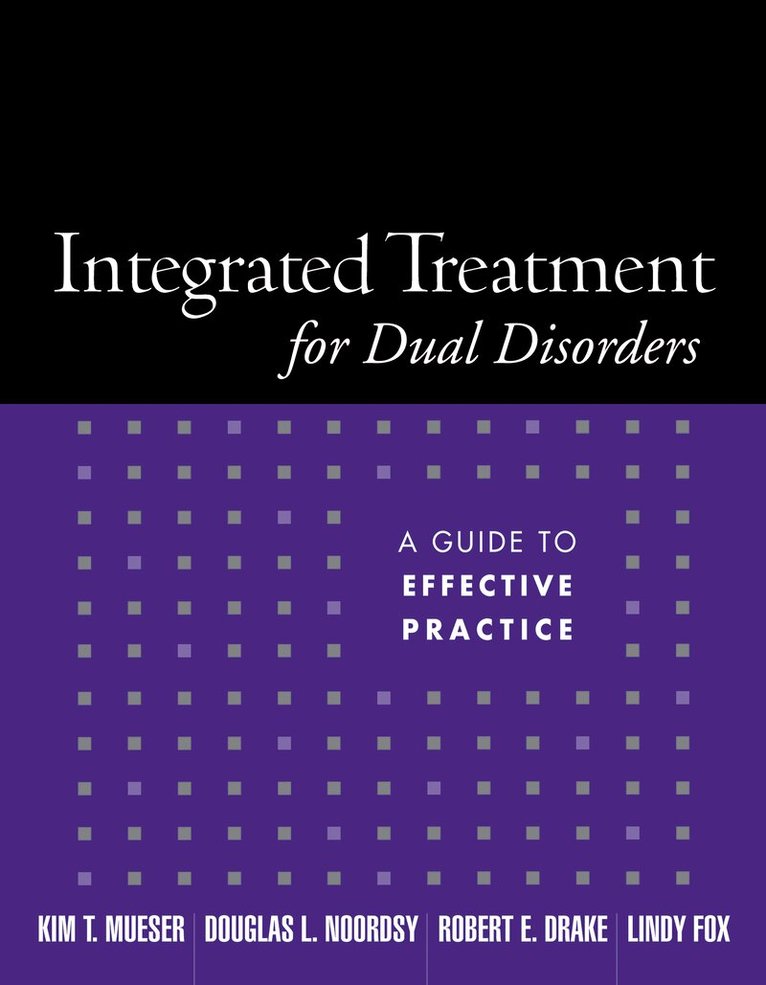
    Integrated Treatment for Dual Disorders

    A Guide to Effective Practice

    AvKim T. Mueser,Douglas L. Noordsy

    Häftad, Engelska, 2003

    Del i serien Treatment Manuals for Practitioners

    919 kr

    Beställningsvara. Skickas inom 5-8 vardagar. Fri frakt över 249 kr.

    Beskrivning

    This comprehensive clinical handbook provides virtually everything needed to plan, deliver, and evaluate effective treatment for persons with substance abuse problems and persistent mental illness. From authors at the forefront of the dual disorders field, the book is grounded in decades of influential research. Presented are clear guidelines for developing integrated treatment programs, performing state-of-the-art assessments, and implementing a wide range of individual, group, and family interventions. Also addressed are residential and other housing services, involuntary interventions, vocational rehabilitation, and psychopharmacology for dual disorders. Throughout, the emphasis is on workable ways to combine psychiatric and substance abuse services into a cohesive, unitary system of care. In a convenient large-size format, the volume includes reproducible assessment forms, treatment planning materials, and client handouts.

    Produktinformation

    • Utgivningsdatum:2003-07-17
    • Mått:219 x 276 x 25 mm
    • Vikt:1 120 g
    • Format:Häftad
    • Språk:Engelska
    • Serie:Treatment Manuals for Practitioners
    • Antal sidor:470
    • Förlag:Guilford Publications
    • ISBN:9781572308503

    Utforska kategorier

    • Klinisk psykologi inom Medicin
    • Psykiatri inom Medicin
    • Missbruk inom Medicin

    Mer om författaren

    Kim T. Mueser, PhD, is Executive Director of the Center for Psychiatric Rehabilitation and Professor in the Department of Occupational Therapy at Boston University. Dr. Mueser's clinical and research interests include psychiatric rehabilitation for persons with severe mental illnesses, intervention for co-occurring psychiatric and substance use disorders, and the treatment of posttraumatic stress disorder. He has served on numerous editorial boards, has published many journal articles and book chapters, and has coauthored over 10 books. His book The Complete Family Guide to Schizophrenia (with Susan Gingerich) received the National Alliance on Mental Illness NYC Metro Ken Book Award.Douglas L. Noordsy, MD, is Associate Professor of Psychiatry and Associate Director of Education and Training in the Department of Psychiatry, Dartmouth Medical School. He is also Chief of Clinical Research at the Mental Health Center of Greater Manchester and Medical Director of Westbridge, Inc., a private nonprofit organization providing services to individuals with dual disorders and their families. Dr. Noordsy has provided clinical care and leadership across the New Hampshire community mental health system, including active work with dual-diagnosis treatment teams, since 1990. He has lectured and published extensively, especially in the areas of comorbid substance abuse and mental illness and recovery-oriented treatment for people with severe mental illness.Robert E. Drake, MD, PhD, is a community psychiatrist, Professor of Psychiatry at Dartmouth Medical School, and Director of the New Hampshire-Dartmouth Psychiatric Research Center. He has worked with community mental health teams developing and refining approaches to integrated dual-disorder treatments for over 20 years.Lindy Fox Smith, MA, MAC, MCAP, operates her own consulting firm, L. B. Fox and Associates, since retiring as a Research Associate at the New Hampshire-Dartmouth Psychiatric Research Center. She has worked extensively on research projects examining the effectiveness of integrated treatment for people with serious mental illnesses and substance use disorders, including involvement in assessments, treatment, and clinical teaching. Ms. Fox’s expertise has been gained through a combination of formal education, personal experience, and professional focus. She has been a recipient of the services she now participates in designing and evaluating. Ms. Fox has consulted throughout the United States and in other countries including Australia, Canada, England, and Sweden. She has also coauthored several articles, and served on the faculty at Dartmouth College in the Department of Family and Community Medicine.

    Recensioner i media

    An outstanding resource for clinicians. The text is remarkable for its comprehensiveness, clarity, practical suggestions, and wealth of reproducible forms and handouts. Social workers will find the book especially useful, as it covers many aspects of treatment that are frequently overlooked, such as case management, family work, residential programs, and employment. This book will serve as a blueprint for providing integrated treatment for dual disorders.--Susan Gingerich, MSW, independent consultant and trainer, Narberth, PennsylvaniaMueser and his colleagues--all internationally recognized experts in their field--have given us a comprehensive, state-of-the-art volume to address empirically validated treatment for co-occurring disorders. With its treatment fidelity checklist and implementation guidelines, this book should be required reading for all program managers and mental health administrators who seek to design an effective, integrated system of care or improve existing service delivery. Grounded in practical clinical experience and well informed by first-rate scholarship, the text includes a variety of client handouts and detailed, step-by-step advice on adopting 'best practice' standards. This outstanding book is an invaluable resource for administrators, supervisors, clinicians, and trainers in social work and other mental health fields. I find it to be very valuable in training new staff. In addition, I highly recommend this book as a text for advanced practice courses in social work, psychology, psychosocial rehabilitation, and psychiatric nursing.--Margaret V. Sherrer, MSW, Project Director, Co-Occurring Addictive and Mental Disorders Program, South Shore Mental Health Center, Charlestown, Rhode Island; designated trainer, RI Council of Community Mental Health Centers, Inc.Providing meaningful help to the addicted client with major mental illness is the most difficult and challenging task that mental health clinicians face. Mueser and colleagues have provided us with a truly helpful and empowering guide. It is the best book in its field--George E. Vaillant, MD, Harvard Medical SchoolIndividuals with severe mental illness and substance abuse are the most neglected group of psychiatric patients. This comprehensive textbook fills a major void and will be infinitely useful to clinicians, administrators, and clinicians-in-training. The authors have a national reputation for pioneering efforts to develop treatment models, and they have laid out a detailed plan for the rest of us to follow. Finally, clinicians have a cure for their dual diagnosis despair!--E. Fuller Torrey, MD, The Stanley Medical Research Institute, Bethesda, MDHelping clients with dual disorders represents one of the most challenging tasks for mental health clinicians and administrators. While there is an extensive scientific literature on the topic, few programs offer integrated, evidence-based treatment. This book has the potential to change that. Written by the experts on the topic, it is a comprehensive, well-written, state-of-the-art manual that explains what needs to be done and then describes how it should be done. This book should find a home in every mental health program that works with dually diagnosed clients, and should be required reading for every new clinician and program administrator.--Alan S. Bellack, PhD, ABPP, Mental Illness Research Education Clinical Center (MIRECC), VA Capitol Health Care Network, Baltimore, MD; Department of Psychiatry, University of Maryland School of Medicine- This book is not written specifically for or by social workers; however, it provides clear, contemporary discussions of practice principles with great relevance and applicability to the social work profession....One of the great strengths of this book lies in its presentation of conceptual frameworks and models related to substance abuse and psychiatric illness....Overall, this book is interesting, well written, and well researched. It would be useful for social work educators seeking basic tools for MSW practice/field courses and for specialized doctoral-level social work education. It is also a good resource for social work students and social work practitioners who want up-to-date training about substance abuse, severe mental illness, and to know what happens when these are experienced together. --Journal of Social Work Practice in the Addictions, 4/27/2003ƒƒ A professor designing a graduate course to investigate how the criminal justice system deals with mentally ill people should certainly include [this book]....Provide[s] basic technical knowledge about service delivery in general, information on specific groups of people, and information about specific disorders and treatments. Correctional staff members who need information about service delivery are well advised to consult [this book]....Provide[s] a wealth of technical information and also provide[s] a good staring point by which to understand correctional health care....Provide[s] needed, valuable information about the mental health and criminal justice interface. --Criminal Justice Review, 4/27/2003ƒƒ Offers a comprehensive guide to the unified treatment of an often overlooked population. The information contained in this publication will enable mental health professionals and facilities to design and implement a treatment program tailored to the special needs of the dual-disordered individual. The authors provide uncommon insight into the challenges of comorbid psychiatric and substance use disorders front the differing perspectives of the client, the family, and the clinician. --Journal of Cognitive Psychotherapy, 4/27/2003

    Innehållsförteckning

    • I. Basics1. Substance Abuse and Severe Mental Illness2. Principles of Integrated Treatment3. Basic Organizational FactorsII. The Assessment Process4. Assessment I: Detection, Classification, and Functional Assessment5. Assessment II: Functional Analysis and Treatment PlanningIII. Individual Approaches6. Stage-Wise Case Management7. Motivational Interviewing8. Cognitive-Behavioral CounselingIV. Group Interventions9. Persuasion Groups10. Active Treatment Groups11. Social Skills Training Groups12. Self-Help GroupsV. Working with Families13. Family Collaboration14. Behavioral Family Therapy15. Multiple-Family GroupsVI. Other Treatment Approaches16. Residential Programs and Other Housing Options17. Involuntary and Coerced Interventions18. Vocational Rehabilitation19. PsychopharmacologyVII. Research20. Research on Dual-Disorder TreatmentEpilogue: Avoiding Burnout and DemoralizationAppendices:A. Dual-Disorder Treatment Fidelity ScaleB. Educational HandoutsC. Assessment Instruments and Other FormsÂ