• Fri frakt över 249 kr
  • •
  • Snabba leveranser
  • •
  • Billiga böcker
Kundservice

Du är på sajten för privatpersoner.

Företag, bibliotek eller offentlig verksamhet?

Du handlar på classic.bokus.com, där alla dina funktioner finns intakta.
Till classic.bokus.com
Bokus logotyp. Gå till startsidan.
  • Erbjudanden
  • Nyheter
  • Student
  • Topplistor
  • Barn & ungdom
  • Bokus Play
  • E-böcker
  • Pocketböcker
  • Spel & pussel

10% rabatt på allt med kod NYSTART10 →

Sidfot

Mina sidor

    Hjälp

    • Kundservice
    • Vanliga frågor och svar
    • Frakt och leverans
    • Retur vid ångerrätt
    • Reklamera vara
    • Betalning
    • Köpvillkor
    • Allmänna villkor
    • Information om webbplatsens tillgänglighet

    Om Bokus

    • Om oss
    • Pressrum
    • För studenter
    • För företag
    • För bibliotek och offentlig verksamhet
    • För leverantörer
    • Hållbarhet

    Populärt

    • Aktuella erbjudanden
    • Presentkort
    • Studentlitteratur
    • Nya böcker
    • Topplistor
    • Signerade böcker
    • Engelska böcker

    Inspiration

    • Boktips
    • BookTok
    • Populära bokserier
    • Barnbokskaraktärer
    • Populära författare
    Logotyp för Bokus
    Följ oss på Facebook (extern länk)Följ oss på Instagram (extern länk)Följ oss på YouTube (extern länk)Följ oss på TikTok (extern länk)
    bokus @ CookiesAnpassa cookiesIntegritetspolicyKöpvillkor
    Till Citymail hemsida (extern länk)Till Budbee hemsida (extern länk)Till Postnord hemsida (extern länk)Till Schenker hemsida (extern länk)Till Early Bird hemsida (extern länk)Till Walleys hemsida (extern länk)
    1. Historia och arkeologi
    2. Historia
    3. Forntidens historia

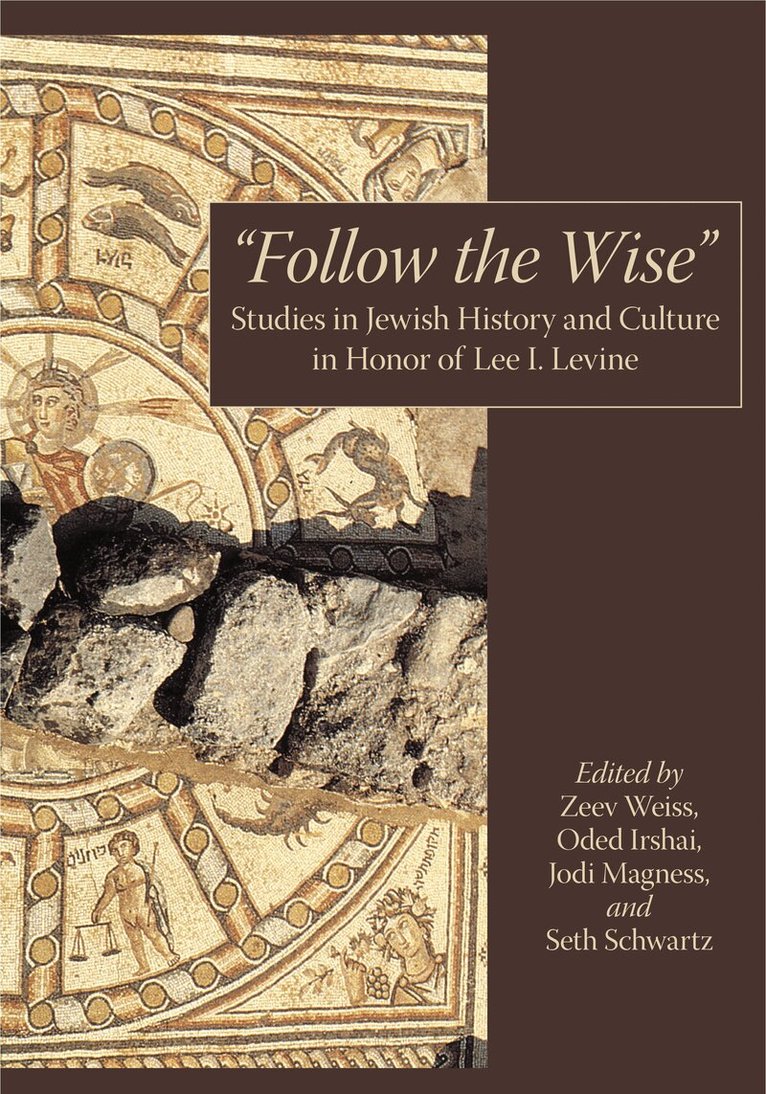
    “Follow the Wise”

    Studies in Jewish History and Culture in Honor of Lee I. Levine

    AvZeev Weiss,Oded Irshai

    Inbunden, Engelska, 2010

    1 148 kr

    Beställningsvara. Skickas inom 5-8 vardagar. Fri frakt över 249 kr.

    Beskrivning

    In 1961, when Lee Israel Levine graduated from both Columbia College in New York, majoring in philosophy, and Jewish Theological Seminary, majoring in Talmud, this accomplishment was only a precursor to the brilliant career that would follow. While researching his Columbia University dissertation in Jerusalem, Levine established close ties with members of the Institute of Archaeology at Hebrew University and Prof. Yigael Yadin, who recognized the need for an interdisciplinary approach that would give graduate archaeology students a solid base in Jewish history and rabbinic sources to supplement their archaeological training. Levine accepted Yadin’s invitation to return to Israel after graduation to teach at the Institute of Archaeology and later was granted a joint appointment in the Institute of Archaeology and the Department of Jewish History. In 1985, he was promoted to the rank of Full Professor, and since 2003, he has held the Rev. Moses Bernard Lauterman Family Chair in Classical Archaeology at the Hebrew University.Levine was instrumental in founding and developing the TALI (an acronym for Tigbur Limudei Yahadut, Enriched Jewish Studies) track of Israel’s state school system. He was also a founding member of the Seminary of Judaic Studies in Jerusalem (now known as the Schechter Institute for Jewish Studies), which opened its doors in 1984. In addition to teaching, Lee headed the Schechter Institute (first as dean and then as president) from 1987 to 1994. Lee was an active member of the Masorti Movement in Israel and represented it abroad as Director of the Foundation for Masorti Judaism (1986–87) and Vice-Chancellor of Israel Affairs at the Jewish Theological Seminary (1987–94).The honoree has published 12 monographs, 11 edited or coedited volumes, and 180 articles. His scholarship encompasses a broad range of topics relating to ancient Judaism, especially archaeology, rabbinic studies, and Jewish history. Within these disciplines he has dealt with a variety of subfields, including ancient synagogues and liturgy, ancient Jewish art, Galilee, Jerusalem, Hellenism and Judaism, and the historical geography of ancient Palestine. He is one of the first major scholars to draw on and integrate data from all of these fields in order to afford a better understanding of ancient Judaism. The 32 contributions to this volume by 35 authors are a tribute to his influence on this field of study and reflect the broad spectrum of his own interests. The 26 English and 6 Hebrew essays are divided into sections on Hellenism, Christianity, and Judaism; art and archaeology—Jerusalem and Galilee; rabbis; the ancient synagogue; sages and patriarchs; and archaeology, art, and historical geography.

    Produktinformation

    • Utgivningsdatum:2010-06-30
    • Mått:178 x 254 x 49 mm
    • Vikt:1 497 g
    • Format:Inbunden
    • Språk:Engelska
    • Antal sidor:600
    • Förlag:Pennsylvania State University Press
    • ISBN:9781575062006

    Utforska kategorier

    • Forntidens historia inom Historia och arkeologi

    Innehållsförteckning

    • Biography of Lee I. LevinePublications of Lee I. LevineAbbreviationsPart 1: Hellenism, Christianity, and JudaismHellenism and Judaism before and after World War II: Two Case Studies—A. D. Momigliano and E. J. Bickerman; Albert I. BaumgartenThe Name of the Ruse: The Toss of a Ring to Save Life and Honor Shaye J. D. CohenJesus and the Galilean Am ha-Aretz: A Reconsideration of an Old Problem Sean FreyneHellenism and Judaism: Fluid Boundaries Erich S. GruenPorphyry on Judaism: Some Observations Pieter W. van der HorstThe Bishops of Sepphoris: Christianity and Synagogue Iconography in the Late Fourth and Early Fifth Centuries Hillel I. NewmanThe Humanistic Evaluation of Religion E. P. SandersPart 2: Art and Archaeology: Jerusalem and GalileeThe Observance of Ritual Purity after 70 c.e.: A Reevaluation of the Evidence in Light of Recent Archaeological Discoveries David Amit and Yonatan AdlerThe Tomb of Jason Reconsidered Dan BaragThe Hippo-Stadium/Amphitheater in Jerusalem Amos Kloner and Sherry WhetstoneAramaic Ostraca of the Late Second Temple Period from a Farmhouse North of Jerusalem Ronny Reich and Eli ShukronAn “Encore” on the Bar Kochba Tetradrachm: A Re-vision of Interpretation Elisheva Revel-NeherBurial Practices in Beth She’rim and the Question of Dating the Patriarchal Necropolis Zeev WeissPart 3: The RabbisAbbaye’s Family Origins: A Study in Rabbinic Genealogy Aaron DemskyThe Miracle of the Septuagint in Ancient Rabbinic and Christian Literature Richard KalminThe Rabbinic Class Revisited: Rabbis as Judges in Later Roman Palestine Hayim LapinRabbis, Preachers, and Aggadists: An Aspect of Jewish Culture in Third- and Fourth-Century Palestine David LevineRabbi Judah ha-Nasi and Babylonia: Ties and Tensions Aharon OppenheimerThe Religious Orientation of Non-Rabbis in Second-Century Palestine: A Rabbinic Perspective Adiel SchremerMartyrdom, the Middle Way, and Mediocrity (Genesis Rabbah 82:8) Daniel R. SchwartzSinai—Mountain and Desert: The Desert Geography and Theology of the Rabbis and Desert Fathers Joshua SchwartzRabbinic and Roman Honor and Deference: Berakot 5.1, 9a, and Y. Bikkurim 3.3, 65c–d Seth SchwartzPart 4: The Ancient SynagogueThe Dura-Europos Synagogue Wall Paintings: A Question of Origin and Interpretation Rachel HachliliPriests and Purity in the Dura-Europos Synagogue Jodi MagnessThe Problem of the Scarcity of Synagogues from 70 to ca c.e.: The Case of Synagogue 1 at Nabratein (2nd–3rd Century c.e.) Eric M. MeyersThe Synagogue as Foe in Early Christian Literature Leonard V. RutgersHebrew SectionPart 1: Sages and PatriarchsEpistles of the Patriarchs in Talmudic Literature Isaiah GafniOn Aggadic Midrashim: Formation, Editing, Survival Moshe David HerrPart 2: Archaeology, Art, and Historical GeographyGader, Migdal Gader, Hammat Gader: Historical and Geographical Considerations in Interpreting a Talmudic Sugya in rubin Motti AradThe Zodiac and Helios in the Synagogue: Between Paganism and Christianity Rina TalgamWas King Herod Indeed a Megalomaniac? In Light of Kasher and Witztum’s New Book, King Herod: A Persecuted Persecutor—Ehud NetzerIs “Bezer in the Wilderness” (Deut 4:43) Bozrah (Bostra, Roman Arabia)?On the Intricacies of a Rabbinic Tradition Oded Irshai062008