• Fri frakt över 249 kr
  • •
  • Snabba leveranser
  • •
  • Billiga böcker
Kundservice

Du är på sajten för privatpersoner.

Företag, bibliotek eller offentlig verksamhet?

Du handlar på classic.bokus.com, där alla dina funktioner finns intakta.
Till classic.bokus.com
Bokus logotyp. Gå till startsidan.
  • Erbjudanden
  • Nyheter
  • Student
  • Topplistor
  • Barn & ungdom
  • Bokus Play
  • E-böcker
  • Pocketböcker
  • Spel & pussel

10% rabatt på allt med kod NYSTART10 →

Sidfot

Mina sidor

    Hjälp

    • Kundservice
    • Vanliga frågor och svar
    • Frakt och leverans
    • Retur vid ångerrätt
    • Reklamera vara
    • Betalning
    • Köpvillkor
    • Allmänna villkor
    • Information om webbplatsens tillgänglighet

    Om Bokus

    • Om oss
    • Pressrum
    • För studenter
    • För företag
    • För bibliotek och offentlig verksamhet
    • För leverantörer
    • Hållbarhet

    Populärt

    • Aktuella erbjudanden
    • Presentkort
    • Studentlitteratur
    • Nya böcker
    • Topplistor
    • Signerade böcker
    • Engelska böcker

    Inspiration

    • Boktips
    • BookTok
    • Populära bokserier
    • Barnbokskaraktärer
    • Populära författare
    Logotyp för Bokus
    Följ oss på Facebook (extern länk)Följ oss på Instagram (extern länk)Följ oss på YouTube (extern länk)Följ oss på TikTok (extern länk)
    bokus @ CookiesAnpassa cookiesIntegritetspolicyKöpvillkor
    Till Citymail hemsida (extern länk)Till Budbee hemsida (extern länk)Till Postnord hemsida (extern länk)Till Schenker hemsida (extern länk)Till Early Bird hemsida (extern länk)Till Walleys hemsida (extern länk)
    1. Filosofi och religion
    2. Filosofi
    3. Filosofiska discipliner

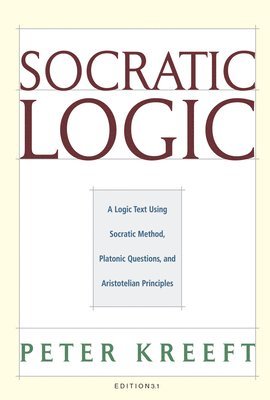
    Socratic Logic 3.1e – Socratic Method Platonic Questions

    AvPeter Kreeft,Trent Dougherty

    Inbunden, Engelska, 2010

    373 kr

    Beställningsvara. Skickas inom 5-8 vardagar. Fri frakt över 249 kr.

    Beskrivning

    This new and revised edition of Peter Kreeft’s Socratic Logic is updated, adding new exercises and more complete examples, all with Kreeft’s characteristic clarity and wit. Since its introduction in the spring of 2004, Socratic Logic has proven to be a different type of logic text:(1) This is the only complete system of classical Aristotelian logic in print. The “old logic” is still the natural logic of the four language arts (reading, writing, speaking, and listening). Symbolic, or “mathematical,” logic is not for the humanities. (How often have you heard someone argue in symbolic logic?)(2) This book is simple and user-friendly. It is highly interactive, with a plethora of exercises and a light, engaging style.(3) It is practical. It is designed for do-it-yourselfers as well as classrooms. It emphasizes topics in proportion to probable student use: e.g., interpreting ordinary language, not only analyzing but also constructing effective arguments, smoking out hidden assumptions, making “argument maps,” and using Socratic method in various circumstances.(4) It is philosophical. Its exercises expose students to many classical quotations, and additional chapters introduce philosophical issues in a Socratic manner and from a commonsense, realistic point of view. It prepares students for reading Great Books rather than Dick and Jane, and models Socrates as the beginner’s ideal teacher and philosopher.

    Produktinformation

    • Utgivningsdatum:2010-09-15
    • Mått:152 x 229 x 28 mm
    • Vikt:658 g
    • Format:Inbunden
    • Språk:Engelska
    • Antal sidor:410
    • Förlag:St Augustine's Press
    • ISBN:9781587318085

    Utforska kategorier

    • Filosofiska discipliner inom Filosofi och religion

    Mer om författaren

    Peter Kreeft has taught logic at Boston College for thirty years. He is an outstanding speaker and has authored forty or so books in philosophy and theology.

    Innehållsförteckning

    • PREFACE ix    INTRODUCTION 11. What good is logic? 1 2. Seventeen ways this book is different 93. The two logics (P)* 154. All of logic in two pages: an overview (B)* 265. The three acts of the mind (B) 28I. THE FIRST ACT OF THE MIND: UNDERSTANDING 351. Understanding: the thing that distinguishes man from both beast and computer (P) 352. Concepts, terms and words (P) 403. The “problem of universals” (P) 414. The extension and comprehension of terms 43II. TERMS 471. Classifying terms 472. Categories (B) 543. Predicables (B) 564. Division and Outlining (B) 62III. MATERIAL FALLACIES 681. Fallacies of language 712. Fallacies of diversion 80 3. Fallacies of oversimplification 864, Fallacies of argumentation 925. Inductive fallacies 1006, Procedural fallacies 1047. Metaphysical fallacies  1098. Short Story: “Love Is a Fallacy” 114IV. DEFINITION  1231. The nature of definition (B) 1232. The rules of definition (B) 1243. The kinds of definition 1244, The limits of definition 129V.  THE SECOND ACT OF THE MIND: JUDGMENT 1381. Judgments, propositions, and sentences 1382. What is truth? (P)  1433. The four kinds of categorical propositions (B) 1454. Logical form (B) 1475. Euler’s circles (B) 1526. Tricky propositions 153 7. The distribution of terms 163VI. CHANGING PROPOSITIONS 1661. Immediate inference 1662. Conversion (B) 1673. Obversion (B) 1704. Contraposition 171VII. CONTRADICTION 1731. What is contradiction? (B) 1732. The Square of Opposition (B) 1743. Existential import (P) 179 4. Tricky propositions on the Square 1815. Some practical uses of the Square of Opposition 183VIII. THE THIRD ACT OF THE MIND: REASONING 1861. What does “reason” mean? (P) 1862. The ultimate foundations of the syllogism (P) 1873. How to detect arguments 1904. Arguments vs. explanations 1935. Truth and validity 194IX. DIFFERENT KINDS OF ARGUMENTS 2001. Three meanings of “because” 2002. The four causes (P) 2023. A classification of arguments 2054. Simple argument maps (B) 2065. Deductive and Inductive reasoning (B) 2106. Combining induction and deduction: Socratic method (P) 211X. SYLLOGISMS 2151. The structure and strategy of the syllogism (B) 2152. The skeptic’s objection to the syllogism (P) 2193. The empiricist’s objection to the syllogism (P) 2224. Demonstrative syllogisms 2305. How to construct convincing syllogisms (B) 232XI. CHECKING SYLLOGISMS FOR VALIDITY 2371. By Euler’s Circles (B) 2372. By Aristotle’s six rules (B) 242 3. “Barbara Celarent”: mood and figure 2574. Venn Diagrams  258XII. MORE DIFFICULT SYLLOGISMS  2641. Enthymemes: abbreviated syllogisms (B) 2642. Sorites: chain syllogisms 2753. Epicheiremas: multiple syllogisms (B) 2794. Complex argument maps  282XIII. COMPOUND SYLLOGISMS 2891. Hypothetical syllogisms (B) 2892. “Reductio ad absurdum” arguments 2943. The practical syllogism: arguing about means and ends 2964. Disjunctive syllogisms (B) 3015. Conjunctive syllogisms (B) 3036. Dilemmas (B) 306XIV. INDUCTION 3131. What is induction? 3132. Generalization  3153. Causal arguments: Mill’s methods  3194. Scientific hypotheses  3255. Statistical probability 3286. Arguments by analogy  3297. A fortiori and a minore arguments 335XV. SOME PRACTICAL APPLICATIONS OF LOGIC 3421. How to write a logical essay 3422. How to write a Socratic dialogue 3443. How to have a Socratic debate 3484. How to use Socratic method on difficult people 3505. How to read a book Socratically 355XVI. SOME PHILOSOPHICAL APPLICATIONS OF LOGIC  3581. Logic and theology (P) 3582. Logic and metaphysics (P) 3593. Logic and cosmology (P) 3604. Logic and philosophical anthropology (P) 3615. Logic and epistemology (P) 3626. Logic and ethics (P) 362 APPENDIX: PROBLEMS WITH MATHEMATICAL LOGIC 3641. Basic modern logic 3642. The paradoxes of material implication 3663. Responses to the paradoxes of material implication 367ANSWERS TO EVEN-NUMBERED EXERCISES 370INDEX OF PRINCIPAL NAMES 400