• Fri frakt över 249 kr
  • •
  • Snabba leveranser
  • •
  • Billiga böcker
Kundservice

Du är på sajten för privatpersoner.

Företag, bibliotek eller offentlig verksamhet?

Du handlar på classic.bokus.com, där alla dina funktioner finns intakta.
Till classic.bokus.com
Bokus logotyp. Gå till startsidan.
  • Erbjudanden
  • Nyheter
  • Student
  • Topplistor
  • Barn & ungdom
  • Bokus Play
  • E-böcker
  • Pocketböcker
  • Spel & pussel

10% rabatt på allt med kod: NYSTART10 →

Sidfot

Mina sidor

    Hjälp

    • Kundservice
    • Vanliga frågor och svar
    • Frakt och leverans
    • Retur vid ångerrätt
    • Reklamera vara
    • Betalning
    • Köpvillkor
    • Allmänna villkor
    • Information om webbplatsens tillgänglighet

    Om Bokus

    • Om oss
    • Pressrum
    • För studenter
    • För företag
    • För bibliotek och offentlig verksamhet
    • För leverantörer
    • Hållbarhet

    Populärt

    • Aktuella erbjudanden
    • Presentkort
    • Studentlitteratur
    • Nya böcker
    • Topplistor
    • Signerade böcker
    • Engelska böcker

    Inspiration

    • Boktips
    • BookTok
    • Populära bokserier
    • Barnbokskaraktärer
    • Populära författare
    Logotyp för Bokus
    Följ oss på Facebook (extern länk)Följ oss på Instagram (extern länk)Följ oss på YouTube (extern länk)Följ oss på TikTok (extern länk)
    bokus @ CookiesAnpassa cookiesIntegritetspolicyKöpvillkor
    Till Citymail hemsida (extern länk)Till Budbee hemsida (extern länk)Till Postnord hemsida (extern länk)Till Schenker hemsida (extern länk)Till Early Bird hemsida (extern länk)Till Walleys hemsida (extern länk)
    1. Språk och ordböcker
    2. Språkvetenskap och lingvistik

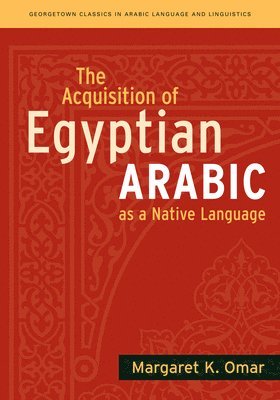
    Acquisition of Egyptian Arabic as a Native Language

    AvMargaret K. Omar

    Häftad, Engelska, 2007

    Del i serien Georgetown Classics in Arabic Languages and Linguistics series

    409 kr

    Tillfälligt slut

    Fler format och utgåvor

    E-bok

    1 500 kr

    Inbunden

    1 640 kr

    Beskrivning

    In 1968 Margaret K. Omar (Nydell) spent four months in a small Egyptian village called Sheikh Mubarak. Located in Middle Egypt near Al-Minya, residents of Sheik Mubarak speak in a dialect closer to Sa'eedi, not the dialect spoken in Cairo. Omar spent time there conducting interviews, examinations, and taping sessions with children and families to study primary language acquisition in non-Western languages. Based on her fieldwork, Omar describes the physical and social environment in which the native language was learned, the development of early communication and speech, and when and how children learn the phonology, vocabulary, morphology, and syntactical patterns of Egyptian Arabic. Omar makes comparisons with aspects of language acquisition of other languages, primarily English, and explores implications for the theory of language acquisition. Originally published in 1973, this book is the most thorough and complete analysis of the stages in which children learn Arabic as a first language. The Arabic in this book is presented in transcription, making the information accessible to all linguists interested in language acquisition.

    Produktinformation

    • Utgivningsdatum:2007-07-17
    • Mått:178 x 254 x 8 mm
    • Vikt:408 g
    • Format:Häftad
    • Språk:Engelska
    • Serie:Georgetown Classics in Arabic Languages and Linguistics series
    • Antal sidor:232
    • Förlag:Georgetown University Press
    • ISBN:9781589011687

    Utforska kategorier

    • Språkvetenskap och lingvistik inom Språk och ordböcker

    Mer om författaren

    Margaret K. Omar (Nydell) is the director of the Flagship Arabic Program (study abroad) at the Center for Teaching Arabic as a Foreign Language at the University of Alexandria in Egypt. She is a specialist in Arabic dialectology and the author of many publications, including Understanding Arabs: A Guide for Westerners and the ten-video teaching module Syrian Arabic Through Video.

    Innehållsförteckning

    • Foreword Preface AcknowledgementsList of Symbols 1. INTRODUCTION Scope of the Study Goals of the StudyNeed for the StudyDuration and Location of the Study DurationLocationMethodology Followed Recordings and Transcriptions Types of Speech Observed Children in the Study Families in the Village and in the Study Approach Used with Village Residents Assistance Received in Conducting the StudyStructural Sketch of the Language The Root and Pattern SystemPhonologyMorphologySyntax 2. BASIC CHARACTERISTICS OF THE PHYSICAL AND FAMILY ENVIRONMENT The Physical Environment The Village SurroundingsFamily HomesThe Government Cooperative UnitPhysical Characteristics of the Children in the StudyThe Social Structure The Extended FamilyRoles of Family MembersTraining of ChildrenChildren's Daily Routines, Work and GamesFormal EducationEffects of the Social Structure on ChildrenSpecial Uses of Language 3. THE DEVELOPMENT OF PHONOLOGY The Phonological System in Adult Language ConsonantsVowelsFunctional Load of PhonemesSyllable TypesThe Babbling Stage Theoretical ConsiderationsData Obtained in This StudyEarly ImitationClassification of DataStages of Acquisition of the Phonological System Theoretical ConsiderationsStage IStage IITwo Intermediate Case StudiesStage IIIOrder of Acquisition of Phonemes Individual PhonemesPhoneme CombinationsSummaryComparison with Phonemic Development in Other LanguagesImitation Theoretical ConsiderationsData Obtained in This StudyThe Imitation TestsFinal Observations 4. EARLY COMMUNICATION AND INITIAL VOCABULARY Comprehension Theoretical ConsiderationsThe Comprehension TestConclusionsEffects of Other Factors on PerformanceEarly Speech and Vocabulary Theoretical ConsiderationsData Obtained in This StudyBaby Talk Theoretical ConsiderationsData Obtained in This StudyLinguistic FeaturesSocial ContextBelief System 5. THE DEVELOPMENT OF SYNTAX Early Stages of Syntactic Development Theoretical ConsiderationsThe One-Word StageThe Multi-Word StagesThe Acquisition of the Negative Rules for Negation in Adult LanguageThe Negation TestChild Syntactical Rules and Stages for NegationThe Acquisition of the Interrogative Rules for Interrogation in Adult LanguageThe Interrogation TestChild Syntactical Rules and Stages for InterrogationSummary 6. THE DEVELOPMENT OF MORPHOLOGY Early Stages of Morphological Development Theoretical ConsiderationsSome Characteristics of Early Morphological DevelopmentThe Acquisition of Inflectional Affixes for Noun Plurals Rules for Pluralizing Nouns in Adult LanguageThe Noun Plural TestChild Rules and Stages for Noun PluralizationsThe Acquisition of the Inflectional Affixes and Agreement for Adjectives Rules for Adjective Inflection and Agreement in Adult LanguageThe Adjective TestChild Rules and Stages for Adjective Inflection and AgreementSummary 7. CONCLUSION Review of Findings in This StudyImplications for Theories Regarding Language and Primary Language AcquisitionSuggestions for Further ResearchBibliography