• Fri frakt över 249 kr
  • •
  • Snabba leveranser
  • •
  • Billiga böcker
Kundservice

Du är på sajten för privatpersoner.

Företag, bibliotek eller offentlig verksamhet?

Du handlar på classic.bokus.com, där alla dina funktioner finns intakta.
Till classic.bokus.com
Bokus logotyp. Gå till startsidan.
  • Erbjudanden
  • Nyheter
  • Student
  • Topplistor
  • Barn & ungdom
  • Bokus Play
  • E-böcker
  • Pocketböcker
  • Spel & pussel

10% rabatt på allt med kod NYSTART10 →

Sidfot

Mina sidor

    Hjälp

    • Kundservice
    • Vanliga frågor och svar
    • Frakt och leverans
    • Retur vid ångerrätt
    • Reklamera vara
    • Betalning
    • Köpvillkor
    • Allmänna villkor
    • Information om webbplatsens tillgänglighet

    Om Bokus

    • Om oss
    • Pressrum
    • För studenter
    • För företag
    • För bibliotek och offentlig verksamhet
    • För leverantörer
    • Hållbarhet

    Populärt

    • Aktuella erbjudanden
    • Presentkort
    • Studentlitteratur
    • Nya böcker
    • Topplistor
    • Signerade böcker
    • Engelska böcker

    Inspiration

    • Boktips
    • BookTok
    • Populära bokserier
    • Barnbokskaraktärer
    • Populära författare
    Logotyp för Bokus
    Följ oss på Facebook (extern länk)Följ oss på Instagram (extern länk)Följ oss på YouTube (extern länk)Följ oss på TikTok (extern länk)
    bokus @ CookiesAnpassa cookiesIntegritetspolicyKöpvillkor
    Till Citymail hemsida (extern länk)Till Budbee hemsida (extern länk)Till Postnord hemsida (extern länk)Till Schenker hemsida (extern länk)Till Early Bird hemsida (extern länk)Till Walleys hemsida (extern länk)
    1. Samhälle och politik
    2. Samhälle och kultur
    3. Kultur och medier
    4. Referensverk och tvärvetenskap

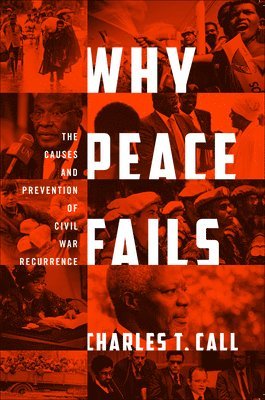
    Why Peace Fails

    The Causes and Prevention of Civil War Recurrence

    AvCharles T. Call

    Häftad, Engelska, 2012

    473 kr

    Beställningsvara. Skickas inom 5-8 vardagar. Fri frakt över 249 kr.

    Beskrivning

    Why does peace fail? More precisely, why do some countries that show every sign of having successfully emerged from civil war fall once again into armed conflict? What explains why peace "sticks" after some wars but not others? In this illuminating study, Charles T. Call examines the factors behind fifteen cases of civil war recurrence in Africa, Asia, the Caucasus, and Latin America. He argues that widely touted explanations of civil war - such as poverty, conflict over natural resources, and weak states - are far less important than political exclusion. Call's study shows that inclusion of former opponents in postwar governance plays a decisive role in sustained peace. "Why Peace Fails" ultimately suggests that the international community should resist the temptation to prematurely withdraw resources and peacekeepers after a transition from war. Instead, international actors must remain fully engaged with postwar elected governments, ensuring that they make room for former enemies.

    Produktinformation

    • Utgivningsdatum:2012-04-03
    • Mått:152 x 229 x 21 mm
    • Vikt:522 g
    • Format:Häftad
    • Språk:Engelska
    • Antal sidor:288
    • Förlag:Georgetown University Press
    • ISBN:9781589018945
    • Utmärkelser:Annual Best Book Award

    Utforska kategorier

    • Referensverk och tvärvetenskap inom Samhälle och politik

    Mer om författaren

    Charles T. Call is an assistant professor in the School of International Studies at American University. He was previously a senior fellow at the US Institute of Peace and is the editor of Building States to Build Peace and Constructing Security and Justice after War. He has conducted research in Afghanistan, West Africa, Bosnia, Kosovo, Haiti, Colombia, Chechnya, and Central America.

    Recensioner i media

    Its clear structure, honest discussion of shortcomings, and mixture of methods - as well as its policy debates and recommendations - make this book an invaluable teaching tool. Indubitably, Call makes some signi cant theoretical contributions, important for scholars and practitioners alike, as civil war recurrences continue to occur. African Affairs Call cites sources that represent the most credible scholarly and professional works available. His research is rigorous, comprehensive, and compelling. It is well articulated and appropriately interwoven, with substantive depth and analysis. His conclusions and recommendations are sound and constructive ... a must-read for conflict theory scholars, academics in the fields of political science and international studies, and military and government leaders-especially those who shape US policy with fragile states. Military Review A systematic, engaging and critical account of commonly used theories and methodologies, while providing a deep understanding of a range of cases that display both the successes and failures of various peace settlements. Sicherheit und Frieden (Security and Peace) The book's most valuable contribution can be found in its final chapter where conclusions for policy and practice are discussed. The book closes with a sophisticated analysis of why legitimacy-building by external actors is so difficult, and an invaluable analysis of the four moments in postwar political processes. -- Clare Lockhart Governance An impressive, focused examination of a crucial question in the study of political violence. Political Science Quarterly

    Innehållsförteckning

    • Introduction: The Tragedy of Civil War RecurrenceThe Importance of This BookThe Central ArgumentContributions to TheoryResearch Design and MethodologyOrganization of the BookNotes Part I: Why Peace Fails: Theory1. What Do We Know about Why Peace Fails?What We Know about Civil Wars and Ethnic ConflictFour Approaches to PeacebuildingClarifying Concepts: Exclusion, Inclusion, and LegitimacyConclusionNotes 2. Is Civil War Recurrence Distinct from Its Onset?: A Quantitative Analysis and the Limits ThereofA Regression Analysis of Civil War RecurrenceThe Contributions and Limitations of Quantitative Methods for Studying Civil WarsConclusionNotes Part II: Examining the Cases3. Liberia: Exclusion and Civil War Recurrence The First Civil WarThe Onset of PeaceThe Second Civil War: A Brief SummaryCharles Taylor's Exclusionary BehaviorAlternative ExplanationsInsights from Liberia's Second Postwar Peace ProcessConclusionNotes 4. Separatist Recurrences of Civil WarSudan: The Marginalization of the SouthChechnya: Reneging and ResistanceGeorgia and South Ossetia: Integration BackfiresChina and Tibet: Compelled from AutonomyAnalyzing Cases of Reneging on Territorial AutonomyNotes 5. Nonseparatist Recurrences of Civil WarPrecipitating Exclusionary BehaviorThe Central African Republic: Exclusion and State WeaknessHaiti: Political Exclusion and RecurrenceEast Timor: Liberation, Statehood, and ExclusionZimbabwe: Liberation, Statehood, and ExclusionBurundi and Rwanda: Chronic Exclusionary BehaviorAlternative Explanations and ConclusionsNotes 6. Recurrences That Defy the ArgumentLebanon: Failed PowersharingMali: Failed PowersharingNicaragua: Externally Driven Recurrence Peru: Exclusion, Coca, and Rebel ResurgenceConclusionNotes 7. Making Peace Stick: Inclusionary Politics and Twenty-Seven Nonrecurrent Civil WarsInclusion, Powersharing, and Peacebuilding SuccessPowersharing and Peace Consolidation: Examining the Pool of CasesBeyond Powersharing: Inclusionary Behavior and PeacePeace and Exclusionary Behavior?International Troops and 'Frozen' ConflictsNotes Part III: Implications for Theory and Practice8. Conclusions for Theory: Legitimacy-Focused PeacebuildingThe Main Findings of the BookRethinking the Aims and Approaches of PeacebuildingAddressing LimitationsNotes 9. Conclusions for Policy and Practice: Can External Actors Build Legitimacy after War?Why Legitimacy-Building Is Exceptionally DifficultBeyond Blanket Inclusionary Formulas: Four 'Moments' for Key Choices and External StrategyConclusionNotes ReferencesIndex