• Fri frakt över 249 kr
  • •
  • Snabba leveranser
  • •
  • Billiga böcker
Kundservice

Du är på sajten för privatpersoner.

Företag, bibliotek eller offentlig verksamhet?

Du handlar på classic.bokus.com, där alla dina funktioner finns intakta.
Till classic.bokus.com
Bokus logotyp. Gå till startsidan.
  • Erbjudanden
  • Student
  • Topplistor
  • Barn & ungdom
  • Bokus Play
  • E-böcker
  • Ljudböcker
  • Pocketböcker
  • Spel och pussel

Pocketfynda! Hundratals böcker för 49 kr/st →

Sidfot

Mina sidor

    Hjälp

    • Kundservice
    • Vanliga frågor och svar
    • Frakt och leverans
    • Retur vid ångerrätt
    • Reklamera vara
    • Betalning
    • Köpvillkor
    • Allmänna villkor
    • Information om webbplatsens tillgänglighet

    Om Bokus

    • Om oss
    • Pressrum
    • För studenter
    • För företag
    • För bibliotek och offentlig verksamhet
    • För leverantörer
    • Hållbarhet

    Populärt

    • Aktuella erbjudanden
    • Presentkort
    • Studentlitteratur
    • Nya böcker
    • Topplistor
    • Signerade böcker
    • Engelska böcker

    Inspiration

    • Boktips
    • BookTok
    • Barnbokskaraktärer
    • Populära författare
    Logotyp för Bokus
    Följ oss på Facebook (extern länk)Följ oss på Instagram (extern länk)Följ oss på YouTube (extern länk)Följ oss på TikTok (extern länk)
    bokus @ CookiesAnpassa cookiesIntegritetspolicyKöpvillkor
    Till Citymail hemsida (extern länk)Till Budbee hemsida (extern länk)Till Postnord hemsida (extern länk)Till Schenker hemsida (extern länk)Till Early Bird hemsida (extern länk)Till Walleys hemsida (extern länk)
    1. Psykologi och pedagogik
    2. Pedagogik
    3. Utbildningsstrategier och utbildningspolitik

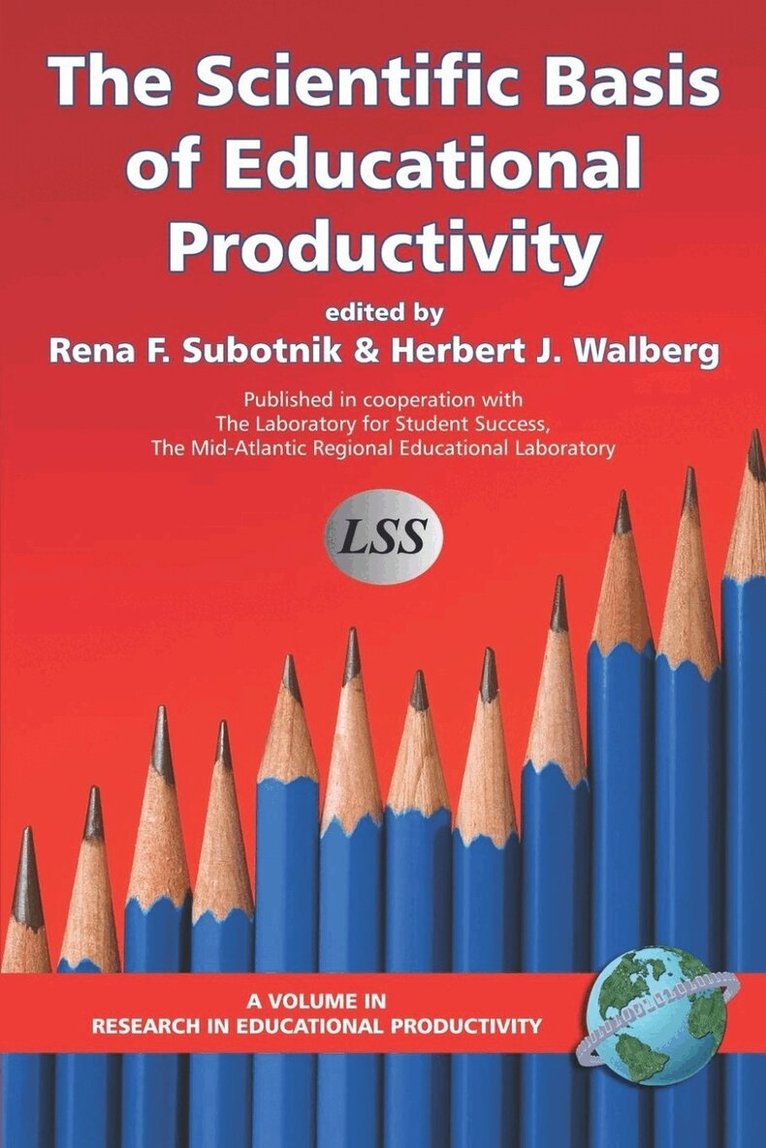
    Scientific Basis of Educational Productivity

    AvRena F. Subotnik,Herbert J. Walberg

    Häftad, Engelska, 2006

    Del i serien Research in Educational Productivity

    602 kr

    Beställningsvara. Skickas inom 5-8 vardagar. Fri frakt över 249 kr.

    Beskrivning

    This volume is not primarily concerned with what students should learn, nor even how they should learn. Rather it concerns how we can discover the best means and conditions for teaching them in school, at home, and in society. Expressed more explicitly, we seek to find out how students can learn efficiently or productively as much as possible within a given amount of time and resources. As in agriculture, medicine, public health, and modern industries, we can turn to rigorous science as one of the best sources for informing ourselves. The intended audiences are not only scholars in a variety of academic disciplines but also research consumers, including educators, policymakers, parents, and citizens who seek principles to critically separate valid from invalid claims for the efficacy and efficiency of education products, personnel, and policies. Initial versions of the chapters were discussed at a national invitational conference sponsored by the Laboratory for Student Success (LSS), the mid-Atlantic regional educational laboratory, at Temple University Center for Research in Human Development and Education. LSS operates under a contract with the U.S. Department of Education’s Institute of Education Sciences.

    Produktinformation

    • Utgivningsdatum:2006-02-01
    • Mått:156 x 234 x 17 mm
    • Vikt:440 g
    • Format:Häftad
    • Språk:Engelska
    • Serie:Research in Educational Productivity
    • Antal sidor:312
    • Förlag:Emerald Publishing Inc
    • ISBN:9781593114497

    Utforska kategorier

    • Utbildningsstrategier och utbildningspolitik inom Psykologi och pedagogik

    Innehållsförteckning

    • Preface.Introduction and Overview; Rena F. Subotnik and Herbert J. Walberg.Chapter 1. Evidence-Based Reform: Experimental and Quasi-Experimental Research Considered; Susan J. Paik.Chapter 2. Scientific Formative Evaluation: The Role of Individual Learners in Generating and Predicting Successful Educational Outcomes; T.V. Joe Layng, Greg Stikeleather, and Janet S. Twyman.Chapter 3. Blending Experimental and Descriptive Research: The Case of Educating Reading Teachers; Elizabeth S. Pang and Michael L. Kamil.Chapter 4. The Enhancement of Critical Thinking: With Decades of Converging Evidence, Meta-Analyses with Large Effect Sizes, and Societal Need, Would You Allow Your Child to Be Assigned to a Control Group?; Diane F. Halpern.Chapter 5. Improving Educational Productivity: An Assessment of Extant Research; Herbert J. Walberg.Chapter 6. The Scientific Basis for the Theory of Successful Intelligence; Robert J. Sternberg.Chapter 7. Science, Politics, and Education Reform: The National Academies' Role in Defining and Promoting High-Quality Scientific Education Research, 2000–2004; Lisa Towne.Chapter 8. American Board for Certification of Teacher Excellence: Applying Research to Develop a Standards-Based Teacher Certification Program; Kathleen Madigan.Chapter 9. Evidence-Based Interventions and Practices in School Psychology: The Scientific Basis of the Profession; Thomas R. Kratochwill.Chapter 10. The Institute of Education Sciences' What Works Clearinghouse; Robert Boruch and Rebecca Herman.Chapter 11. Conclusions and Recommendations; Herbert J. Walberg and Rena F. Subotnik.About the Contributors.