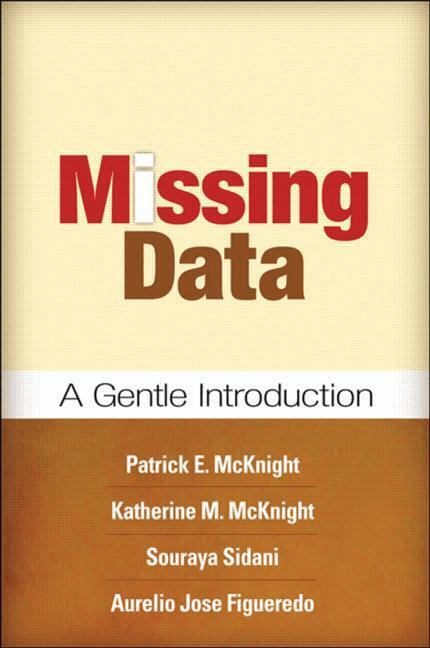
Del i serien Methodology in the Social Sciences
599 kr
Beställningsvara. Skickas inom 7-10 vardagar. Fri frakt över 249 kr.
Fler format och utgåvor
Beskrivning
Produktinformation
- Utgivningsdatum:2007-05-24
- Mått:152 x 229 x 19 mm
- Vikt:420 g
- Format:Häftad
- Språk:Engelska
- Serie:Methodology in the Social Sciences
- Antal sidor:251
- Förlag:Guilford Publications
- ISBN:9781593853938
Utforska kategorier
Mer om författaren
Patrick E. McKnight, PhD, is Assistant Professor in the Department of Psychology at George Mason University, Fairfax, Virginia. The majority of his work focuses on health services outcomes and, in particular, on measuring those outcomes to make them readily interpretable. He has worked and published in the health-related areas of asthma, arthritis, cancer, speech, pain, low vision, and rehabilitation. Dr. McKnight is an active member of the American Evaluation Association, serving as co-chair of the quantitative methods topical interest group for the past 4 years. Katherine M. McKnight, PhD, teaches statistics at George Mason University, Fairfax, Virginia, and is Director of Evaluation for LessonLab Research Institute, part of Pearson Achievement Solutions. She has published numerous articles reflecting a wide range of interests, with the common underlying framework of the thoughtful use of research methods, measurement, and data analysis for addressing research and evaluation questions. She is a member of the American Evaluation Association and the Association for Psychological Science. Souraya Sidani, PhD, RN,is Canada Research Chair, Tier One, in Health Interventions Design and Evaluation at Toronto Metropolitan University. Aurelio José Figueredo, PhD, is Professor of Psychology at the University of Arizona. He is the director of the graduate program in Ethology and Evolutionary Psychology (EEP), a cross-disciplinary program integrating the studies of comparative psychology, ethology, sociobiology, and behavioral ecology, genetics, and development. His major areas of research interest are the evolutionary psychology and behavioral development of life-history strategy and sex and violence in human and nonhuman animals, and the quantitative ethology and social development of insects, birds, and primates. In the EEP he regularly teaches the graduate year-long course in Statistical Methods in Psychological Research.
Recensioner i media
"This book is full of useful information about methodological and statistical issues related to missing data. It includes clear definitions of types of missing data, ways to reduce their negative effects, and analytical strategies for maximizing the use of all data--even partial data--collected in a research study. A unique strength of the book is its focus on missing data as a threat to the validity of a study's conclusions. Unlike other sources on missing data analysis, design approaches for preventing missing data are emphasized. More advanced statistical approaches to missing data analysis are also described clearly. This is a valuable, practical resource."--David MacKinnon, PhD, Department of Psychology, Arizona State University "This very important, interesting, and well-written book addresses a serious problem in contemporary social science research. Statisticians have made considerable progress in developing methodologies for dealing with missing data. However, these methods are not well known to social science researchers or to many graduate students in the behavioral sciences. This book systematically explores methods for classification, diagnosis, and prevention of missing data problems. It provides step-by-step instructions for analyzing data sets with some observations missing; reviews imputation methods; and advises investigators on how to report on analyses when some participants have been lost to follow-up. This is an excellent book that will help behavioral science investigators handle analytical problems for virtually every study they conduct."--Robert M. Kaplan, PhD, Regenstrief Distinguished Fellow, Purdue University; Professor of Medicine and Director of Research, Clinical Excellence Research Center, Stanford University - The authors present a comprehensive discussion of missing data in a nontechnical fashion that will not intimidate those who lack an extensive mathematical background....The book discusses missing data at an introductory level, focusing on how missing data affects scientific research, how it can be prevented or minimized throughout a study, and how it can be appropriately accounted for in the statistical analysis and study conclusions. --American Statistician, 3/30/2007ƒƒ Provides a comprehensive and nuanced discussion of the complexities and variety of solutions. It also offers approaches to reduce the likelihood of obtaining missing data by considering research procedures or design. This book serves as one of the better introductions to this topic for students and will be useful for others seeking a more general overview of approaches for missing data....This book is unique in addressing not only the statistical issues but also in its coverage on preventing the occurrence of missing data as research is planned or conducted, and how missing data should be presented in publications....A very good introduction....Provides some insightful connections between research designs used in psychology or social studies and missing data patterns. --PsycCRITIQUES, 3/30/2007ƒƒ The information in this book is practical, judicious, and empirically sound. The authors have managed to compile a very useful book on an often repressed topic among researchers. For students, this is a worthwhile introduction that manages to avoid being too technical. Yet, there are very functional suggestions both in terms of study design and the handling of missing data that would be useful for seasoned researchers. Weighted Numerical Score: 97 - 5 Stars! --Doody's Review Service, 3/30/2007
Innehållsförteckning
- 1. A Gentle Introduction to Missing Data1.1. The Concept of Missing Data1.2. The Prevalence of Missing Data1.3. Why Data Might Be Missing1.4. The Impact of Missing Data1.5. What's Missing in the Missing Data Literature?1.6. A Cost-Benefit Approach to Missing Data1.7. Missing Data--Not Just for Statisticians Anymore2. Consequences of Missing Data2.1. Three General Consequences of Missing Data2.2. Consequences of Missing Data on Construct Validity2.3. Consequences of Missing Data on Internal Validity2.4. Consequences on Causal Generalization2.5. Summary3. Classifying Missing Data3.1. The Silence That Betokens3.2. The Current Classification System: Mechanisms of Missing Data3.3. Expanding the Classification System3.4. Summary4. Preventing Missing Data by Design4.1. Overall Study Design4.2. Characteristics of the Target Population and the Sample4.3. Data Collection and Measurement4.4. Treatment Implementation4.5. Data Entry Process4.6. Summary5. Diagnostic Procedures5.1. Traditional Diagnostics5.2. Dummy Coding Missing Data5.3. Numerical Diagnostic Procedures5.4. Graphical Diagnostic Procedures5.5. Summary6. The Selection of Data Analytic Procedures6.1. Preliminary Steps6.2. Decision Making6.3. Summary7. Data Deletion Methods for Handling Missing Data7.1. Data Sets7.2. Complete Case Method7.3. Available Case Method7.4. Available Item Method7.5. Individual Growth Curve Analysis7.6. Multisample Analyses7.7. Summary8. Data Augmentation Procedures8.1. Model-Based Procedures8.2. Markov Chain Monte Carlo8.3. Adjustment Methods8.4. Summary9. Single Imputation Procedures9.1. Constant Replacement Methods9.2. Random Value Imputation9.3. Nonrandom Value Imputation: Single Condition9.4. Nonrandom Value Imputation: Multiple Conditions9.5. Summary10. Multiple Imputation10.1. The MI Process10.2. Summary11. Reporting Missing Data and Results11.1. APA Task Force Recommendations11.2. Missing Data and Study Stages11.3. TFSI Recommendations and Missing Data11.4. Reporting Format11.5. Summary12. Epilogue
Du kanske också är intresserad av
Missing Data
Patrick E. McKnight, Katherine M. McKnight, Souraya Sidani, Aurelio Jose Figueredo
1 347 kr
Theory Construction and Model-Building Skills, Second Edition
James Jaccard, Jacob Jacoby
861 kr