• Fri frakt över 249 kr
  • •
  • Snabba leveranser
  • •
  • Billiga böcker
Kundservice

Du är på sajten för privatpersoner.

Företag, bibliotek eller offentlig verksamhet?

Du handlar på classic.bokus.com, där alla dina funktioner finns intakta.
Till classic.bokus.com
Bokus logotyp. Gå till startsidan.
  • Erbjudanden
  • Nyheter
  • Student
  • Topplistor
  • Barn & ungdom
  • Bokus Play
  • E-böcker
  • Pocketböcker
  • Spel & pussel

10% rabatt på allt med kod NYSTART10 →

Sidfot

Mina sidor

    Hjälp

    • Kundservice
    • Vanliga frågor och svar
    • Frakt och leverans
    • Retur vid ångerrätt
    • Reklamera vara
    • Betalning
    • Köpvillkor
    • Allmänna villkor
    • Information om webbplatsens tillgänglighet

    Om Bokus

    • Om oss
    • Pressrum
    • För studenter
    • För företag
    • För bibliotek och offentlig verksamhet
    • För leverantörer
    • Hållbarhet

    Populärt

    • Aktuella erbjudanden
    • Presentkort
    • Studentlitteratur
    • Nya böcker
    • Topplistor
    • Signerade böcker
    • Engelska böcker

    Inspiration

    • Boktips
    • BookTok
    • Populära bokserier
    • Barnbokskaraktärer
    • Populära författare
    Logotyp för Bokus
    Följ oss på Facebook (extern länk)Följ oss på Instagram (extern länk)Följ oss på YouTube (extern länk)Följ oss på TikTok (extern länk)
    bokus @ CookiesAnpassa cookiesIntegritetspolicyKöpvillkor
    Till Citymail hemsida (extern länk)Till Budbee hemsida (extern länk)Till Postnord hemsida (extern länk)Till Schenker hemsida (extern länk)Till Early Bird hemsida (extern länk)Till Walleys hemsida (extern länk)
    1. Naturvetenskap och teknik
    2. Geovetenskap
    3. Miljövetenskap och miljöpolitik

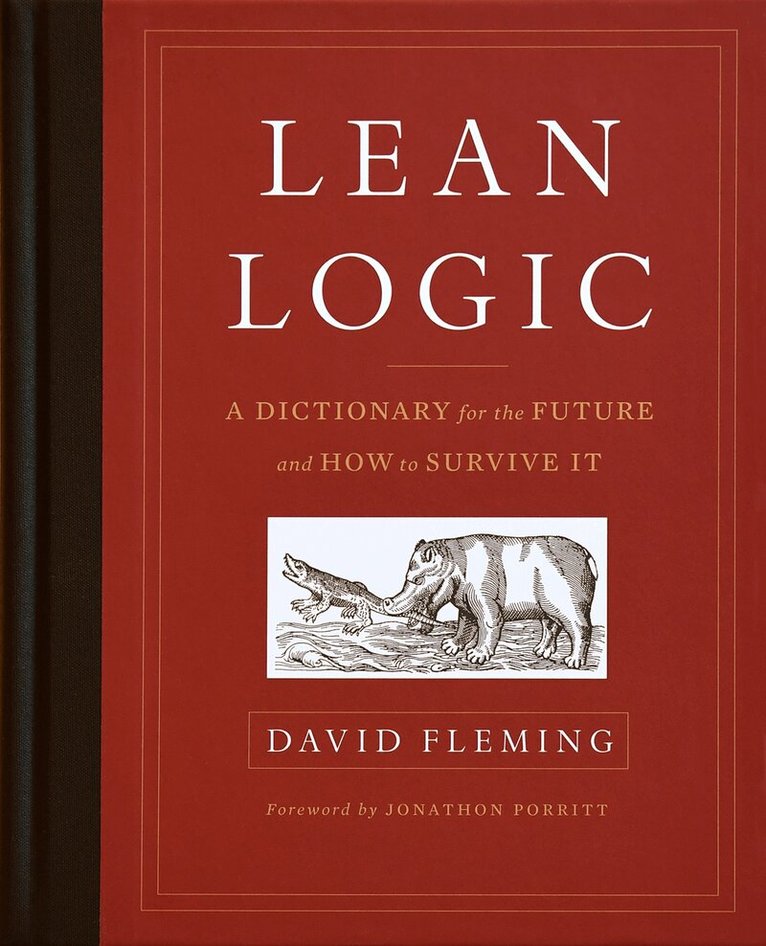
    Lean Logic

    A Dictionary for the Future and How to Survive It

    AvDavid Fleming,Shaun Chamberlin

    Inbunden, Engelska, 2016

    417 kr

    Skickas . Fri frakt över 249 kr.

    Beskrivning

    Lean Logic is David Fleming’s masterpiece, the product of more than thirty years’ work and a testament to the creative brilliance of one of Britain’s most important intellectuals.A dictionary unlike any other, it leads readers through Fleming’s stimulating exploration of fields as diverse as culture, history, science, art, logic, ethics, myth, economics, and anthropology, being made up of four hundred and four engaging essay-entries covering topics such as Boredom, Community, Debt, Growth, Harmless Lunatics, Land, Lean Thinking, Nanotechnology, Play, Religion, Spirit, Trust, and Utopia.The threads running through every entry are Fleming’s deft and original analysis of how our present market-based economy is destroying the very foundations—ecological, economic, and cultural— on which it depends, and his core focus: a compelling, grounded vision for a cohesive society that might weather the consequences. A society that provides a satisfying, culturally-rich context for lives well lived, in an economy not reliant on the impossible promise of eternal economic growth. A society worth living in. Worth fighting for. Worth contributing to.The beauty of the dictionary format is that it allows Fleming to draw connections without detracting from his in-depth exploration of each topic. Each entry carries intriguing links to other entries, inviting the enchanted reader to break free of the imposed order of a conventional book, starting where she will and following the links in the order of her choosing. In combination with Fleming’s refreshing writing style and good-natured humor, it also creates a book perfectly suited to dipping in and out.The decades Fleming spent honing his life's work are evident in the lightness and mastery with which Lean Logic draws on an incredible wealth of cultural and historical learning—from Whitman to Whitefield, Dickens to Daly, Kropotkin to Kafka, Keats to Kuhn, Oakeshott to Ostrom, Jung to Jensen, Machiavelli to Mumford, Mauss to Mandelbrot, Leopold to Lakatos, Polanyi to Putnam, Nietzsche to Næss, Keynes to Kumar, Scruton to Shiva, Thoreau to Toynbee, Rabelais to Rogers, Shakespeare to Schumacher, Locke to Lovelock, Homer to Homer-Dixon—in demonstrating that many of the principles it commends have a track-record of success long pre-dating our current society.Fleming acknowledges, with honesty, the challenges ahead, but rather than inducing despair, Lean Logic is rare in its ability to inspire optimism in the creativity and intelligence of humans to nurse our ecology back to health; to rediscover the importance of place and play, of reciprocity and resilience, and of community and culture.------Recognizing that Lean Logic’s sheer size and unusual structure could be daunting, Fleming’s long-time collaborator Shaun Chamberlin has also selected and edited one of the potential pathways through the dictionary to create a second, stand-alone volume, Surviving the Future: Culture, Carnival and Capital in the Aftermath of the Market Economy. The content, rare insights, and uniquely enjoyable writing style remain Fleming’s, but presented at a more accessible paperback-length and in conventional read-it-front-to-back format.

    Produktinformation

    • Utgivningsdatum:2016-07-27
    • Mått:178 x 229 x 64 mm
    • Vikt:1 293 g
    • Format:Inbunden
    • Språk:Engelska
    • Antal sidor:656
    • Förlag:Chelsea Green Publishing Co
    • Medarbetare:Jonathon Porritt
    • ISBN:9781603586481

    Utforska kategorier

    • Miljövetenskap och miljöpolitik inom Naturvetenskap och teknik
    • Sociala och etiska frågor inom Samhälle och politik
    • Filosofi inom Filosofi och religion

    Mer om författaren

    Dr. David Fleming (1940 – 2010) was a visionary thinker and writer who played significant roles in the genesis of the UK Green Party, the Transition Towns movement, and the New Economics Foundation, as well as chairing the Soil Association. He was also one of the early whistle-blowers on oil depletion and designer of the influential TEQs carbon/energy rationing system. He read Modern History at Trinity College, Oxford, and later earned an MBA and then an MSc and PhD in economics (in 1988). These enabled him to better engage with and confound the mainstream, in support of his true passion and genius: understanding that diverse and mysterious thing “community.” Lean Logic was the work of over thirty years.Shaun Chamberlin has been involved with the Transition Network since its inception, co-founding Transition Town Kingston and authoring the movement’s second book, The Transition Timeline. He was also one of Extinction Rebellion’s first arrestees, chair of the Ecological Land Co-operative, and has spoken at venues ranging from Occupy camps to national parliaments. In exploring the cultural narratives charting society’s course he has written and edited diverse publications, including bringing his late mentor David Fleming's lifework Lean Logic: A Dictionary for the Future and How to Survive It to posthumous publication, and creating from it the paperback Surviving the Future: Culture, Carnival, and Capital in the Aftermath of the Market Economy. He is also a consulting scholar at Sterling College, and lead writer of the film The Sequel: What Will Follow Our Troubled Civilisation? His website is www.darkoptimism.org.Jonathon Porritt co-chaired the UK Green Party from 1980-83, and acted as the director of Friends of the Earth from 1984-1990. In 1996 he co-founded Forum for the Future and was Chair of the UK’s Sustainable Development Commission from 2000-2009, receiving a CBE for services to environmental protection. He has written eight books, including Capitalism As If The World Matters (2007) and The World We Made (2013).

    Recensioner i media

    Choice-"The late author, who passed away suddenly in 2010, was a prominent UK Green Party theorist and advocate. This book—thoughtfully edited by his protégé Chamberlin—represents the distillation of a life's work. Fleming is best known for introducing the economic concept of "Tradable Energy Quotas" (TEQs), which aims to plot the means for a vast reduction of carbon emissions and energy consumption. Even though the book is laid out in a dictionary format, it is best viewed as a series of interconnected essays. The overall goal is to detail the self-destructiveness of the market economy's dependence on sustained growth and at the same time paint a picture of a much less dynamic economy of the future. The notion of "lean logic," i.e., thinking small and local, exemplifies the public policies that he predicted will emerge pursuant to the implosion of the market economy. Fleming claims an optimistic vision, yet the stark overhaul of existing social ties he foresees has a strong chiliastic bent. His idea of the market economy is the polar opposite of the recent work of Deirdre McCloskey, Bourgeois Equality: How Ideas, Not Capital or Institutions, Enriched the World (CH, Oct'16, 54-0926). Nonetheless, this is a welcome work with a distinctive and well-articulated point of view. Summing Up: Highly recommended. All readership levels.”

    Betyg & recensioner

    5/5