• Fri frakt över 249 kr
  • •
  • Snabba leveranser
  • •
  • Billiga böcker
Kundservice

Du är på sajten för privatpersoner.

Företag, bibliotek eller offentlig verksamhet?

Du handlar på classic.bokus.com, där alla dina funktioner finns intakta.
Till classic.bokus.com
Bokus logotyp. Gå till startsidan.
  • Erbjudanden
  • Nyheter
  • Student
  • Topplistor
  • Barn & ungdom
  • Bokus Play
  • E-böcker
  • Pocketböcker
  • Spel & pussel

10% rabatt på allt med kod NYSTART10 →

Sidfot

Mina sidor

    Hjälp

    • Kundservice
    • Vanliga frågor och svar
    • Frakt och leverans
    • Retur vid ångerrätt
    • Reklamera vara
    • Betalning
    • Köpvillkor
    • Allmänna villkor
    • Information om webbplatsens tillgänglighet

    Om Bokus

    • Om oss
    • Pressrum
    • För studenter
    • För företag
    • För bibliotek och offentlig verksamhet
    • För leverantörer
    • Hållbarhet

    Populärt

    • Aktuella erbjudanden
    • Presentkort
    • Studentlitteratur
    • Nya böcker
    • Topplistor
    • Signerade böcker
    • Engelska böcker

    Inspiration

    • Boktips
    • BookTok
    • Populära bokserier
    • Barnbokskaraktärer
    • Populära författare
    Logotyp för Bokus
    Följ oss på Facebook (extern länk)Följ oss på Instagram (extern länk)Följ oss på YouTube (extern länk)Följ oss på TikTok (extern länk)
    bokus @ CookiesAnpassa cookiesIntegritetspolicyKöpvillkor
    Till Citymail hemsida (extern länk)Till Budbee hemsida (extern länk)Till Postnord hemsida (extern länk)Till Schenker hemsida (extern länk)Till Early Bird hemsida (extern länk)Till Walleys hemsida (extern länk)
    1. Naturvetenskap och teknik
    2. Geovetenskap
    3. Miljövetenskap och miljöpolitik

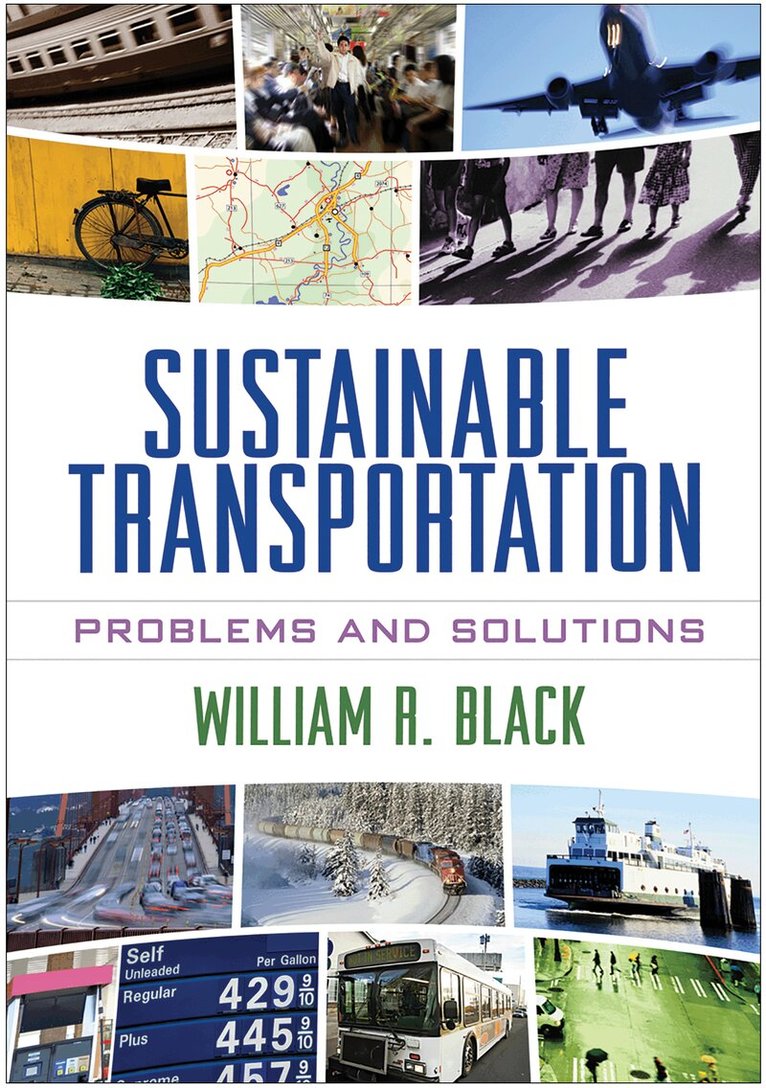
    Sustainable Transportation

    Problems and Solutions

    AvWilliam R. Black

    Inbunden, Engelska, 2010

    892 kr

    Beställningsvara. Skickas inom 5-8 vardagar. Fri frakt över 249 kr.

    Fler format och utgåvor

    E-bok

    1 059 kr

    Beskrivning

    During the last two decades, sustainability has become the dominant concern of transportation planners and policymakers. This timely text provides a framework for developing systems that move people and products efficiently while minimizing damage to the local and global environment. The book offers a uniquely comprehensive perspective on the problems surrounding current transportation systems: climate change, urban air pollution, diminishing petroleum reserves, safety issues, and congestion. It explores the full range of possible solutions, including applications of pricing, planning, policy, education, and technology. Numerous figures, tables, and examples are featured, with a primary focus on North America.

    Produktinformation

    • Utgivningsdatum:2010-05-10
    • Mått:178 x 254 x 23 mm
    • Vikt:720 g
    • Format:Inbunden
    • Språk:Engelska
    • Antal sidor:299
    • Förlag:Guilford Publications
    • ISBN:9781606234853

    Utforska kategorier

    • Miljövetenskap och miljöpolitik inom Naturvetenskap och teknik
    • Regional planering inom Naturvetenskap och teknik

    Mer om författaren

    William R. Black, PhD, until his death in 2013, was Professor Emeritus in the Department of Geography at Indiana University in Bloomington. A foundational figure in transport geography, he directed over 20 transportation research and planning projects, published over 200 research papers and reports, and authored, coauthored, or edited seven books. He founded the Transportation Geography Specialty Group of the Association of American Geographers (AAG), was a key figure in the development of the Journal of Transport Geography, and served on numerous panels and committees of the Transportation Research Board of the National Research Council. Dr. Black received the Edward L. Ullman Award for significant contributions to transportation geography from the AAG, which also selected him to present the Fleming Lecture in Transportation Geography.

    Recensioner i media

    This is not only an excellent book, it is a wise book. Rather than providing a 'silver bullet' for the problems of sustainable transportation, Black clarifies the options in a dynamic and increasingly vulnerable world. He shows how policy can play a role, as can pricing, more travel options, and design solutions. The text provides a panoramic and historical view of the limits of sustainability, from the level of horse manure New York City streets could handle in 1900 to the amount of oil we can import today without risking national security and our climate. This is a book that students, educators, planners, placemakers, and reform advocates would do well to study and reflect upon.--David Burwell, founding chair, Transportation Research Board Committee on Transportation and Sustainability This book is a welcome addition to the evolving literature on how to put transport systems on a more sustainable pathway. Its coverage is vast--beyond widely discussed topics like climate change, energy depletion, and local air pollution, Sustainable Transportation also chronicles the societal costs of road fatalities, oil spills, and traffic jams. Technological, urban planning, and demand management approaches to solving such problems are critically reviewed. The book deserves a place on transportation professionals' bookshelves and in graduate courses in environmental and transportation planning.--Robert Cervero, Department of City and Regional Planning and Director, University of California Transportation Center, University of California, Berkeley This outstanding book should become a standard text for courses on transportation. The analytical message is clear and the coverage is excellent. Black has struck 'pay dirt' in the clarity of his delivery and in refocusing traditional approaches to transportation from a sustainability orientation. In an engaging and appealing style, the text directly addresses what today's professors and students want to know about the interface of transport, energy, environment, and policy. Students in geography, planning, sociology, public affairs, environmental science, and civil engineering would flock to a course organized around this text.--Kingsley E. Haynes, Dean and University Professor, School of Public Policy, George Mason University Black, true to form, has provided essential reading for anyone interested in sustainability challenges and solutions. This text is comprehensive in scope, accessibly written, and current. At times provocative, the book tackles issues as diverse as vehicle technology, full-cost pricing, and educating for change, and gives clear messages about the way forward.--Jean Andrey, Department of Geography and Environmental Management, University of Waterloo, Canada - Provides a succinct definition of sustainable transportation, identifies key problems of the current U.S. transportation system, and evaluates a set of possible solutions for more sustainable transportation in the United States. This book is most valuable for planners and policy makers who are not (yet) experts in transportation or as a textbook for an introductory transportation course for undergraduate students. Each chapter resembles an entertaining lecture consisting of an introduction, analysis, discussion, and conclusion. --Journal of Education and Research, 11/3/2011

    Innehållsförteckning

    • I. The Nature of the Problem 1. The Problem of Sustainability in the Transport Sector2. The Historical Problem of Sustainability in the Transport Sector3. Climate Change4. Urban Air Quality5. The Finite Nature of Petroleum Reserves6. Motor Vehicle Crashes and Safety7. Congestion and SustainabilityII. Possible Solutions 8. An Introduction to the Range of Possible SolutionsPricing9. The Full Costs of Transportation10. Pricing and TaxationPlanning11. Urban Form: Planning for Sustainability12. Indicator-Based PlanningPolicy13. A Continuum of Policies14. The Special Role of Speed and Speed Limit Policies15. National Policy Solutions16. Sustainable Travel Demand ManagementEducation17. Educating for ChangeTechnology18. Information and Communication Technologies, and E-Commerce19. The Potential of Alternative Fuels20. New Vehicles, Fuel Cells, and Catalytic Converters21. Intelligent Transport SystemsIII. Summary and Conclusions22. Summary, Conclusions, and the Current Status of Sustainable Transport