E-bok, Engelska, 2011
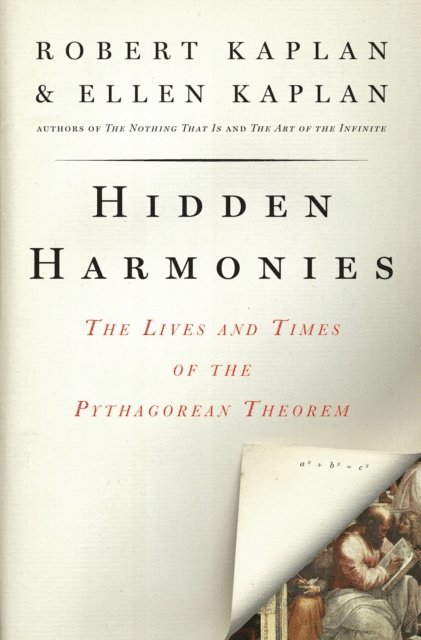
Hidden Harmonies
Av Ellen Kaplan, Robert Kaplan
191 kr
Läs direkt i Bokus Reader – eller ladda ned till din enhet
Beskrivning
A squared plus b squared equals c squared. Itsounds simple, doesn''t it? Yet this familiar expression is a gatewayinto the riotous garden of mathematics, and sends us on a journey ofexploration in the company of two inspired guides, acclaimed authorsRobert and Ellen Kaplan. With wit, verve, and clarity, they trace thelife of the Pythagorean theorem, from ancient Babylon to the present,visiting along the way Leonardo da Vinci, Albert Einstein, PresidentJames Garfield, and the Freemasons-not to mention the elusive Pythagorashimself, who almost certainly did not make the statement that bears hisname.How can a theorem have more than one proof? Why does this one havemore than two hundred-or is it four thousand? The Pythagorean theoremhas even more applications than proofs: Ancient Egyptians used it forsurveying property lines, and today astronomers call on it to measurethe distance between stars. Its generalizations are stunning-the theoremworks even with shapes on the sides that aren''t squares, and not justin two dimensions, but any number you like, up to infinity. And perhapsits most intriguing feature of all, this tidy expression opened the doorto the world of irrational numbers, an untidy discovery that deeplytroubled Pythagoras''s disciples.Like the authors'' bestselling The Nothing That Is and Chances Are . . .-hailed as "erudite and witty," "magnificent," and "exhilarating"-Hidden Harmonies makes the excitement of mathematics palpable.
Produktinformation
- Utgivningsdatum: 2011-01-11
- Språk: Engelska
- Antal sidor: 304
- Filformat: EPUB
- Kopieringsskydd: LCP
- ISBN: 9781608192915
- Förlag: Bloomsbury Publishing Plc
- Mått: 140 x 210 x undefined mm
Utforska kategorier
Betyg & recensioner
0 recensioner
Inga recensioner tillgängliga.