
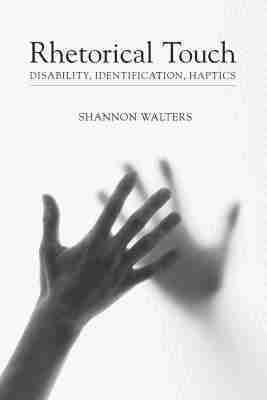
Rhetorical Touch
Disability, Identification, Haptics
E-bok
Engelska, 2014645 kr
Läs direkt i Bokus Reader – eller ladda ned till din enhet
Fler format och utgåvor
Beskrivning
Rhetorical Touch argues for an understanding of touch as a rhetorical art by approaching the sense of touch through the kinds of bodies and minds that rhetorical history and theory have tended to exclude. In resistance to a rhetorical tradition focused on shaping able bodies and neurotypical minds, Shannon Walters explores how people with various disabilities—psychological, cognitive, and physical—employ touch to establish themselves as communicators and to connect with disabled and nondisabled audiences. In doing so, she argues for a theory of rhetoric that understands and values touch as rhetorical.
Essential to her argument is a redefinition of key concepts and terms—the rhetorical situation, rhetorical identification, and the appeals of ethos (character), pathos (emotion), and logos (logic or message). By connecting Empedoclean and sophistic theories to Aristotelian rhetoric and Burkean approaches, Walters''s methods mobilize a wide range of key figures in rhetorical history and theory in response to the context of disability. Using Empedocles'' tactile approach to logos, Walters shows how the iterative writing processes of people with psychological disabilities shape crucial spaces for identification based on touch in online and real life spaces. Mobilizing the touch-based properties of the rhetorical practice of mētis, Walters demonstrates how rhetors with autism approach the crafting of ethos in generative and embodied ways. Rereading the rhetorical practice of kairos in relation to the proximity between bodies, Walters demonstrates how writers with physical disabilities move beyond approaches of pathos based on pity and inspiration. The volume also includes a classroom-based exploration of the discourses and assumptions regarding bodies in relation to haptic, or touch-based, technologies.
Because the sense of touch is the most persistent of the senses, Walters argues that in contexts of disability and in situations in which people with and without disabilities interact, touch can be a particularly vital instrument for creating meaning, connection, and partial identification. She contends that a rhetoric thus reshaped stretches contemporary rhetoric and composition studies to respond to the contributions of disabled rhetors and transforms the traditional rhetorical appeals and canons. Ultimately, Walters argues, a rhetoric of touch allows for a richer understanding of the communication processes of a wide range of rhetors who use embodied strategies.
Produktinformation
Utforska kategorier
Hoppa över listan





Du kanske också är intresserad av
- Signerad!
- Nyhet
- Signerad!
Del 3
- -19%
- -19%
- Nyhet
- -21%
- Nyhet
- -30%