• Fri frakt över 249 kr
  • •
  • Snabba leveranser
  • •
  • Billiga böcker
Kundservice

Du är på sajten för privatpersoner.

Företag, bibliotek eller offentlig verksamhet?

Du handlar på classic.bokus.com, där alla dina funktioner finns intakta.
Till classic.bokus.com
Bokus logotyp. Gå till startsidan.
  • Erbjudanden
  • Student
  • Topplistor
  • Barn & ungdom
  • Bokus Play
  • E-böcker
  • Ljudböcker
  • Pocketböcker
  • Spel och pussel

Pocketfynda! Hundratals böcker för 49 kr/st →

Sidfot

Mina sidor

    Hjälp

    • Kundservice
    • Vanliga frågor och svar
    • Frakt och leverans
    • Retur vid ångerrätt
    • Reklamera vara
    • Betalning
    • Köpvillkor
    • Allmänna villkor
    • Information om webbplatsens tillgänglighet

    Om Bokus

    • Om oss
    • Pressrum
    • För studenter
    • För företag
    • För bibliotek och offentlig verksamhet
    • För leverantörer
    • Hållbarhet

    Populärt

    • Aktuella erbjudanden
    • Presentkort
    • Studentlitteratur
    • Nya böcker
    • Topplistor
    • Signerade böcker
    • Engelska böcker

    Inspiration

    • Boktips
    • BookTok
    • Barnbokskaraktärer
    • Populära författare
    Logotyp för Bokus
    Följ oss på Facebook (extern länk)Följ oss på Instagram (extern länk)Följ oss på YouTube (extern länk)Följ oss på TikTok (extern länk)
    bokus @ CookiesAnpassa cookiesIntegritetspolicyKöpvillkor
    Till Citymail hemsida (extern länk)Till Budbee hemsida (extern länk)Till Postnord hemsida (extern länk)Till Schenker hemsida (extern länk)Till Early Bird hemsida (extern länk)Till Walleys hemsida (extern länk)
    1. Samhälle och politik
    2. Samhälle och kultur
    3. Kultur och medier
    4. Referensverk och tvärvetenskap

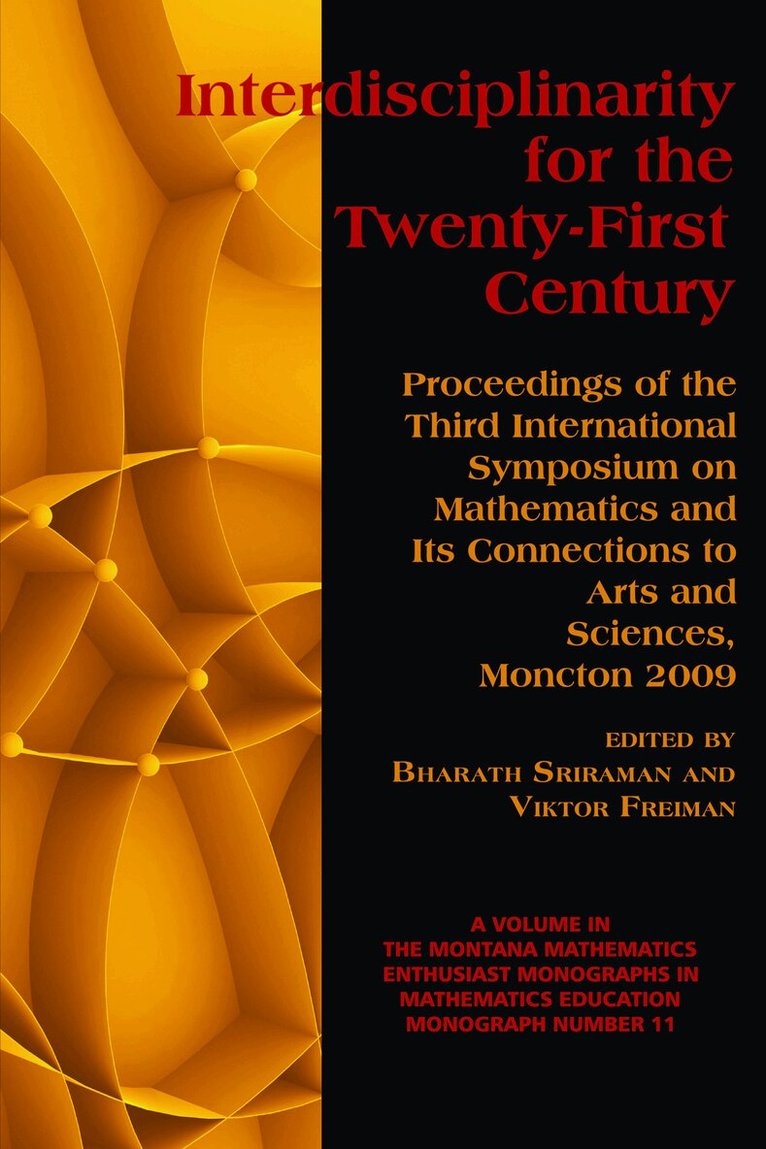
    Interdisciplinarity for the 21st Century

    Proceedings of the 3rd International Symposium on Mathematics and its Connections to Arts and Sciences, Moncton 2009

    AvBharath Sriraman,Viktor Freiman

    Häftad, Engelska, 2010

    Del i serien The Montana Mathematics Enthusiast

    756 kr

    Beställningsvara. Skickas inom 5-8 vardagar. Fri frakt över 249 kr.

    Beskrivning

    Interdisciplinarity has become increasingly important for emergent professions of the 21st century yet there is a dearth of systematic studies aimed at implementing it in the school and university curricula. The Mathematics and its Connections to the Arts and Sciences (MACAS ) group places Mathematics as a vehicle through which deep and meaningful connections can be forged with the Arts and the Sciences and as a means of promoting interdisciplinary and transdisciplinary thinking traits amongst students. The Third International Symposium held by the MACAS group in Moncton, Canada in 2009 included numerous initiatives and ideas for interdisciplinarity that are implementable in both the school and university setting. The chapters in this book cover interdisciplinary links with mathematics found in the domains of culture, art, aesthetics, music, cognition, history, philosophy, engineering, technology and science with contributors from Canada, U.S, Denmark, Germany, Mexico, Iran and Poland amongst others.

    Produktinformation

    • Utgivningsdatum:2010-10-26
    • Mått:156 x 234 x 26 mm
    • Vikt:706 g
    • Format:Häftad
    • Språk:Engelska
    • Serie:The Montana Mathematics Enthusiast
    • Antal sidor:508
    • Förlag:Emerald Publishing Inc
    • ISBN:9781617352188

    Utforska kategorier

    • Referensverk och tvärvetenskap inom Samhälle och politik
    • Matematik inom Naturvetenskap och teknik

    Innehållsförteckning

    • Introduction: Interdisciplinary Networks for Better Education in Mathematics, Science, and the Arts; Viktor Freiman and Bharath Sriraman.Chapter 1. Intercultural Positioning in Mathematics; David Wagner.Chapter 2. History in Mathematics Education—Why Bother? Interdisciplinarity, Mathematical Competence, and the Learning of Mathematics; Tinne Hoff Kjeldsen.Chapter 3. The Role of the Aesthetic in Mathematical Problem Solving; Nathalie Sinclair and Christian Berneche.Chapter 4. Mathematics in the Everyday World and at Work: Prolegomena for Rethinking the Concept of Interdisciplinarity; Wolff-Michael Roth.Chapter 5. A Portrait on How Groups of Elementary Age Students in a French Language Minority Setting Pose an Environmental Problem; Viktor Freiman, Diane Pruneau, Joanne Langis, Pierre-Yves Barbier, Marianne Cormier, and Monique Langis.Chapter 6. Teaching Citizenship Education Through the Mathematics Course; Annie Savard.Chapter 7. Flow: An Emotional Experience in Mathematics Problem Solving; T. Seifert, O. Radu, and A. Doyle.Chapter 8. Learner Directed Opportunities Through Adaptive Hypermedia Systems; Adnen Barhoumi and Chadia Moghrabi.Chapter 9. Quantitative Reasoning as a Tool for Understanding; Natalya Vinogradova.Chapter 10. Interdisciplinarity Through Processes of Modeling and Sociomathematical Decision Making; Claus Michelsen and Jan Alexis Nielsen.Chapter 11. Do Mathematical Laboratories Enhance Primary School Students' Hands-On Learning Experiences; Mark Applebaum and Viktor Freiman.Chapter 12. Amazing Math-Science-Arts Connections: Getting Insight Into the Golden Ratio; Dominic Manuel, Viktor Freiman, Edel Reilly, Ildiko Pelczer, Natalya Vinogradova, Bharath Sriraman, and Astrid Beckmann.Chapter 13. Mathematics in Contemporary Art; Nathalie Sayac.Chapter 14. Advancing the Concept of Variables Through Cross-Curricular Stations Between Arts and Mathematics Instruction; Astrid Beckmann.Chapter 15. Visual Arts and Mathematics: Intertwining for a New Conversation in Education; Lise Robichaud.Chapter 16. Why Is a Negative × a Negative = a Positive? Possible Benefits of Interdisciplinarity; Polotskaia Elena.Chapter 17. Writing + Math = Opportunity: Forging New Interdisciplinary Connections; Edel M. Reilly.Chapter 18. Study of the Potential of the Use of Degrees of Certainty to Provide the Common Sense with an Alert Bell; Sophie René de Cotret, Manon LeBlanc, and Réal Larose.Chapter 19. Visuo-Dynamic Learning: How Does the Net Generation Learn; Zekeriya Karadag.Chapter 20. Online Video Technology as Enabler for Teaching and Learning Multidisciplinary Topics; Dragana Martinovic.Chapter 21. Directional Pitch Spaces; Ilhan M. Izmirli.Chapter 22. A Note on Fibonacci Numbers in Music; Larry G. Blaine.Chapter 23. Robotic-Based Learning: RoboMaTIC; Samuel F. J. Blanchard.Chapter 24. NET Generation: Social Media and Its Link to Interdisciplinarity; Samuel F. J. Blanchard.Chapter 25. A City Built on Geometry: Project-Based Learning in a Grade 10 Math Classroom; Marcia Cormier.Chapter 26. Plato's Timaeus and the Intervals Used in Traditional Music of the Middle Classroom; Amirhossein Damadi and Payam Seraji.Chapter 27. Using Origami as Context Builder to Teach (Pre)Math Skills; Ildikó Pelczer.Chapter 28. Are There Mathematical Phenomena; Herbert Gerstberger.Chapter 29. Mathematical Literacy and How Scientific Experiments Can Promote That Conception; Simon Zell.Chapter 30. Cross-Curricular Teaching Between Mathematics and Biology—Nutrition Circle, Similarity, and Allometry; Astrid Beckmann and Annika Grube.Chapter 31. A Call for Integrating Engineering Through Cooperative Learning in the Mathematics and Science Teacher Education Program; Ke Wu Norman, Anne L. Kern, and Tamara J. Moore.Chapter 32. Choosing to Study Mathematics and Science Beyond the Classroom: Who Participates and Why; Karen Sullenger and Viktor Freiman.Chapter 33. A Brief History and Exploration of Some Didactic Journeys to Connect the Great Continents of Knowledge; Alan Rogerson.Chapter 34. Some Remarks on the Comparison Between Mathematical and Poetical Facts/Events; Romualdas Kašuba.