• Fri frakt över 249 kr
  • •
  • Snabba leveranser
  • •
  • Billiga böcker
Kundservice

Du är på sajten för privatpersoner.

Företag, bibliotek eller offentlig verksamhet?

Du handlar på classic.bokus.com, där alla dina funktioner finns intakta.
Till classic.bokus.com
Bokus logotyp. Gå till startsidan.
  • Erbjudanden
  • Student
  • Topplistor
  • Barn & ungdom
  • Bokus Play
  • Bokus Play
  • E-böcker
  • Ljudböcker
  • Pocketböcker
  • Spel & pussel

10% rabatt på allt med kod NYSTART10 →

Sidfot

Mina sidor

    Hjälp

    • Kundservice
    • Vanliga frågor och svar
    • Frakt och leverans
    • Retur vid ångerrätt
    • Reklamera vara
    • Betalning
    • Köpvillkor
    • Allmänna villkor
    • Information om webbplatsens tillgänglighet

    Om Bokus

    • Om oss
    • Pressrum
    • För studenter
    • För företag
    • För bibliotek och offentlig verksamhet
    • För leverantörer
    • Hållbarhet

    Populärt

    • Aktuella erbjudanden
    • Presentkort
    • Studentlitteratur
    • Nya böcker
    • Topplistor
    • Signerade böcker
    • Engelska böcker

    Inspiration

    • Boktips
    • BookTok
    • Populära bokserier
    • Barnbokskaraktärer
    • Populära författare
    Logotyp för Bokus
    Följ oss på Facebook (extern länk)Följ oss på Instagram (extern länk)Följ oss på YouTube (extern länk)Följ oss på TikTok (extern länk)
    bokus @ CookiesAnpassa cookiesIntegritetspolicyKöpvillkor
    Till Citymail hemsida (extern länk)Till Budbee hemsida (extern länk)Till Postnord hemsida (extern länk)Till Schenker hemsida (extern länk)Till Early Bird hemsida (extern länk)Till Walleys hemsida (extern länk)
    1. Data och IT
    2. Informationsteknik: allmänt

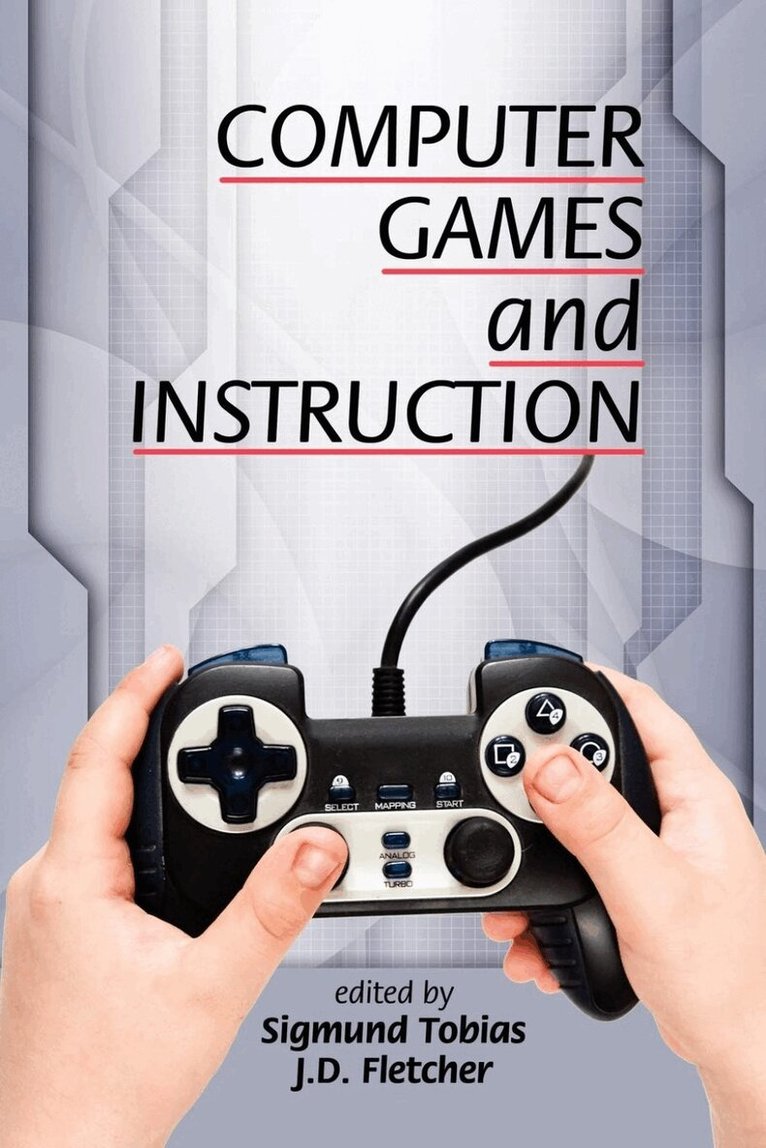
    Computer Games and Instruction

    AvSigmund Tobias,J. D. Fletcher

    Häftad, Engelska, 2011

    729 kr

    Beställningsvara. Skickas inom 5-8 vardagar. Fri frakt över 249 kr.

    Beskrivning

    There is intense interest in computer games. A total of 65 percent of all American households play computer games, and sales of such games increased 22.9 percent last year. The average amount of game playing time was found to be 13.2 hours per week. The popularity and market success of games is evident from both the increased earnings from games, over $7 Billion in 2005, and from the fact that over 200 academic institutions worldwide now offer game related programs of study.In view of the intense interest in computer games educators and trainers, in business, industry, the government, and the military would like to use computer games to improve the delivery of instruction. Computer Games and Instruction is intended for these educators and trainers. It reviews the research evidence supporting use of computer games, for instruction, and also reviews the history of games in general, in education, and by the military. In addition chapters examine gender differences in game use, and the implications of games for use by lower socio-economic students, for students’ reading, and for contemporary theories of instruction. Finally, well known scholars of games will respond to the evidence reviewed.

    Produktinformation

    • Utgivningsdatum:2011-03-23
    • Mått:156 x 234 x 29 mm
    • Vikt:782 g
    • Format:Häftad
    • Språk:Engelska
    • Antal sidor:564
    • Förlag:Emerald Publishing Inc
    • ISBN:9781617354083

    Utforska kategorier

    • Informationsteknik: allmänt inom Data och IT
    • Material och digital teknik i undervisningen inom Psykologi och pedagogik

    Innehållsförteckning

    • Preface.Section I. Introduction To Computer Games.Introduction; Sigmund Tobias and J. D. Fletcher.Chapter 1. Searching For the Fun in Learning: A Historical Perspective on the Evolution of Educational Video Games; Alex Games and Kurt D. Squire.Chapter 2. Using Video Games as Educational Tools in Healthcare; Janis A. Cannon-Bowers.Chapter 3. Cannon-Bowers; Clint Bowers and Katelyn Procci.Chapter 4. After the Revolution: Game-Informed Training in the U.S. Military; Ralph Ernest Chatham.Chapter 5. Multi-User Games and Learning: A Review of the Research; Jonathon Richter and Daniel Livingstone.Section II. Review Of The Literature And Reactions.Chapter 6. Review of Research on Computer Games; Sigmund Tobias, J. D. Fletcher, David Yun Dai, and Alexander P. Wind.Chapter 7. Reflections on Empirical Evidence on Games and Learning; James Paul Gee.Chapter 8. Developing a Research Agenda for Educational Games and Simulations; Chris Dede.Chapter 9. Comments on Research Comparing Games to Other Instructional Methods; Marc Prensky.Section III. Computer Game Issues.Chapter 10. Multimedia Learning and Games; Richard E. Mayer.Chapter 11. Action Game Play as a Tool to Enhance Perception, Attention and Cognition; Ashley F. Anderson and Daphne Bavelier.Chapter 12. Developing an Electronic Game for Vocabulary Learning: A Case Study; Michael L. Kamil and Cheryl Taitague.Chapter 13. Instructional Support in Games; Henny Leemkuil and Ton de Jong.Chapter 14. Implications of Constructivism for the Design and Use of Serious Games; Jamie R. Kirkley, Thomas M. Duffy, Sonny E. Kirkley, and Deborah L. Kremer.Chapter 15. Implications of Game Use for Explicit Instruction; Putai Jin and Renae Low.Chapter 16. Cost Analysis in Assessing Games for Learning; J. D. Fletcher.Chapter 17. Using Computer Games to Teach Adult Learners Problem Solving; Joan (Yuan-Chung) Lang and Harold F. O'Neil.Chapter 18. Gender and Gaming; Elisabeth R. Hayes.Chapter 19. Computer Games and Opportunity to Learn: Implications for Teaching Students from Low Socioeconomic Backgrounds; David Yun Dai and Alexander P. Wind.Section IV. Evaluation And Summing Up.Chapter 20. Stealth Assessment in Computer-Based Games to Support Learning; Valerie J. Shute.Chapter 21. Computer Games, Present and Future; Sigmund Tobias and J. D. Fletcher.Author Identification.