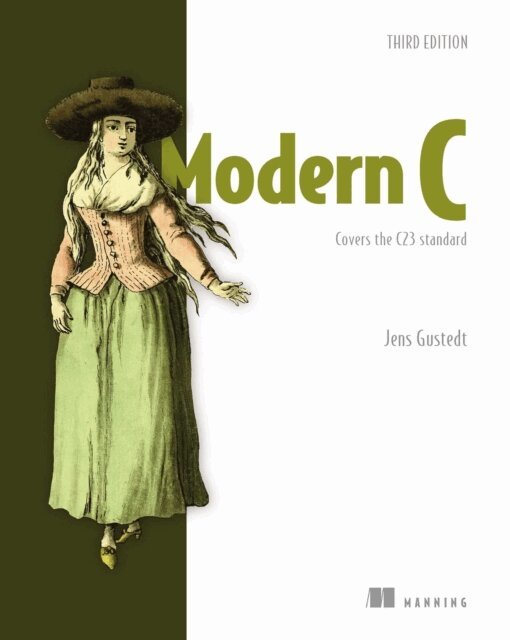
E-bok, Engelska, 2025
Modern C, Third Edition
Av Jens Gustedt
652 kr
Läs direkt i Bokus Reader – eller ladda ned till din enhet
Beskrivning
Discover the full power of modern C programming, with an inside look at the new C23 standard.For programs that need to be small, fast, and reliable, C is the gold standard. Whether youre writing embedded code, low-level system routines, or high-performance applications, C is up to the challenge. This unique book by Jens Gustedt, a member of the ISO C standards committee, gets you up to speed with C23.In Modern C, Third Edition youll:Learn C basics, core features, and advanced conceptsLeverage major C23 improvements for security, reliability, and performanceWrite portable code that runs anywhereBuild multi-threaded applications with atomics and synchronizationCreate robust and resilient software with error handlingUse type-generic programming for reusable codeIn Modern C, Third Edition youll learn to harness Cs full potential using the latest tools and techniques. After a quick review of the fundamentals suited for coders who havent used C in a while, this book guides you to mastery of C23, the latest ISO standard.About the TechnologyFrom code running on the smallest embedded devices to the low-level libraries behind popular programming languages like Python and Ruby, the software world depends on C. And even after 50 years, its still getting better! The new C23 standard adds improvements for security, reliability, and performance. In this thoroughly-revised new edition, author Jens Gustedt gives you an authoritative inside view.About the BookModern C, Third Edition is a fast-paced introduction to the C language, with special attention on its most modern features. It starts with a quick review of structure, grammar, and execution and then progresses quickly to control structures, data types, operators, and other core language features. Fully revised for C23, this expanded Third Edition covers compound expressions and lambdas, new insights into approaching program failure, and how to transition smoothly to C23.Whats InsideAll major C23 featuresPortable code that runs anywhereMulti-threaded applications with atomics and synchronizationUse type-generic programming for reusable codeAbout the ReadersFor readers with intermediate skills in any programming language.About the AuthorJens Gustedt is a senior scientist at the French National Institute for Computer Science and Control (INRIA), deputy director of the ICube lab in Strasbourg, France, and an active member of the ISO C standards committee.Table of ContentsLevel 0 Encounter1 Getting started2 The principal structure of a programLevel 1 Acquaintance3 Everything is about control4 Expressing computations5 Basic values and data6 Derived data types7 Functions8 C library functionsLevel 2 Cognition9 Style10 Organization and documentation11 Pointers12 The C memory model13 Storage14 More involved processing and I/O15 Program failureLevel 3 Experience16 Performance17 Function-like macros18 Type-generic programming19 Variations in control flow20 Threads21 Atomic access and memory consistencyA Transitional codeB C compilersC C librariesTakeaways
Produktinformation
- Utgivningsdatum: 2025-10-21
- Språk: Engelska
- Filformat: EPUB
- Kopieringsskydd: LCP
- ISBN: 9781638357711
- Förlag: Manning
Betyg & recensioner
0 recensioner
Inga recensioner tillgängliga.