• Fri frakt över 249 kr
  • •
  • Snabba leveranser
  • •
  • Billiga böcker
Kundservice

Du är på sajten för privatpersoner.

Företag, bibliotek eller offentlig verksamhet?

Du handlar på classic.bokus.com, där alla dina funktioner finns intakta.
Till classic.bokus.com
Bokus logotyp. Gå till startsidan.
  • Erbjudanden
  • Nyheter
  • Student
  • Topplistor
  • Barn & ungdom
  • Bokus Play
  • E-böcker
  • Pocketböcker
  • Spel & pussel

10% rabatt på allt med kod NYSTART10 →

Sidfot

Mina sidor

    Hjälp

    • Kundservice
    • Vanliga frågor och svar
    • Frakt och leverans
    • Retur vid ångerrätt
    • Reklamera vara
    • Betalning
    • Köpvillkor
    • Allmänna villkor
    • Information om webbplatsens tillgänglighet

    Om Bokus

    • Om oss
    • Pressrum
    • För studenter
    • För företag
    • För bibliotek och offentlig verksamhet
    • För leverantörer
    • Hållbarhet

    Populärt

    • Aktuella erbjudanden
    • Presentkort
    • Studentlitteratur
    • Nya böcker
    • Topplistor
    • Signerade böcker
    • Engelska böcker

    Inspiration

    • Boktips
    • BookTok
    • Populära bokserier
    • Barnbokskaraktärer
    • Populära författare
    Logotyp för Bokus
    Följ oss på Facebook (extern länk)Följ oss på Instagram (extern länk)Följ oss på YouTube (extern länk)Följ oss på TikTok (extern länk)
    bokus @ CookiesAnpassa cookiesIntegritetspolicyKöpvillkor
    Till Citymail hemsida (extern länk)Till Budbee hemsida (extern länk)Till Postnord hemsida (extern länk)Till Schenker hemsida (extern länk)Till Early Bird hemsida (extern länk)Till Walleys hemsida (extern länk)
    1. Psykologi och pedagogik
    2. Psykologi
    3. Psykologiska teorier och skolor

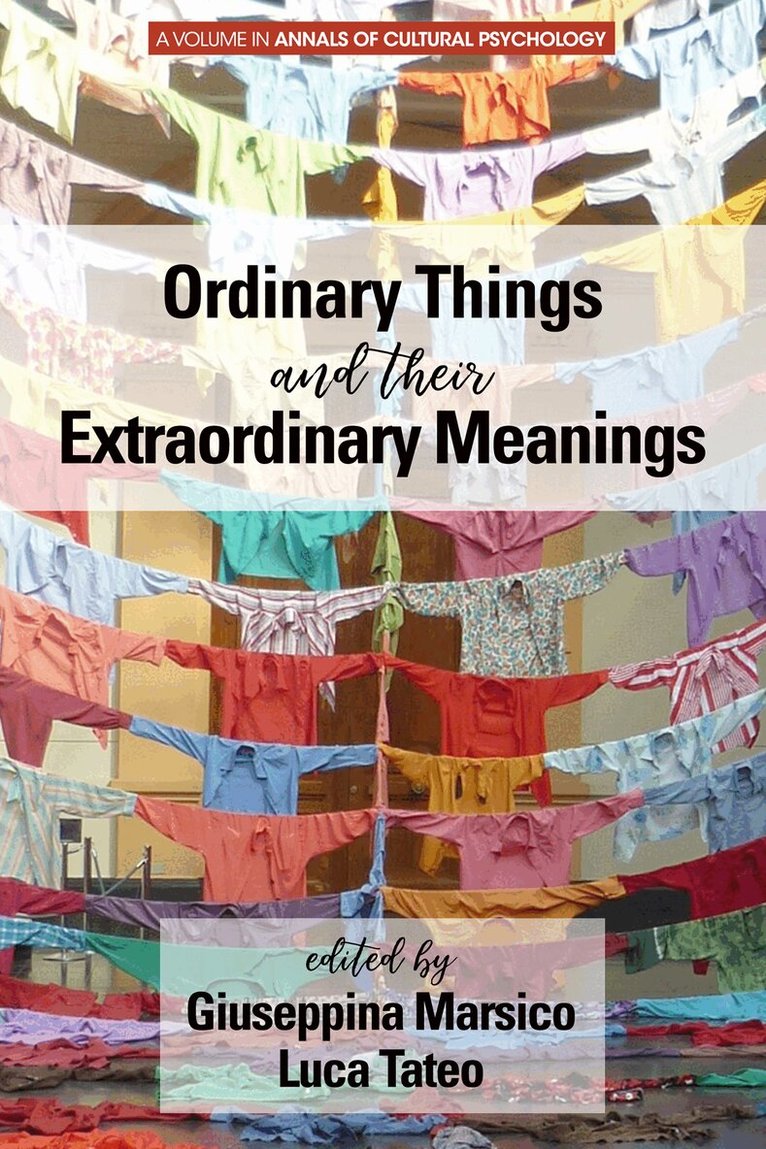
    Ordinary Things and Their Extraordinary Meanings

    AvGuiseppina Marsico,Luca Tateo

    Inbunden, Engelska, 2019

    Del i serien Annals of Cultural Psychology

    1 072 kr

    Beställningsvara. Skickas inom 5-8 vardagar. Fri frakt över 249 kr.

    Beskrivning

    The book provides a new look at the everyday relationship between psychological processes and extraordinary aspects of ordinary phenomena. Why should we deal with ordinary things? People’s life is made of everyday practical, taken-for-granted things, such as driving a car, using money, listening music, etc. When you drive from home to workplace, you are migrating between contexts. Is this an empty space you are crossing, or the time you spend into the car is something meaningful?In psychological terms, things have, at least, three levels of existence, a material, a symbolic and an affective one. The underlying idea is that the symbolic elaboration of everyday things is characterized by the transcendence of the particular object-sign, leading to the creation of more and more complex sign fields. These fields expand according to an inclusive logic up to dialogically and dialectically incorporate opposites (i.e. clean/dirty, transparent/opaque, hide/ show, join/divide, slow/fast, etc.). Even the meaning of “ordinary” and “extraordinary” follow such an inclusive logic: if you give a positive value to ordinary, extraordinary is rule-breaking; otherwise, if ordinary means trivial, extraordinary assumes a positive value. Besides, things are cultural artifacts mediating the experience of the world, the psychological processes and the construction of mind. Reflecting upon “things” is thus a more meaningful pathway to understand Psyche.

    Produktinformation

    • Utgivningsdatum:2019-05-29
    • Mått:156 x 234 x 19 mm
    • Vikt:623 g
    • Format:Inbunden
    • Språk:Engelska
    • Serie:Annals of Cultural Psychology
    • Antal sidor:318
    • Förlag:Emerald Publishing Inc
    • ISBN:9781641136839

    Utforska kategorier

    • Psykologiska teorier och skolor inom Psykologi och pedagogik

    Mer om författaren

    Giuseppina Marsico, University of Salerno, Italy. Luca Tateo, Aalborg University, Denmark

    Innehållsförteckning

    • Series Editors — Preface: How Can Things Be Ordinary?Introduction: Framing a Theory of Ordinary and Extraordinary in Cultural Psychology; Luca Tateo and Giuseppina Marsico.Chapter 1. On the Border for Hiding and Revealing: Dialogues Through Underwear; Jaan Valsiner.Chapter 2. The Magic of Holes; Achille C. Varzi.Chapter 3. The Pornographic Gaze and the Sense of Listening; Sven Hroar Klempe.Chapter 4. The Poetic Resonance of an Instant: Making Sense of Experience and Existence Through the Emotional Value of Encounters; Olga V. Lehmann.Chapter 5. Words and Numbers and Their Singular Multiplicity; Marco Tonti.Chapter 6. The Pen: How Cultural Objects Become Semiotically Impregnated; Ana Cecí­lia de Sousa Bastos and Maria Angélica Gonçalves Coutinho.Chapter 7. Lotteries, Betting, Coca-Cola, and Octopus Paul: The Extraordinary Side of the Ordinary; Sergio Salvatore.Chapter 8. Money for Ordinary Things—Clean or Dirty? Money: Ordinary Things but Deeply Culturally Embedded Phenomenon; Tatsuya Sato, Hideaki Kasuga, and Akinobu Nameda.Chapter 9. Clocks, Watch, or Something Else? Ruggero Andrisano Ruggieri and Claudia Venuleo.Chapter 10. Through the Looking Glass: Monitor and Display; Luca Tateo.Chapter 11. One Mirror, No Mirror, One Hundred Thousand Mirrors; Maria Virgí­nia Dazzani, Waldomiro Silva Filho, and José Carlos Ribeiro.Chapter 12. Why Is the Virgin Mary Not an Ordinary Mother? Finding Otherness and Selfness in the Sacred Triangle; Koji Komatsu.Chapter 13. What May We See From the Window or What a Window May Show to Us? Kirill S. Maslov.Chapter 14. The Balcony; Giuseppina Marsico.Chapter 15. A Discussion About Musical Instruments: Prostheses of Body, Prostheses of Culture: Objects or Processes; Raffaele De Luca Picione.About the Contributors.