• Fri frakt över 249 kr
  • •
  • Snabba leveranser
  • •
  • Billiga böcker
Kundservice

Du är på sajten för privatpersoner.

Företag, bibliotek eller offentlig verksamhet?

Du handlar på classic.bokus.com, där alla dina funktioner finns intakta.
Till classic.bokus.com
Bokus logotyp. Gå till startsidan.
  • Erbjudanden
  • Nyheter
  • Student
  • Topplistor
  • Barn & ungdom
  • Bokus Play
  • E-böcker
  • Pocketböcker
  • Spel & pussel

10% rabatt på allt med kod: NYSTART10 →

Sidfot

Mina sidor

    Hjälp

    • Kundservice
    • Vanliga frågor och svar
    • Frakt och leverans
    • Retur vid ångerrätt
    • Reklamera vara
    • Betalning
    • Köpvillkor
    • Allmänna villkor
    • Information om webbplatsens tillgänglighet

    Om Bokus

    • Om oss
    • Pressrum
    • För studenter
    • För företag
    • För bibliotek och offentlig verksamhet
    • För leverantörer
    • Hållbarhet

    Populärt

    • Aktuella erbjudanden
    • Presentkort
    • Studentlitteratur
    • Nya böcker
    • Topplistor
    • Signerade böcker
    • Engelska böcker

    Inspiration

    • Boktips
    • BookTok
    • Populära bokserier
    • Barnbokskaraktärer
    • Populära författare
    Logotyp för Bokus
    Följ oss på Facebook (extern länk)Följ oss på Instagram (extern länk)Följ oss på YouTube (extern länk)Följ oss på TikTok (extern länk)
    bokus @ CookiesAnpassa cookiesIntegritetspolicyKöpvillkor
    Till Citymail hemsida (extern länk)Till Budbee hemsida (extern länk)Till Postnord hemsida (extern länk)Till Schenker hemsida (extern länk)Till Early Bird hemsida (extern länk)Till Walleys hemsida (extern länk)
    1. Samhälle och politik
    2. Samhälle och kultur
    3. Kultur och medier
    4. Referensverk och tvärvetenskap

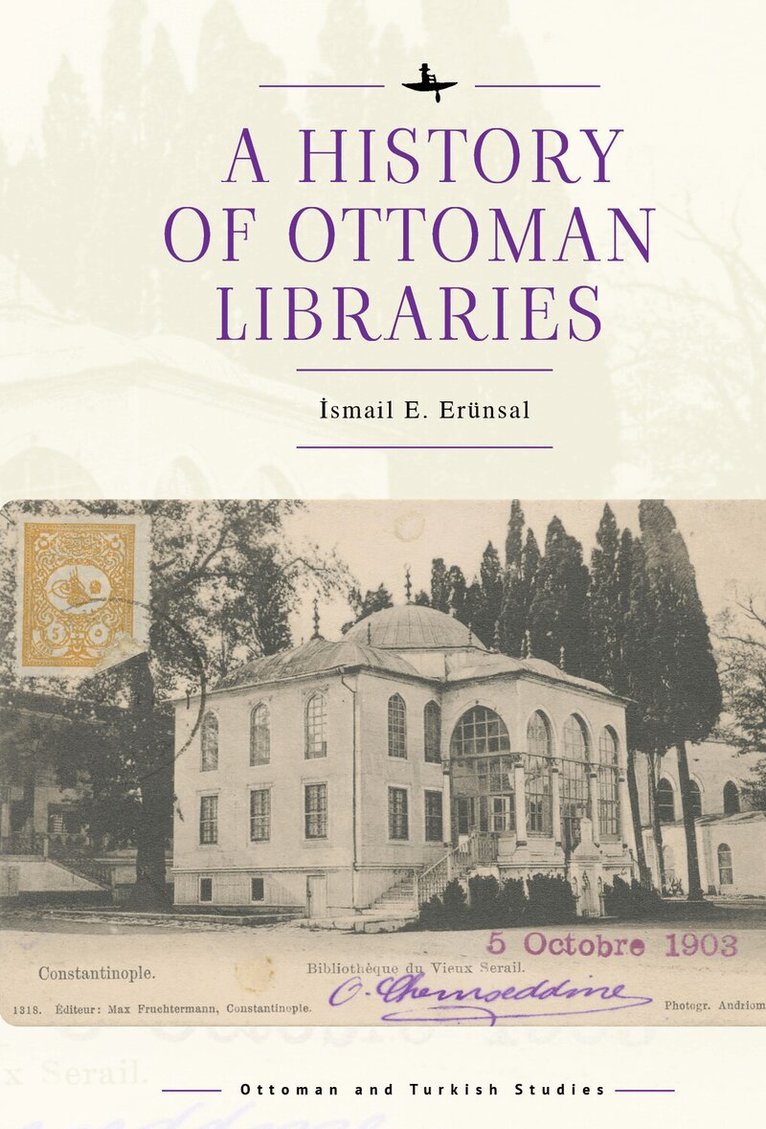
    History of Ottoman Libraries

    Avİsmail E. Erünsal

    Inbunden, Engelska, 2022

    Del i serien Ottoman and Turkish Studies

    1 561 kr

    Skickas . Fri frakt över 249 kr.

    Fler format och utgåvor

    E-bok

    2 479 kr

    E-bok

    1 967 kr

    Beskrivning

    A History of Ottoman Libraries tells the story of the development and the organization of Ottoman libraries from the fourteenth through the twentieth century. In the first part, the book surveys the phases through which the Ottoman libraries evolved from a few shelves of books to sizable, endowed collections housed in free-standing library buildings. Ottoman libraries were mainly established as charitable foundations, that is by endowing the books and steady income for the maintenance of the collection and the library building. The second part of the book focuses on the organization, the personnel, and the day-to-day functioning of Ottoman libraries. This first complete history of Ottoman libraries was written based on hitherto untapped archival sources.

    Produktinformation

    • Utgivningsdatum:2022-08-11
    • Mått:155 x 234 x 17 mm
    • Vikt:36 g
    • Format:Inbunden
    • Språk:Engelska
    • Serie:Ottoman and Turkish Studies
    • Antal sidor:280
    • Förlag:Academic Studies Press
    • ISBN:9781644698624

    Utforska kategorier

    • Referensverk och tvärvetenskap inom Samhälle och politik

    Mer om författaren

    İsmail Erünsal obtained his PhD from Edinburgh University in 1977. He taught at Istanbul University’s Department of Library Sciences, and later chaired the Department of Archival Studies of Marmara University from 1990 to 2006. Professor Erünsal has extensively published on the history of libraries, booksellers, and book culture in the Islamic world.

    Recensioner i media

    “А Нistory of Ottoman Libraries is based on meticulous research which covers а mind-boggling amount of archival documents from different institutions…It also has the great merit of nanking important scholarship in Turkish accessible to an English reading scholarly audience…[This book] is а systematic, well-researched, and carefully argued woгk that will, no doubt, become an extremely important reference work fог future reseaгch on topics pertaining to the Ottoman library system and to individual libraries. No comparable survey of the library system has been written to this day.”— Feras Krimsti, Gotha Reseaгch Libгary, University of Erfurt, Archivum Ottmanicum“A History of Ottoman Libraries is a timely addition to Ottoman intellectual history. Erünsal, who has published widely in Turkish on Ottoman libraries, noted the gap in Anglophone scholarship regarding this topic and duly assembled this book. … İsmail E. Erünsal's work has something to offer to all book lovers and historians alike with its comprehensive detailing of the institution of the Ottoman library.”— Gemma Masson, World History Encyclopedia“Surely a study that historians of Ottoman culture will refer to for many decades, this work impresses the reader by the broad documentation on libraries containing manuscripts germane to Islamic studies, which the author has investigated during a long and distinguished career. Prof. Erünsal has used a large number of pious/charitable foundation deeds made out by members of the Ottoman governing elite as well as by rich and public-spirited persons desiring to promote Islamic scholarship. His work thus clarifies how book collections until the later 1600s always were part of Islamic colleges, acquiring the manuscripts needed by their teachers and students. Even when eighteenth-century donors established independent libraries, these institutions often allowed for teaching, perhaps to a group of amateurs broader than the students and teachers benefiting from college libraries. After all, the latter were part of institutions, whose aim was to prepare students for careers as judges and teachers. Moreover, the author explains in a cogent fashion how in the nineteenth century, the dependence of Ottoman libraries on the conditions established by long-deceased founders made adaptation to the needs of a modernizing empire very difficult.In addition, Prof. Erünsal has cleared up misunderstandings that have bedeviled historians for a long time. In particular, twentieth-century scholars had often assumed that the order of the chief mufti serving Ahmed III (r. 1703-30), to the effect that texts concerning non-religious disciplines could not be part of foundation libraries and thus were liable to confiscation, was an expression of hostility against non-religious learning on the part of the Ottoman religious elite. By contrast, Prof. Erünsal has convincingly argued in favor of an ad hoc fatwa that the sultan demanded from a compliant chief mufti: a reminder that throughout history, powerful people might conjure up supposedly religious or cultural arguments so that they could satisfy their acquisitive instincts.”– Suraiya Faroqhi, Professor (Retired), Ludwig Maximilians Universität; Professor of History, Ibn Haldun University, Istanbul

    Innehållsförteckning

    • AcknowledgmentsIllustrationsNote on Transcription and DatesPrefaceIntroductionPart 1: Historical Development1. Early Ottoman Libraries (1299-1453)2. From College and Mosque Libraries to the Independent Library (1453-1650s)3. Independent and Large College Libraries (1650s–1730)4. The Expansion and Reorganization of the Ottoman Library System (1730-1839)5. Foundation Libraries in the Age of Reforms (1839-1922)Part 2: Organization6. Personnel7. The Establishment and Maintenance of Collections8. Catalogues and Cataloguing9. Services Offered10. Budgets and Audits11. Library Buildings and FurnishingConclusionBibliography