Handbook of Catholic Dogmatics, Book 6
The Realization of the Salvation Merited by Christ in Individual Human Beings Through the Justifying Grace of Christ
897 kr
Beställningsvara. Skickas inom 5-8 vardagar. Fri frakt över 249 kr.
Beskrivning
Produktinformation
- Utgivningsdatum:2023-12-30
- Mått:152 x 229 x undefined mm
- Vikt:1 022 g
- Format:Inbunden
- Språk:Engelska
- Serie:Handbook of Catholic Dogmatics
- Antal sidor:536
- Förlag:Emmaus Academic
- ISBN:9781645852391
- Översättare:Michael J. Miller
Utforska kategorier
Mer om författaren
Matthias Joseph Scheeben (1835-1888) was a German priest and scholar whose theology points to the inner coherence of the Christian faith and its supernatural mysteries. Notable in his own time, Scheeben later received praise from Pope Pius XI, who in 1935 encouraged study of the late theologian's works, reflecting: "The entire theology of Scheeben bears the stamp of a pious ascetical theology." Hans Urs von Balthasar credited Scheeben as "the greatest German theologian to date." Scheeben's works include Nature and Grace, The Mysteries of Christianity, and the unfinished Handbook of Catholic Dogmatics.
Recensioner i media
The culmination of his theological career, this volume of Matthias Scheeben's celebrated Handbook of Catholic Dogmatics is the most precise, most detailed, and most challenging in the master's corpus, superior—if one can believe it—even to his celebrated treatise on the Blessed Virgin Mary. In Scheeben's treatise on grace, one finds the harvest of almost fifteen hundred years of reflection on St. Augustine's doctrine, an enlightening history of the division between actual and habitual grace, searching etymological investigations of the full array of technical terms used in Scholastic debates, and the master's adjudication of controversies between Thomists, Molinists, Jansenists, and Reformers. Sympathetic to all—but beholden to none—Scheeben restores the properly patristic notion of delectatio to Catholic theology, exposes differences between the interpreters of St. Thomas Aquinas, and reformulates the basic questions of the de auxiliis controversy—all to the end of presenting his own theology of the dynamic-organic ordination of the will to God's grace. It is, quite simply, the greatest single treatise on grace in modern Catholic theology." - Trent Pomplun, University of Notre Dame"This volume completes Michael Miller's masterful translation of Scheeben's magnum opus, a triumph for Emmaus Academic. Scheeben's first published book was on the topic of nature and grace, and his Dogmatics comes to an end with this masterwork on grace, published shortly before his death. His entire life was a celebration of Christ's grace, given to us by the Holy Spirit. To understand how significant this witness is, consider the fact that Scheeben wrote during Bismarck's Kulturkampf, during which the seminaries in Germany were shut down and bishops were imprisoned. Bismarck's purpose was to tame the Catholic Church, which he considered backward and too Italian—all for the purpose of German nationalism. And Bismarck was supported by prominent Catholic university professors, among them the excommunicated but still extraordinarily influential prince of German Catholic historians Ignaz von Döllinger, who rejected Vatican I and who stood in many ways as a harbinger of the modernist rationalism that would dominate the early and late twentieth century in Catholic academia. In the midst of this fraught context, Scheeben undertakes a biblically grounded investigation of grace that demonstrates a mastery of the patristic, medieval, Reformation and post-Tridentine, and nineteenth-century discussions. Readers of this book will receive a profound education in the development and continuity of Catholic theology with respect to Christ the divine physician, to the economy of justification and salvation, to the distinctions within the order of grace, and to the greatest contributors to the theme, particularly after the Council of Trent. Recovering the wisdom and disagreements of the diverse Thomistic commentators, including the Jesuits (Molinists), the Dominicans (largely Bañezians), and the Carmelites would be theological education enough; and the massive works by Soto, Bellarmine, and Suarez find condensed expression here. But the scriptural, patristic, and sacramental depths of Scheeben's treatment are also striking and instructive, as are his controversies vis-a-vis Pelagius, Luther, Calvin, Baius, and Jansen, whose names evoke the lines beyond which Catholic theology of grace goes at its peril. In this book, too, one finds not only depth-soundings in justification and sanctification which need reclaiming today, but also Scheeben's own Jesuit-influenced grappling with the biblical mystery of predestination or election. This final volume of Scheeben's Dogmatics is a feast of faith, a tour de force of faith seeking understanding via the lights of Scripture and Tradition, guided by the Church's dogmatic teaching and controversies, as well as by the great theologians and saints from the Fathers onward. Like grace itself, this book comes to English-speaking theology as a gift and an illumination." - Matthew Levering, Mundelein Seminary"Grace, as a topic of systematic theology, has not attracted much attention among recent academic dogmatic and historical theologians. With the publication of this classic work, this lacuna has now been somewhat rectified, for it can now be the source for seminary and graduate courses, as well as an incentive for scholars to take up this important theological topic once again. Scheeben's masterful and creative study is well worth reading. His theological treatment of the doctrine of grace brings to the fore God's great love for humankind made manifest in Jesus Christ and consummated through the indwelling of the Holy Spirit." - Thomas G. Weinandy, OFM., Cap., Former Member of the Vatican's International Theological Commission
Innehållsförteckning
- ForewordBOOK SIX: The Realization of the Salvation Merited by Christ in Individual Human Beings through the Justifying Grace of ChristIntroduction and divisionCHAPTER ONE: The saving grace of Christ as principle of the reestablishment and perfecting of a holy and righteous life, or as grace that produces and supports life, or as healing and fortifying graceDefinition of the subject matter in generalOrientation about names, concept, and elements of actual grace or of aiding and assisting graceOrientation on names, concept, and elements of actual grace. Continuation. More precise definition concerning actual grace as an assisting energy or disposition of the soulOrientation concerning the name, concept, and elements of actual grace. Conclusion. Further definitions about the divine action on the soul that is at work in actual graceOrientation concerning the name and concept of actual grace. Conclusion. Correlation between actual grace as a disposition of the soul and as a divine action 99 Heresies and the dogma formulated against themPure PelagianismThe Semi-Pelagian error and the Catholic dogmaThe Reformation heresies of the 16th and 17th centuries and the Church’s dogma 211 The necessity of the grace of Christ in order to do good and to avoid sinThe true necessity of the grace of Christ as opposed to the illegitimate denial or restriction of it—1) first for fallen man absolutelyThe true necessity of actual grace in fallen man 2) after his rebirth for the activation and preservation of his supernatural life—first a) on account of its supernatural character 267Necessity of actual grace in the reborn. Continuation. b) The reason for it: the residual weakness of human natureNecessity of grace in those who are reborn. Conclusion. c) The necessity of it for final perseverance in the state of gracea. Appendix 1 to §§292–295: The teaching of the Fathers of the Church and particularly of St. Augustine about the necessity and significance of grace in the original state, and the fundamental patristic principles prominent in that teachingb. Appendix 2 to §§293–295. The so-called seven gifts of the Holy Ghost as means for promoting the life of graceII. The limits to the necessity of the grace of Christ with regard to its exaggeration by the Reformers and Jansenists. 1) The alleged necessity of charity for all non-sinful actions. The position of charity in the organization of the commandments and virtues. The commandment to refer works to God. “Caritas” in Augustine’s writingsThe limits to the necessity of grace. Continuation.2) The alleged necessity of the grace of theological faith. The various forms of fides as the general rule of moral actionThe limits of the necessity of grace. Conclusion.3) The necessity of grace generally in order to avoid sinfulness in all volition and action or in order to produce any moral goodness of action. The opinion of the Church Fathers on the dependence of all good on supernatural graceSelected BibliographyScripture IndexSubject and Persons Index
Mer från samma författare
Manual of Catholic Theology; Based on Scheeben's "Dogmatik,"; Volume 2
Matthias Joseph Scheeben, Joseph Wilhelm, Thomas Bartholomew Scannell
Inbunden, 2022
475 kr
Manual of Catholic Theology; Based on Scheeben's "Dogmatik,"; Volume 2
Matthias Joseph Scheeben, Joseph Wilhelm, Thomas Bartholomew Scannell
Häftad, 2022
363 kr
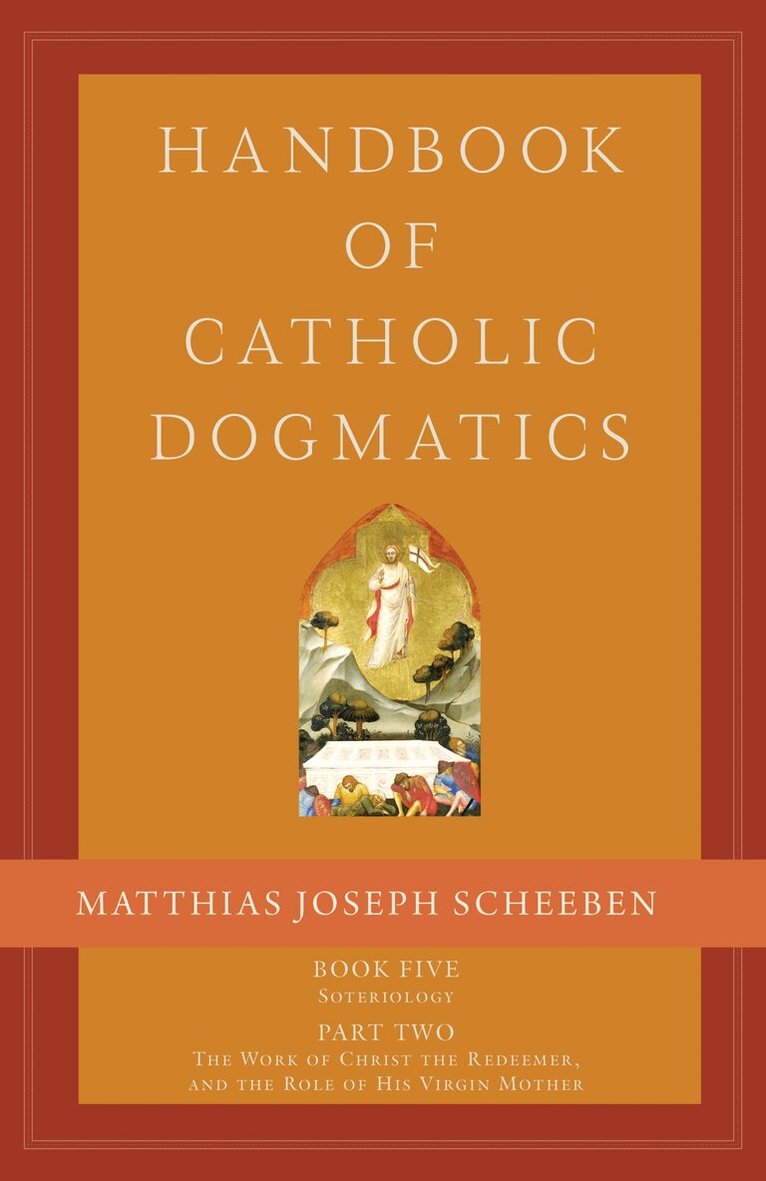
Manual of Catholic Theology; Based on Scheeben's "Dogmatik"; Volume I
Matthias Joseph Scheeben, Joseph Wilhelm, Thomas Bartholomew Scannell
Inbunden, 2022
475 kr
Manual of Catholic Theology; Based on Scheeben's "Dogmatik"; Volume I
Matthias Joseph Scheeben, Joseph Wilhelm, Thomas Bartholomew Scannell
Häftad, 2022
359 kr
Manual Of Catholic Theology
Matthias Joseph Scheeben, Joseph Wilhelm, Thomas Bartholomew Scannell
Inbunden, 2022
475 kr
Manual Of Catholic Theology
Matthias Joseph Scheeben, Joseph Wilhelm, Thomas Bartholomew Scannell
Häftad, 2022
363 kr