• Fri frakt över 249 kr
  • •
  • Snabba leveranser
  • •
  • Billiga böcker
Kundservice

Du är på sajten för privatpersoner.

Företag, bibliotek eller offentlig verksamhet?

Du handlar på classic.bokus.com, där alla dina funktioner finns intakta.
Till classic.bokus.com
Bokus logotyp. Gå till startsidan.
  • Erbjudanden
  • Nyheter
  • Student
  • Topplistor
  • Barn & ungdom
  • Bokus Play
  • E-böcker
  • Pocketböcker
  • Spel & pussel

10% rabatt på allt med kod: NYSTART10 →

Sidfot

Mina sidor

    Hjälp

    • Kundservice
    • Vanliga frågor och svar
    • Frakt och leverans
    • Retur vid ångerrätt
    • Reklamera vara
    • Betalning
    • Köpvillkor
    • Allmänna villkor
    • Information om webbplatsens tillgänglighet

    Om Bokus

    • Om oss
    • Pressrum
    • För studenter
    • För företag
    • För bibliotek och offentlig verksamhet
    • För leverantörer
    • Hållbarhet

    Populärt

    • Aktuella erbjudanden
    • Presentkort
    • Studentlitteratur
    • Nya böcker
    • Topplistor
    • Signerade böcker
    • Engelska böcker

    Inspiration

    • Boktips
    • BookTok
    • Populära bokserier
    • Barnbokskaraktärer
    • Populära författare
    Logotyp för Bokus
    Följ oss på Facebook (extern länk)Följ oss på Instagram (extern länk)Följ oss på YouTube (extern länk)Följ oss på TikTok (extern länk)
    bokus @ CookiesAnpassa cookiesIntegritetspolicyKöpvillkor
    Till Citymail hemsida (extern länk)Till Budbee hemsida (extern länk)Till Postnord hemsida (extern länk)Till Schenker hemsida (extern länk)Till Early Bird hemsida (extern länk)Till Walleys hemsida (extern länk)
    1. Medicin
    2. Andra medicinska specialiteter
    3. Klinisk psykologi

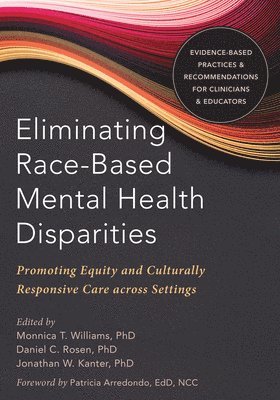
    Eliminating Race-Based Mental Health Disparities

    Promoting Equity and Culturally Responsive Care Across Settings

    AvMonnica Williams,Monnica T. Williams

    Häftad, Engelska, 2019

    816 kr

    Beställningsvara. Skickas inom 5-8 vardagar. Fri frakt över 249 kr.

    Beskrivning

    Eliminating Race-Based Mental Health Disparities offers concrete guidelines and evidence-based best practices for addressing racial inequities and biases in clinical care.Perhaps there is no subject more challenging than the intricacies of race and racism in American culture. More and more, it has become clear that simply teaching facts about cultural differences between racial and ethnic groups is not adequate to achieve cultural competence in clinical care. One must also consider less "visible" constructs-including implicit bias, stereotypes, white privilege, intersectionality, and microaggressions-as potent drivers of behaviours and attitudes.In this edited volume, three leading experts in race, mental health, and contextual behaviour science explore the urgent problem of racial inequities and biases, which often prevent people of color from seeking mental health services-leading to poor outcomes if and when they do receive treatment. In this much-needed resource, you'll find evidence-based recommendations for addressing problems at multiple levels, and best practices for compassionately and effectively helping clients across a range of cultural groups and settings.As more and more people gain access to services that have historically been unavailable to them, guidelines for cultural competence in clinical care are needed. Eliminating Race-Based Mental Health Disparities offers a comprehensive road map to help you address racial health disparities and improve treatment outcomes in your practice.

    Produktinformation

    • Utgivningsdatum:2019-12-26
    • Mått:178 x 252 x 24 mm
    • Vikt:659 g
    • Format:Häftad
    • Språk:Engelska
    • Antal sidor:384
    • Förlag:New Harbinger Publications
    • ISBN:9781684031962

    Utforska kategorier

    • Klinisk psykologi inom Medicin
    • Psykisk hälsovård inom Medicin
    • Etnicitet inom Samhälle och politik

    Mer om författaren

    Monnica T. Williams, PhD, ABPP, is a board-certified clinical psychologist and associate professor at the University of Connecticut in the Department of Psychological Sciences, with a joint appointment Psychiatry. She completed her undergraduate studies at MIT (biotechnology) and UCLA (psychology). She received her master's and doctoral degrees from the University of Virginia, where she conducted research in the areas of major mental illness, tests and measurement, and ethnic differences. Her clinical work and research focus on African American mental health, culture, trauma, and OCD. She serves on the scientific advisory board of the International OCD Foundation, the editorial board of several scientific journals, and is currently an associate editor of The Behavior Therapist and New Ideas in Psychology. Williams has published over 100 peer-reviewed articles and book chapters, focused on psychopathology and cultural differences. She gives diversity trainings nationally. Her work has been featured in several major media outlets, including NPR, CNN, and the New York Times.Daniel C. Rosen, PhD, is chair and associate professor in the department of counseling and health psychology at Bastyr University, and founding codirector of The Daniel K. Church Center for Social Justice & Diversity. He earned a PhD in counseling psychology from Arizona State University after completing his predoctoral internship at the Center for Multicultural Training in Psychology at Boston Medical Center/Boston University School of Medicine. He completed his postdoctoral fellowship in the Behavioral Medicine Program at Cambridge Health Alliance/Harvard Medical School. Rosen's scholarship is focused in multicultural psychology, and has explored issues of social justice in mental health, addressing disparities in access to and quality of mental health services, and antisemitism-related stress. He has a private practice in Seattle, WA.Jonathan Kanter, PhD, received his doctorate in clinical psychology from the University of Washington in 2002, and then moved to the University of Wisconsin-Milwaukee where he spent several years collaborating closely with members of the Black, Latinx and Muslim communities on issues of social and political activism (including police brutality and voter rights), racism and discrimination, and culturally appropriate treatments of depression. In 2013, Kanter came to the University of Washington to direct the Center for the Science of Social Connection (CSSC), where he approaches projects with a contextual behavioral science model that integrates disciplines, including evolution science, neuroscience, anthropology and psychology, within a behavioral science foundation. Kanter is regularly invited to give talks and workshops nationally and internationally on topics of interest to the Center, including anti-racism workshops, workshops for therapists on how to improve psychotherapy relationships and help clients with relational problems, and culturally tailored behavioral treatments for depression.