• Fri frakt över 249 kr
  • •
  • Snabba leveranser
  • •
  • Billiga böcker
Kundservice

Du är på sajten för privatpersoner.

Företag, bibliotek eller offentlig verksamhet?

Du handlar på classic.bokus.com, där alla dina funktioner finns intakta.
Till classic.bokus.com
Bokus logotyp. Gå till startsidan.
  • Erbjudanden
  • Nyheter
  • Student
  • Topplistor
  • Barn & ungdom
  • Bokus Play
  • E-böcker
  • Pocketböcker
  • Spel & pussel

10% rabatt på allt med kod: NYSTART10 →

Sidfot

Mina sidor

    Hjälp

    • Kundservice
    • Vanliga frågor och svar
    • Frakt och leverans
    • Retur vid ångerrätt
    • Reklamera vara
    • Betalning
    • Köpvillkor
    • Allmänna villkor
    • Information om webbplatsens tillgänglighet

    Om Bokus

    • Om oss
    • Pressrum
    • För studenter
    • För företag
    • För bibliotek och offentlig verksamhet
    • För leverantörer
    • Hållbarhet

    Populärt

    • Aktuella erbjudanden
    • Presentkort
    • Studentlitteratur
    • Nya böcker
    • Topplistor
    • Signerade böcker
    • Engelska böcker

    Inspiration

    • Boktips
    • BookTok
    • Populära bokserier
    • Barnbokskaraktärer
    • Populära författare
    Logotyp för Bokus
    Följ oss på Facebook (extern länk)Följ oss på Instagram (extern länk)Följ oss på YouTube (extern länk)Följ oss på TikTok (extern länk)
    bokus @ CookiesAnpassa cookiesIntegritetspolicyKöpvillkor
    Till Citymail hemsida (extern länk)Till Budbee hemsida (extern länk)Till Postnord hemsida (extern länk)Till Schenker hemsida (extern länk)Till Early Bird hemsida (extern länk)Till Walleys hemsida (extern länk)
    1. Skönlitteratur
    2. Litteraturvetenskap

    Aesthetics of Kinship

    Form and Family in the Long Eighteenth Century

    AvHeidi Schlipphacke

    Inbunden, Engelska, 2023

    1 959 kr

    Beställningsvara. Skickas inom 5-8 vardagar. Fri frakt över 249 kr.

    Fler format och utgåvor

    Häftad

    543 kr

    Beskrivning

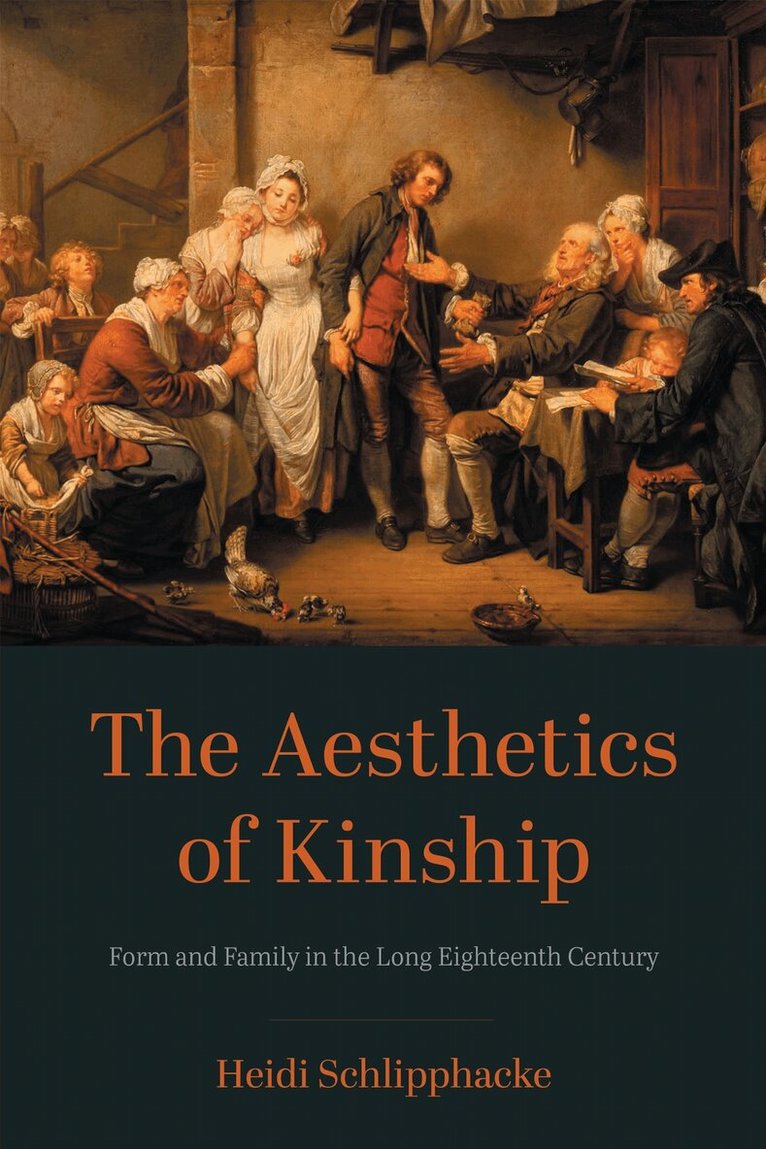
    The Aesthetics of Kinship intervenes critically into rigidified discourses about the emergence of the nuclear family and the corresponding interior subject in the eighteenth century. By focusing on kinship constellations instead of "family plots" in seminal literary works of the period, this book presents an alternative view of the eighteenth-century literary social world and its concomitant ideologies. Whereas Enlightenment and post-Enlightenment philosophy and political theory posit the nuclear family as a microcosm for the ideal modern nation-state, literature of the period offers a far more heterogeneous image of kinship structures, one that includes members of various classes and is not defined by blood. Through a radical re-reading of the multifarious kinship structures represented in literature of the long eighteenth century, The Aesthetics of Kinship questions the inevitability of the dialectic of the Enlightenment and invokes alternative futures for conceptions of social and political life.

    Produktinformation

    • Utgivningsdatum:2023-01-13
    • Mått:152 x 229 x 28 mm
    • Vikt:485 g
    • Format:Inbunden
    • Språk:Engelska
    • Antal sidor:354
    • Förlag:Bucknell University Press,U.S.
    • ISBN:9781684484546

    Utforska kategorier

    • Litteraturvetenskap inom Skönlitteratur
    • Litteraturvetenskap inom Skönlitteratur
    • Filosofiska discipliner inom Filosofi och religion

    Mer om författaren

    HEIDI SCHLIPPHACKE is a professor of Germanic studies at the University of Illinois, Chicago. Her research explores the intersections of aesthetics, gender, sexuality, and social forms in the European Enlightenment and in post-WWII German-language literature, thought, and film. She is the author of Nostalgia After Nazism: History, Home, and Affect in German and Austrian Literature and Film (Bucknell University Press).

    Recensioner i media

    "The Aesthetics of Kinship provides a thoroughly new understanding of how German authors, including major ones like Lessing, Schiller, and Goethe, used tableaux, props, and letters to highlight multiple types of family kinships that depict heterogeneous social groupings that highlight diversity, and that defy any narrow definition of 'family.'"— Susan Gustafson, author of Goethe's Families of the Heart"An incisive rethinking of a widely naturalized construction of the bourgeois nuclear family and its representation in the long eighteenth century."— Lessing Yearbook/Jahrbuch"Schlipphacke demonstrates an active curiosity and adept intellect as she analyzes literary forms (such as unconventional endings and halted narrative progression) as challenges to the inward-focused, nuclear family as it begins to unfold into the nineteenth century. Rare is the scholar who links the study of social relations to aesthetics."— Alice Kuzniar, author of The Birth of Homeopathy out of the Spirit of Romanticism"Historically significant and extremely timely! Schlipphacke's fascinating turn to the period tableaux compellingly illustrates aesthetic experiments with diverse forms of relations, fruitfully challenging accounts of the rise of the nuclear family."— Stefani Engelstein, author of Sibling Action: The Genealogical Structure of Modernity"Schlipphacke's focus on dramatic tableaux and tableaux vivants, gesture, and props offers genuinely new ways of understanding the ways in which dramas and novels from around 1750 to 1820 depict—and, in depicting, imagine, suggest, and experiment with—affective ties that are not limited to the strictly biological."— Monatshefte"Schlipphacke's smart style brings the eighteenth-century tableau into vivid life. This wonderfully learned study expands our understanding of the eighteenth-century tableau beyond its immediate theatrical and painterly associations to show how it reframed models of family and kinship. Challenging the long standing presumption that the Bildungsroman coalesced around the nuclear family, Schlipphacke illuminates the tableau's elastic depiction of porous social relations across an array of genres and media. Her queer, allegorical sensibility draws our attention away from the hermeneutic depths of the Romantic nuclear family onto the tableau's surface alignments. The Aesthetics of Kinship brilliantly condenses eighteenth-century theories of spectatorship, theater, and the novel."— Daniel Purdy, author of On the Ruins of Babel: Architectural Metaphor in German Thought"The Aesthetics of Kinship is a challenging but rewarding study. It forces the reader to reconsider assumptions about the rise of the nuclear family in early-modern Europe. It also provides valuable tools for analyzing visual and ekphrastic elements of literature."— New Perspectives on the Eighteenth Century"[A] thoroughly innovative and convincing analysis of the significance and uniqueness of the tableau in German dramas and literature during the Enlightenment and Classical periods."— Oxford German Studies"Schlipphacke brilliantly deconstructs the divisions between interiority and exteriority, mimetic and allegorical art forms, and kinship and the nuclear family in the literature of the long eighteenth century in a way that reveals the haziness of forms of thought, aesthetics, and sociality in transition and enables us to see the queer constellations of elective social affinities at the center of eighteenth-century German literature. She provides a model for identifying and removing the blinders of ideology to seriously reconsider the sometimes more radical and certainly more complex politics of social formation and identity in the eighteenth century that we have overlooked."— German Studies Review

    Innehållsförteckning

    • List of IllustrationsList of AbbreviationsIntroduction1          Middle Class/Bourgeois/Bürger: The Idiosyncrasies of German Dramatic Realism2          Tableau/Tableau Vivant: German-French Dramatic Encounters3          The German Dramatic Tableau beyond Lessing4          Against Interiority: Letters and Portraits as Dramatic Props5          Material Kinship: The Economy of Props in G.E. Lessing's Nathan der Weise6          The Tableau of Relations: Novels in Stillness and Motion7          Kinship and Aesthetic Depth: The Tableau Vivant in Goethe's Wahlverwandtschaften [Elective Affinities]Concluding ReflectionsAcknowledgmentsBibliographyIndex