• Fri frakt över 249 kr
  • •
  • Snabba leveranser
  • •
  • Billiga böcker
Kundservice

Du är på sajten för privatpersoner.

Företag, bibliotek eller offentlig verksamhet?

Du handlar på classic.bokus.com, där alla dina funktioner finns intakta.
Till classic.bokus.com
Bokus logotyp. Gå till startsidan.
  • Erbjudanden
  • Nyheter
  • Student
  • Topplistor
  • Barn & ungdom
  • Bokus Play
  • E-böcker
  • Pocketböcker
  • Spel & pussel

10% rabatt på allt med kod: NYSTART10 →

Sidfot

Mina sidor

    Hjälp

    • Kundservice
    • Vanliga frågor och svar
    • Frakt och leverans
    • Retur vid ångerrätt
    • Reklamera vara
    • Betalning
    • Köpvillkor
    • Allmänna villkor
    • Information om webbplatsens tillgänglighet

    Om Bokus

    • Om oss
    • Pressrum
    • För studenter
    • För företag
    • För bibliotek och offentlig verksamhet
    • För leverantörer
    • Hållbarhet

    Populärt

    • Aktuella erbjudanden
    • Presentkort
    • Studentlitteratur
    • Nya böcker
    • Topplistor
    • Signerade böcker
    • Engelska böcker

    Inspiration

    • Boktips
    • BookTok
    • Populära bokserier
    • Barnbokskaraktärer
    • Populära författare
    Logotyp för Bokus
    Följ oss på Facebook (extern länk)Följ oss på Instagram (extern länk)Följ oss på YouTube (extern länk)Följ oss på TikTok (extern länk)
    bokus @ CookiesAnpassa cookiesIntegritetspolicyKöpvillkor
    Till Citymail hemsida (extern länk)Till Budbee hemsida (extern länk)Till Postnord hemsida (extern länk)Till Schenker hemsida (extern länk)Till Early Bird hemsida (extern länk)Till Walleys hemsida (extern länk)
    1. Naturvetenskap och teknik
    2. Matematik och naturvetenskap
    3. Fysik
    4. Klassisk mekanik

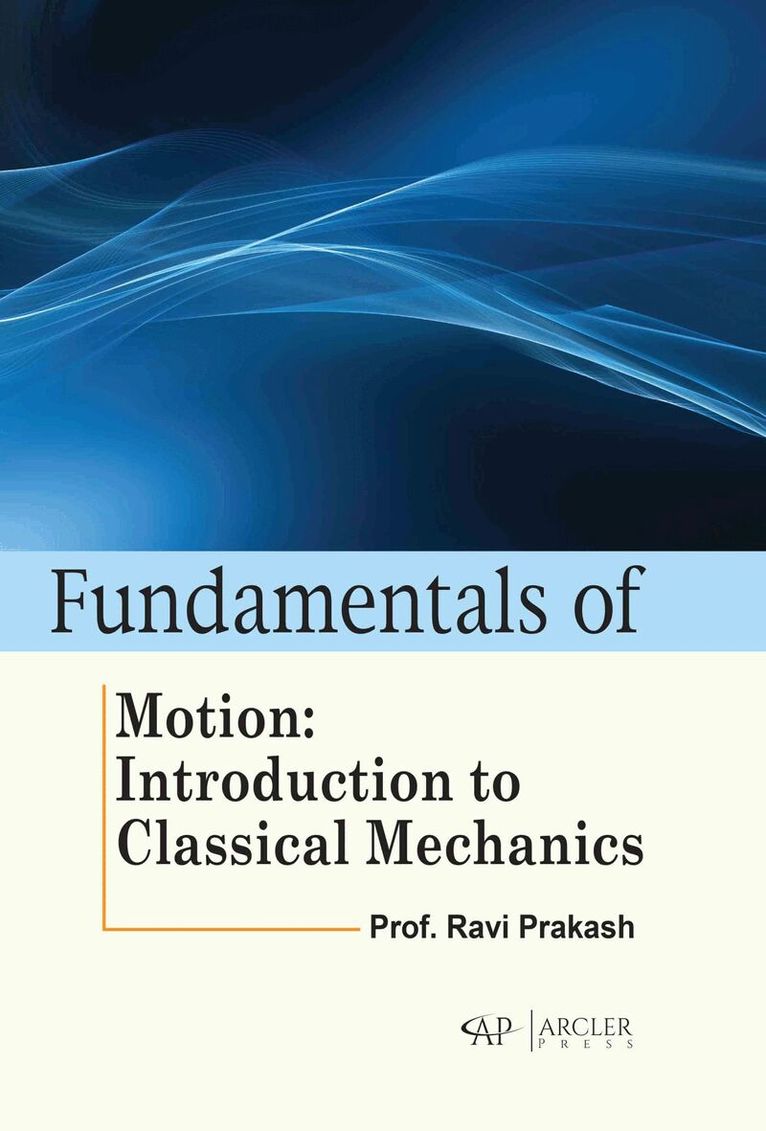
    Fundamentals of Motion

    Introduction to Classical Mechanics

    AvRavi Prakash

    Inbunden, Engelska, 2024

    1 977 kr

    Beställningsvara. Skickas inom 5-8 vardagar. Fri frakt över 249 kr.

    Beskrivning

    Classical Mechanics, a branch of physics that addresses the motion of macroscopic objects, is founded upon fundamental principles that govern the behavior of physical bodies. Central to this are Newton's three laws of motion. The first law, or the law of inertia, posits that an object will remain in a state of rest or uniform motion unless acted upon by an external force. The second law provides a mathematical description of how the velocity of an object changes when it is subjected to an external force, and is often expressed as F=ma, where F is the total force, m is the object's mass, and a is its acceleration. The third law, the principle of action and reaction, asserts that for every action, there is an equal and opposite reaction. These laws have been instrumental in the development of various disciplines such as engineering and astronomy and remain applicable to most physical systems, except when dealing with phenomena at extremely small scales or relativistic speeds. The Fundamentals of Motion: Introduction to Classical Mechanics is an essential textbook that provides a thorough examination of the principles underlying the motion of macroscopic objects. Designed for students, educators, and professionals in physics and engineering, this book delves into the core concepts of Classical Mechanics, including Newton's laws of motion, conservation of momentum and energy, dynamics, kinematics, and rotational motion. It offers a systematic approach to understanding fundamental theories and mathematical formulations, coupled with illustrative examples and practical exercises. This textbook also incorporates discussions on the historical development and philosophical aspects of Classical Mechanics, the limitations of the classical view in the face of relativistic and quantum phenomena, and emerging connections to other areas of physics. With its methodical exposition and clear insights, Fundamentals of Motion: Introduction to Classical Mechanics serves as an indispensable guide for those seeking to understand the intricate workings of physical laws that govern our world, equipping readers with the knowledge and tools to explore the underlying nature of motion and mechanics.

    Produktinformation

    • Utgivningsdatum:2024-03-31
    • Mått:152 x 229 x 27 mm
    • Vikt:664 g
    • Format:Inbunden
    • Språk:Engelska
    • Antal sidor:323
    • Förlag:Arcler Press
    • ISBN:9781774699379

    Utforska kategorier

    • Klassisk mekanik inom Naturvetenskap och teknik

    Mer om författaren

    Prof. Ravi Prakash is working as an assisastant Professor in Electronics and Communication Engineering Uma Nath Singh Institute of Engineering and Technology Veer Bahadur Singh Purvanchal University Jaunpur, Uttar Pradesh, India. He was born on January 19, 1975, in Jaunpur, U.P., India. He received the B. Tech. degree in Electronics and Telecommunication Engineering from University of Allahabad, Allahabad, U.P., India in 1997, and M. Tech. degree in Electronics Engineering (Communication Technology) from University of Allahabad, Allahabad, U. P., 2001. He is gold medalist at his graduation level and rank holder in board examination. He has almost 21 years teaching experience at B. Tech., M. Tech. and Ph.D. level in engineering. He had worked as head of department of Electronics Engineering at Veer Bahadur Singh Purvanchal University Jaunpur for almost ten years. He received the Ph.D. degree in Electronics and Communication Engineering from University of Allahabad, U.P., India. His current research interests include Communication Technology. He has published several research articles in reputed international journals related to wireless, optical and digital communication. He has worked as several research and reviewer committee member, and he has excellent work in the field of digital communication, wireless and mobile communication. He had worked as Nodal officer, academic in the Technical Education Quality Improvement Program (TEQIP) supported by World Bank at university level.

    Innehållsförteckning

    • Chapter 1 Introduction to Classical MechanicsChapter 2 Kinematics: Describing MotionChapter 3 Dynamics: Forces and MotionChapter 4 Work, Energy, and PowerChapter 5 Momentum and Impulse and CollisionChapter 6 Rotational MotionChapter 7 Oscillation Simple Harmonic MotionChapter 8 Universal Gravitation and Planetary Motion