• Fri frakt över 249 kr
  • •
  • Snabba leveranser
  • •
  • Billiga böcker
Kundservice

Du är på sajten för privatpersoner.

Företag, bibliotek eller offentlig verksamhet?

Du handlar på classic.bokus.com, där alla dina funktioner finns intakta.
Till classic.bokus.com
Bokus logotyp. Gå till startsidan.
  • Erbjudanden
  • Nyheter
  • Student
  • Topplistor
  • Barn & ungdom
  • Bokus Play
  • E-böcker
  • Pocketböcker
  • Spel & pussel

10% rabatt på allt med kod NYSTART10 →

Sidfot

Mina sidor

    Hjälp

    • Kundservice
    • Vanliga frågor och svar
    • Frakt och leverans
    • Retur vid ångerrätt
    • Reklamera vara
    • Betalning
    • Köpvillkor
    • Allmänna villkor
    • Information om webbplatsens tillgänglighet

    Om Bokus

    • Om oss
    • Pressrum
    • För studenter
    • För företag
    • För bibliotek och offentlig verksamhet
    • För leverantörer
    • Hållbarhet

    Populärt

    • Aktuella erbjudanden
    • Presentkort
    • Studentlitteratur
    • Nya böcker
    • Topplistor
    • Signerade böcker
    • Engelska böcker

    Inspiration

    • Boktips
    • BookTok
    • Populära bokserier
    • Barnbokskaraktärer
    • Populära författare
    Logotyp för Bokus
    Följ oss på Facebook (extern länk)Följ oss på Instagram (extern länk)Följ oss på YouTube (extern länk)Följ oss på TikTok (extern länk)
    bokus @ CookiesAnpassa cookiesIntegritetspolicyKöpvillkor
    Till Citymail hemsida (extern länk)Till Budbee hemsida (extern länk)Till Postnord hemsida (extern länk)Till Schenker hemsida (extern länk)Till Early Bird hemsida (extern länk)Till Walleys hemsida (extern länk)
    1. Data och IT
    2. Systemvetenskap och AI

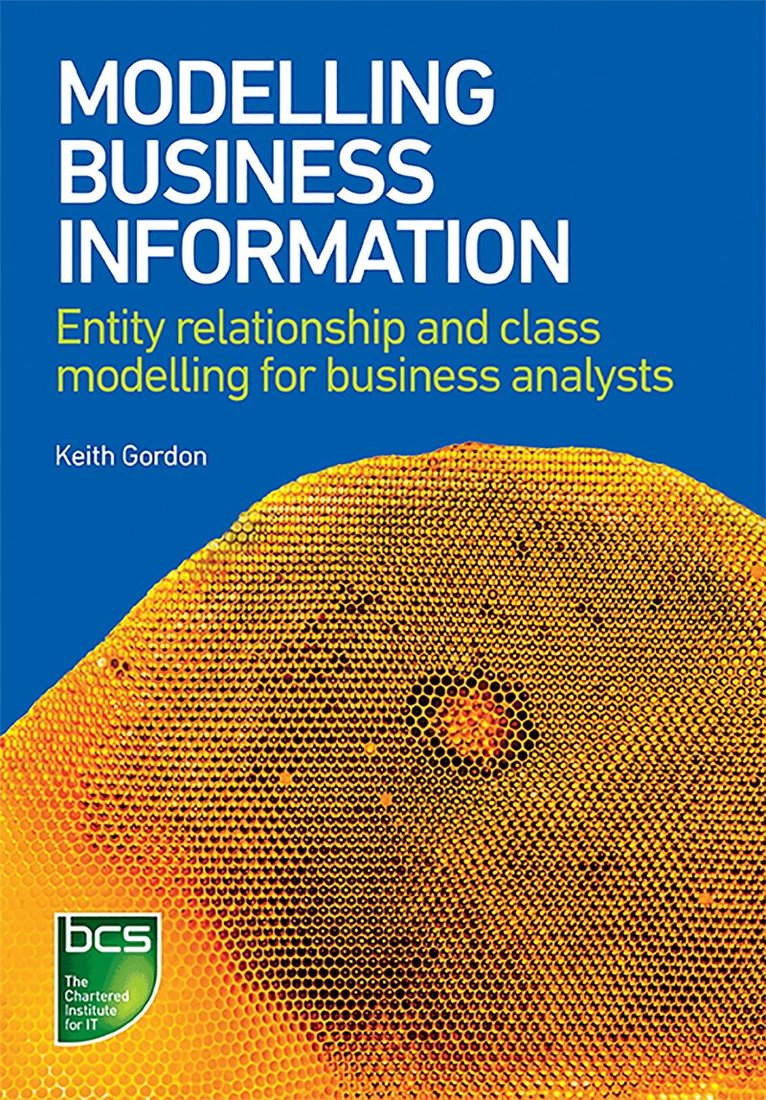
    Modelling Business Information

    Entity relationship and class modelling for Business Analysts

    AvKeith Gordon

    Häftad, Engelska, 2017

    514 kr

    Beställningsvara. Skickas inom 5-8 vardagar. Fri frakt över 249 kr.

    Fler format och utgåvor

    E-bok

    514 kr

    E-bok

    512 kr

    Beskrivning

    It is almost universally accepted that requirements documents for new or enhanced IT systems by business analysts should include a ‘data model’ to represent the information that has to be handled by the system. Starting from first principles, this book will help business analysts to develop the skills required to construct data models through comprehensive coverage of entity relationship and class modelling, in line with, and beyond, the BCS Data Analysis syllabus.

    Produktinformation

    • Utgivningsdatum:2017-08-25
    • Mått:170 x 244 x 11 mm
    • Vikt:370 g
    • Format:Häftad
    • Språk:Engelska
    • Antal sidor:202
    • Förlag:BCS Learning & Development Limited
    • ISBN:9781780173535

    Utforska kategorier

    • Systemvetenskap och AI inom Data och IT
    • Databaser inom Data och IT

    Mer om författaren

    Keith Gordon is an independent consultant and lecturer specialising in data management and business analysis. He has spent over 50 years in technical, education and training environments as an engineer, computer consultant, data manager, business analyst, education and training manager.

    Recensioner i media

    '“Modelling Business Information” by Keith Gordon, is aimed at those who are new to business analysis or information modelling. Keith draws on a wealth of experience in information management, both as a practitioner, and as a lecturer with the Open University in his writing.The first six chapters provide an accessible and clear foundation in the topic covering the reasons for developing information models, the basic elements of entity-relationship diagrams, how to develop an information model from basic information requirements, and finally how to normalise existing data. I particularly like that it uses two graphical notations, the Barker-Ellis notation, noted for its readability, and the ubiquitous Unified Modelling Language notation, which helps to demonstrate that there are different notations that entity-relationship models can be developed in. This first part of the book also takes care to cover the syllabus for the Data Analysis certificate that is part of the scheme for the BCS Advanced International Diploma in Business Analysis.The second part of the book covers a range of more advanced topics from naming conventions and yet more entity-relationship model notations, to considerations of quality in information models, corporate data models, modelling for business intelligence applications, and finally goes on to look at data and database topics including an overview of SQL, and moving to database design and optimisation.Overall, the book provides an excellent grounding in the full range of topics related to information modelling.'

    Innehållsförteckning

    • IntroductionPart 1: The BasicsChapter 1: Why business analysts should model information Chapter 2: Modelling the things of interest to the business and the relationships between themChapter 3: Modelling more complex relationships  Chapter 4: Drawing and validating data model diagrams Chapter 5: Recording information about things Chapter 6: Rationalising data using normalisation Part 2: Supplementary MaterialChapter 7: Other modelling notationsChapter 8: The naming of artefacts on information modelsChapter 9: Information model qualityChapter 10: Corporate information and data modelsChapter 11: Data and databasesChapter 12: Business intelligenceChapter 13: Advances in SQL (or why business analysts should not be in the weeds)Chapter 14: Taking a requirements information model into database designAppendix A: Table of equivalencesAppendix B: BibliographyAppendix C: Solutions to the exercises