• Fri frakt över 249 kr
  • •
  • Snabba leveranser
  • •
  • Billiga böcker
Kundservice

Du är på sajten för privatpersoner.

Företag, bibliotek eller offentlig verksamhet?

Du handlar på classic.bokus.com, där alla dina funktioner finns intakta.
Till classic.bokus.com
Bokus logotyp. Gå till startsidan.
  • Erbjudanden
  • Nyheter
  • Student
  • Topplistor
  • Barn & ungdom
  • Bokus Play
  • E-böcker
  • Pocketböcker
  • Spel & pussel

10% rabatt på allt med kod: NYSTART10 →

Sidfot

Mina sidor

    Hjälp

    • Kundservice
    • Vanliga frågor och svar
    • Frakt och leverans
    • Retur vid ångerrätt
    • Reklamera vara
    • Betalning
    • Köpvillkor
    • Allmänna villkor
    • Information om webbplatsens tillgänglighet

    Om Bokus

    • Om oss
    • Pressrum
    • För studenter
    • För företag
    • För bibliotek och offentlig verksamhet
    • För leverantörer
    • Hållbarhet

    Populärt

    • Aktuella erbjudanden
    • Presentkort
    • Studentlitteratur
    • Nya böcker
    • Topplistor
    • Signerade böcker
    • Engelska böcker

    Inspiration

    • Boktips
    • BookTok
    • Populära bokserier
    • Barnbokskaraktärer
    • Populära författare
    Logotyp för Bokus
    Följ oss på Facebook (extern länk)Följ oss på Instagram (extern länk)Följ oss på YouTube (extern länk)Följ oss på TikTok (extern länk)
    bokus @ CookiesAnpassa cookiesIntegritetspolicyKöpvillkor
    Till Citymail hemsida (extern länk)Till Budbee hemsida (extern länk)Till Postnord hemsida (extern länk)Till Schenker hemsida (extern länk)Till Early Bird hemsida (extern länk)Till Walleys hemsida (extern länk)
    1. Samhälle och politik
    2. Samhälle och kultur
    3. Kultur och medier
    4. Referensverk och tvärvetenskap

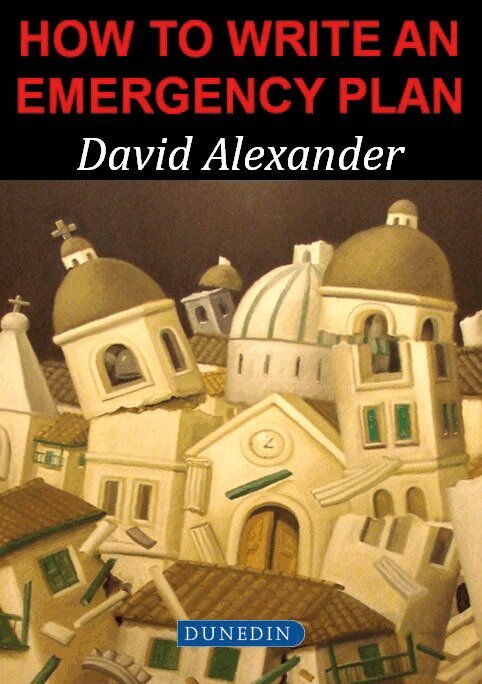
    How to Write an Emergency Plan

    AvDavid E. Alexander

    Häftad, Engelska, 2016

    641 kr

    Beställningsvara. Skickas inom 5-8 vardagar. Fri frakt över 249 kr.

    Beskrivning

    The world is becoming more hazardous as natural and social processes combine to create complex situations of increased vulnerability and risk. There is increasing recognition that this trend is creating exigencies that must be dealt with. The common approach is to delegate the task of preparing an emergency plan to someone. Often that person is expected to get on with job but rarely is the means and instruction of how to write such a plan provided to them. There are a host of instances in which the letter of the law, not the spirit, is honoured by providing a token plan of little validity.David Alexander provides, in this book, the assistance needed to write an emergency plan. It is a practical ‘how to’ manual and guide aimed at managers in business, civil protection officers, civil security officials, civil defence commanders, neighbourhood leaders and disaster managers who have been tasked with writing, reviewing or preparing emergency plans for all kinds of emergency, disaster or catastrophe. He takes the reader through the process of writing an emergency plan, step by step, starting with the rationale and context, before moving on through the stages of writing and activating a basic, generic emergency plan and concludes with information on specific kinds of plan, for example, for hospitals and cultural heritage sites.This practical guide also provides a core for postgraduate training in emergency management and has been written in such a way that it is not tied to the legal constraints of any particular jurisdiction.

    Produktinformation

    • Utgivningsdatum:2016-06-02
    • Mått:156 x 234 x 21 mm
    • Vikt:444 g
    • Format:Häftad
    • Språk:Engelska
    • Antal sidor:268
    • Förlag:Liverpool University Press
    • ISBN:9781780460130

    Utforska kategorier

    • Referensverk och tvärvetenskap inom Samhälle och politik
    • Sociala och etiska frågor inom Samhälle och politik

    Mer om författaren

    David Alexander is Professor of Risk and Disaster Reduction at University College London. He is also Visiting Professor at the Universities of Bournemouth and Northumbria (UK), Affiliated Professor at the University of Lund (Sweden) and Research Fellow at the Global Risk Forum GRF Davos (Switzerland). Professor Alexander is Vice-President of the Institute of Civil Protection and Emergency Management and Editor-in-Chief of the International Journal of Disaster Risk Reduction.

    Recensioner i media

    'In his third related publication, How to Write an Emergency Plan, David Alexander once again provides an engaging and principles-based book, suitable for the novice and experienced emergency, disaster or crisis practitioner…In this book, Alexander not only considers the range of traditional circumstances, scenarios and hazard types (or sources) including natural hazards (fire and flood, for example) but extends to those that are less frequent, yet increasingly appearing on the risk profiles of governments. These include critical infrastructure failure, animal emergency diseases and human (public) health emergencies. In doing so, the book underlines the importance of acknowledging that while a type or classification of emergency, disaster and crisis may yield some common characteristics or indicate a consistent response, they are each different or unique and should be treated as such.Pleasingly, How to Write an Emergency Plan explores the contemporary process of identifying lessons and their translation to recommendations and practice. The value of a lessons-management approach cannot be underestimated and should feature as a component of all emergency, disaster or crisis management systems, plans and arrangements.Not satisfied with delivering a useful resource for an emergency, disaster or crisis planner, in his conclusion, Alexander looks forward and provides the reader with an insight as to how the role of a planner may be perceived under a variety of more than probable scenarios.I congratulate David Alexander on producing an very valuable resource and commend its reading to those with an emerging or established emergency, disaster or crisis planning role.'Australian Journal of Emergency Management‘Alexander’s (2016) newest book, How to Write an Emergency Plan, provides readers with practical advice about emergency planning. In this regard, the content of the book is as much about planning processes as it is about the content and structure of an emergency plan. This new book expands on Alexander’s previous work on the subject of emergency planning…While Alexander is a Professor of Risk and Disaster Reduction at University of College London and a distinguished academic, his newest book is written for a lay audience and is intended to function as a guide for anyone, anywhere, who has a responsibility for emergency planning. The book is generally jargon free and key terms are defined and topics are properly introduced, making the book valuable for those without formal education or training relating to emergency management. While the book draws from both research and practice knowledge about emergency planning, the book is written in a conversational style with limited references to academic literature…Throughout the book, Alexander presents principles of practice that apply to emergency planning regardless of the context. The principles provide a concise summary of generic rules that should inform emergency planning. An example of a principle offered in the Introduction chapter is, “emergency planning is about helping to create a common language and culture, and common objectives, for the organizations and people who respond to emergencies” (Alexander, 2016, p. 7). Most but not all sections in the book offer one or more principles that help to summarize and reinforce key best practices.Overall, the book provides considerable guidance related to developing and writing an emergency plan. While noting that context matters and explaining how it matters (e.g., local hazards, legislation), Alexander’s approach to how to develop and write an emergency plan is for the most part, context-independent. Further, while the book recognizes mandated responsibility for emergency planning by civil authorities, the idea of emergency management as being a distributed function within society, with other entities (e.g., industry, schools) also having responsibility for emergency planning is acknowledged. In this regard, there is good value in Alexander’s newest book for a broad audience who have interest in or responsibility for emergency planning.’Recovery Diva, May 2017

    Innehållsförteckning

    • Contents: Foreword. 1. Introduction. Scope and objectives of this book; 2. What are emergencies? 3. What is an emergency plan? 4. The emergency planning process; 5. First step: background research; 6. Second step: scenario building; 7. Third Step: from scenarios to actions; 8. A note on the structure of the plan; 9. Fourth step: using the plan; 10. Planning to maintain the continuity of normal activities; 11. Specialized emergency planning; 12. Conclusion: the future of emergency planning. Afterword. Appendix 1: Glossary of working definitions by key terms. Appendix 2: Bibliography of selected references. Index.