• Fri frakt över 249 kr
  • •
  • Snabba leveranser
  • •
  • Billiga böcker
Kundservice

Du är på sajten för privatpersoner.

Företag, bibliotek eller offentlig verksamhet?

Du handlar på classic.bokus.com, där alla dina funktioner finns intakta.
Till classic.bokus.com
Bokus logotyp. Gå till startsidan.
  • Erbjudanden
  • Nyheter
  • Student
  • Topplistor
  • Barn & ungdom
  • Bokus Play
  • E-böcker
  • Pocketböcker
  • Spel & pussel

10% rabatt på allt med kod: NYSTART10 →

Sidfot

Mina sidor

    Hjälp

    • Kundservice
    • Vanliga frågor och svar
    • Frakt och leverans
    • Retur vid ångerrätt
    • Reklamera vara
    • Betalning
    • Köpvillkor
    • Allmänna villkor
    • Information om webbplatsens tillgänglighet

    Om Bokus

    • Om oss
    • Pressrum
    • För studenter
    • För företag
    • För bibliotek och offentlig verksamhet
    • För leverantörer
    • Hållbarhet

    Populärt

    • Aktuella erbjudanden
    • Presentkort
    • Studentlitteratur
    • Nya böcker
    • Topplistor
    • Signerade böcker
    • Engelska böcker

    Inspiration

    • Boktips
    • BookTok
    • Populära bokserier
    • Barnbokskaraktärer
    • Populära författare
    Logotyp för Bokus
    Följ oss på Facebook (extern länk)Följ oss på Instagram (extern länk)Följ oss på YouTube (extern länk)Följ oss på TikTok (extern länk)
    bokus @ CookiesAnpassa cookiesIntegritetspolicyKöpvillkor
    Till Citymail hemsida (extern länk)Till Budbee hemsida (extern länk)Till Postnord hemsida (extern länk)Till Schenker hemsida (extern länk)Till Early Bird hemsida (extern länk)Till Walleys hemsida (extern länk)
    1. Juridik
    2. Internationell rätt
    3. Folkrätt

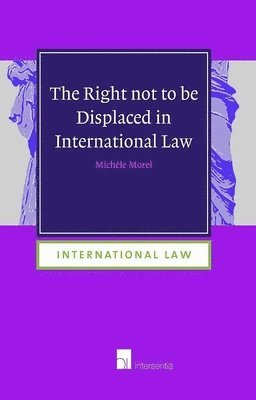
    Right Not to be Displaced in International Law

    AvMichele Morel

    Inbunden, Engelska, 2014

    Del 13 i serien International Law

    1 031 kr

    Tillfälligt slut

    Beskrivning

    Every year, millions of people worldwide are forced to leave their homes and become displaced due to a variety of causes. This book explores the role of international human rights law in protecting people against involuntary displacement. It does so with reference to the idea of a 'human right not to be displaced'.

    Produktinformation

    • Utgivningsdatum:2014-03-10
    • Mått:163 x 246 x 28 mm
    • Vikt:746 g
    • Format:Inbunden
    • Språk:Engelska
    • Serie:International Law
    • Antal sidor:554
    • Förlag:Intersentia Ltd
    • ISBN:9781780682051

    Utforska kategorier

    • Folkrätt inom Juridik

    Mer om författaren

    Dr. Michele Morel currently works at the Legal Department of Caritas International as jurist in the field of asylum and migration law. Her main focus is on the detention of asylum seekers and undocumented migrants. Dr. Morel obtained her doctoral degree in 2012 from Ghent University, Faculty of Law, Belgium.

    Recensioner i media

    'Michele Morel must be commended for applying for the first time a comprehensive analytical framework to a wide array of explicit and implicit prohibitions of displacement in international law showing that the 'right not to be displaced' can and should be constructed as an effective human right. She does so with great rigour, displaying not only a remarkable command of human rights doctrine, but also, and above all, a genuine commitment to the cause of the millions of displaced persons in today's world. This is a most welcome contribution to scholarship on internal displacement, and a testimony to the evocative power of international law.' Prof. Walter Kalin, former Representative of the UN Secretary General on the human rights of internally displaced persons

    Innehållsförteckning

    • Acknowledg Table of cases and other mat Table of treaties and other inst Abbrevi Chapter 1. Introduction 1. Objective of the book 1.1. Overall objective of the book 1.2. Basic premises of the book 1.3. Academic and societal contribution of the book 1.4. Added value of the book compared with existing literature 2. Research questions forming the structure of the book 3. Methodology and sources 3.1. Methodology of and sources for the research 3.2. Sources of international (human rights) law 4. Scope and limitations Chapter 2. The Displacement Phenomenon 1. Defining displacement 1.1. A myriad of terms 1.2. Displacement as overarching notion 1.3. Causes of displacement 1.4. Impact of displacement 1.5. Displacement figures 2. Displacement as a human rights issue 2.1. The international response to displacement 2.2. Rights-based approach to displacement 2.2.1. Human rights violations leading to displacement 2.2.2. Human rights violations following displacement 2.2.3. Displacement as a human rights violation The Right not to be Displaced in Internatio Chapter 3. The Emergence of New Human Rights 1. The proliferation of rights 1.1. Human rights law since the Second World War 1.2. Three generations of human rights 1.3. On the nature of human rights 1.4. The proliferation of human rights: defects and merits 2. The formation of human rights 3. The desirability of new human rights: eligibility criteria Chapter 4. The Current Status of the Right not to be Displaced in International Law 1. Introduction 2. Protection standards with limited scope of application 2.1. Introduction 2.2. Protection from conflict-induced displacement 2.2.1. Displacement in international armed conflict 2.2.2. Displacement in internal armed conflict 2.3. Protection from persecution-induced displacement 2.4. Protection from development-induced displacement 2.5. Protection from disaster-induced displacement 2.6. Protection from expulsion 2.6.1. Expulsion of nationals 2.6.2. Expulsion of lawfully residing aliens 2.6.3. Expulsion of lawfully residing stateless persons 2.6.4. Expulsion of migrant workers and their family members 2.6.5. Collective expulsion 2.6.6. Expulsion to risk of persecution 2.6.7. Expulsion to risk of torture or cruel, inhuman or degrading treatment or punishment 2.6.8. Expulsion to risk of execution 2.6.9. Expulsion to risk of enforced disappearance 2.6.10. Exile 2.6.11. Deportation in armed conflict 2.7. Protection from displacement for indigenous people 2.8. Protection from internal displacement 2.9. Protection from 'forced eviction' 2.10. Other protection standards 2.10.1. Population transfer and the implantation of settlers 2.10.2. Customary norm prohibiting arbitrary forced relocation 2.11. International criminal responsibility for displacement 2.11.1. Displacement as crime of genocide 2.11.2. Displacement as crime against humanity 2.11.3. Displacement as war crime Inte C 2.12. Conclusion 3. Explicit recognition of the right not to be displaced 3.1. The Guiding Principles on Internal Displacement 3.2. The Kampala Convention 3.3. The Pinheiro Principles 3.4. Reflections and conclusions 4. Protection from displacement deriving from other human rights 4.1. Introduction 4.2. The freedom of movement and residence 4.2.1. Introduction 4.2.2. International and regional human rights instruments 4.2.2.1. The International Covenant on Civil and Political Rights 4.2.2.2. Regional human rights instruments 4.2.3. (Quasi-)judicial decisions 4.2.3.1. Case law overview 4.2.3.2. Case law-based conclusions and clarifications 4.2.4. General conclusion 4.3. The right to respect for private life 4.3.1. Introduction 4.3.2. International and regional human rights instruments 4.3.2.1. The International Covenant on Civil and Political Rights and the International Covenant on Economic, Social and Cultural Rights 4.3.2.2. Regional human rights instruments 4.3.3. (Quasi-)judicial decisions 4.3.3.1. Home searches: Human Rights Committee 4.3.3.2. Massive evictions and home destruction 4.3.3.3. Evictions and Travellers: European Court of Human Rights 4.3.3.4. Evictions and procedural safeguards: European Court of Human Rights 4.3.3.5. Evictions and alternative housing: European Court of Human Rights 4.3.3.6. Deportations 4.3.4. Conclusion 4.4. The right to property 4.4.1. Introduction 4.4.2. Regional human rights instruments 4.4.3. (Quasi-)judicial decisions 4.4.3.1. Home destruction 4.4.3.2. Land and house expropriations: European Court of Human Rights The Right not to be Displaced in Internatio 4.4.3.3. Indigenous land rights 4.4.3.4. Some other cases 4.4.4. Conclusion 4.5. The right to housing 4.5.1. Introduction 4.5.2. International and regional human rights instruments 4.5.2.1. The International Covenant on Economic, Social and Cultural Rights 4.5.2.2. Regional human rights instruments 4.5.3. (Quasi-)judicial decisions 4.5.3.1. African Commission on Human and Peoples' Rights 4.5.3.2. European Committee of Social Rights 4.5.4. Conclusion 4.6. Other human rights 4.7. Conclusion 5. Customary norm on the prohibition of displacement? 6. Conclusion Chapter 5. The Future of the Right not to be Displaced 1. Desirability of the right not to be displaced 2. Solidifying the right not to be displaced 2.1. Terminology 2.2. Formal recognition 2.2.1. General 2.2.2. Recent examples of formal recognition 2.2.3. Some reflections 2.3. Clarification of the content 2.3.1. Content overview 2.3.2. Scope of application 2.3.2.1. Personal scope of application 2.3.2.2. Substantive scope of application 2.3.2.3. Territorial scope of application 2.3.2.4. Temporal scope of application 2.3.3. Rights and obligations 2.3.3.1. Rights holders and duty bearers 2.3.3.2. Types of obligations 2.3.3.3. Obligations relating to protection from displacement 2.3.3.4. Obligations relating to protection during displacement 2.3.3.5. Obligations relating to protection aft er displacement xii Intersentia C 2.3.4. Conditions for lawful interference 2.3.4.1. Legality of interference 2.3.4.2. Legitimacy of interference 2.3.4.2. Necessity and proportionality of interference 2.3.4.4. Preview of legal provision 2.4. Implementation and enforcement Chapter 6. Conclusion Bibliography