• Fri frakt över 249 kr
  • •
  • Snabba leveranser
  • •
  • Billiga böcker
Kundservice

Du är på sajten för privatpersoner.

Företag, bibliotek eller offentlig verksamhet?

Du handlar på classic.bokus.com, där alla dina funktioner finns intakta.
Till classic.bokus.com
Bokus logotyp. Gå till startsidan.
  • Erbjudanden
  • Nyheter
  • Student
  • Topplistor
  • Barn & ungdom
  • Bokus Play
  • E-böcker
  • Pocketböcker
  • Spel & pussel

10% studentrabatt med kod TERM26

Sidfot

Mina sidor

    Hjälp

    • Kundservice
    • Vanliga frågor och svar
    • Frakt och leverans
    • Retur vid ångerrätt
    • Reklamera vara
    • Betalning
    • Köpvillkor
    • Allmänna villkor
    • Information om webbplatsens tillgänglighet

    Om Bokus

    • Om oss
    • Pressrum
    • För studenter
    • För företag
    • För bibliotek och offentlig verksamhet
    • För leverantörer
    • Hållbarhet

    Populärt

    • Aktuella erbjudanden
    • Presentkort
    • Studentlitteratur
    • Nya böcker
    • Topplistor
    • Signerade böcker
    • Engelska böcker

    Inspiration

    • Boktips
    • BookTok
    • Populära bokserier
    • Barnbokskaraktärer
    • Populära författare
    Logotyp för Bokus
    Följ oss på Facebook (extern länk)Följ oss på Instagram (extern länk)Följ oss på YouTube (extern länk)Följ oss på TikTok (extern länk)
    bokus @ CookiesAnpassa cookiesIntegritetspolicyKöpvillkor
    Till Citymail hemsida (extern länk)Till Budbee hemsida (extern länk)Till Postnord hemsida (extern länk)Till Schenker hemsida (extern länk)Till Early Bird hemsida (extern länk)Till Walleys hemsida (extern länk)
    1. Juridik
    2. Internationell rätt
    3. Folkrätt

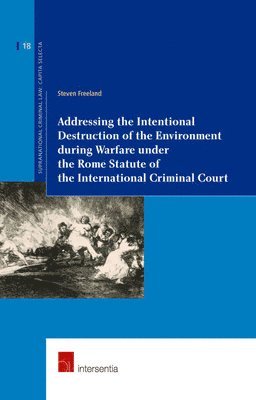
    Addressing the Intentional Destruction of the Environment during Warfare under the Rome Statute of the International Criminal Court

    AvSteven Freeland

    Häftad, Engelska, 2015

    Del 18 i serien Supranational Criminal Law

    1 044 kr

    Beställningsvara. Skickas inom 5-8 vardagar. Fri frakt över 249 kr.

    Beskrivning

    Acts perpetrated during the course of warfare have, through the ages, led to significant environmental destruction. These have included situations where the natural environment has intentionally been targeted as a 'victim', or has somehow been manipulated to serve as a 'weapon' of warfare. Until recently, such acts were generally regarded as an unfortunate but unavoidable element of armed conflict, despite their potentially disastrous impacts. The existing international rules have largely been ineffective and inappropriate, and have in practical terms done little to deter deliberate environmental destruction, particularly when measured against perceived military advantages. However, as the significance of the environment has come to be more widely understood and recognised, this is no longer acceptable, particularly given the ongoing development of weapons capable of widespread and significant damage. This book therefore examines the current international legal regime relevant to the intentional destruction of the environment during warfare, and argues that such acts should, in appropriate circumstances, be recognised as an international crime and should be subject to more effective rules giving rise to international criminal responsibility. It also suggests a framework within the Rome Statute of the International Criminal Court as to how this might be achieved.

    Produktinformation

    • Utgivningsdatum:2015-06-10
    • Mått:160 x 240 x 2 mm
    • Vikt:570 g
    • Format:Häftad
    • Språk:Engelska
    • Serie:Supranational Criminal Law
    • Antal sidor:354
    • Förlag:Intersentia Ltd
    • ISBN:9781780683140

    Utforska kategorier

    • Folkrätt inom Juridik

    Mer om författaren

    Steven Freeland is Emeritus Professor of International Law at Western Sydney University, where he was previously Dean of the School of Law, and Professorial Fellow at Bond University. He also holds Visiting or Adjunct positions at various other Universities/Institutes in Copenhagen, Vienna, Toulouse, Hong Kong, Montreal, Kuala Lumpur and London. Prior to becoming an academic, he had a 20-year career as an international commercial lawyer and an investment banker. He is a Member of the Advisory Group of the Australian Space Agency and has been an advisor to the Australian, New Zealand, Norwegian and several other Governments on issues relating to national space legislative frameworks and policy. He has represented the Australian Government at the Committee on the Peaceful Uses of Outer Space (UNCOPUOS) and has also been appointed by UNCOPUOS to co-chair multilateral discussions on the exploration, exploitation and utilisation of space resources. He has also been a Visiting Professional within the Appeals Chamber at the International Criminal Court, and a Special Advisor to the Danish Foreign Ministry in matters related to the International Criminal Court. He is a Co-Principal of specialised space law firm Azimuth Advisory and also a Director of the International Institute of Space Law, and a Member of the Space Law Committee of the International Law Association and of the Space Law and War Crimes Committees of the International Bar Association. In addition to co-Editing the Annotated Leading Cases of International Criminal Tribunals book series, he also sits on the Editorial Board / Advisory Board of a number of internationally recognised academic journals

    Innehållsförteckning

    • CONTENTSIntroductionChapter One: The Imperative to Regulate the Intentional Destruction of the Environment during Warfare under International Criminal Law 1.1. Introduction - Intentional Environmental Destruction as a Part of Warfare 1.2. Impact of Environmental Destruction on Human Security and Conflict 1.3. Intentional Targeting of the Environment during Warfare and the Development of International Criminal Justice 1.4. The Need for Legal Regulation 1.4.1. National Law 1.4.2. Regional Law 1.4.3. International Law, Armed Conflict and the Environment 1.5. International Criminal Law as a Regulatory Mechanism 1.6. Could State Criminal Responsibility Apply? 1.6.1. State Criminal Responsibility? 1.6.2. Individual Criminal Responsibility 1.7. Key Questions Chapter Two: Regulation of the Intentional Destruction of the Environment during Warfare under Treaty Law 2.1. Introduction - Treaties under International Law 2.2. International Humanitarian Law (Jus in Bello) - Relevant Treaty Provisions 2.2.1. 1868 St. Petersburg Declaration 2.2.2. 1899 Hague Conference Conventions and Declarations 2.2.3. 1907 Hague Convention IV Respecting the Laws and Customs of War on Land 2.2.4. 1925 Geneva Protocol for the Prohibition of the Use in Warof Asphyxiating, Poisonous and Other Gases, and of Bacteriological Methods of Warfare 2.2.5. 1949 Geneva Conventions 2.2.6. 1954 Hague Convention for the Protection of Cultural Property in the Event of Armed Conflict 2.2.7. 1972 Biological Weapons Convention 2.2.8. 1976 Convention on the Prohibition of Military or Any Other Hostile Use of Environmental Modification Techniques 2.2.9. 1977 Additional Protocol I 2.2.10. 1981 Certain Conventional Weapons Convention 2.2.11. 1993 Chemical Weapons Convention 2.2.12. 1997 Ottawa Convention on the Prohibition of the Use, Stockpiling, Production and Transfer of Anti-Personnel Mines and on Their Destruction 2.2.13. 1999 Second Protocol to the Hague Convention of 1954 for the Protection of Cultural Property in the Event of Armed Conflict 2.3. Applicability of International Environmental Law Treaties 2.3.1. Development of International Environmental Law Treaties 2.3.2. Applicability during Warfare? 2.3.3. Liability and State Responsibility rather than Criminal Responsibility 2.4. Conclusion Chapter Three: Regulation of the Intentional Destruction of the Environment during Warfare under Customary International Law 3.1. Introduction - Customary International Law within International Law 3.2. Fundamental Customary Rules of the Jus in Bello 3.2.1. Principle of Military Necessity 3.2.2. Principle of Distinction 3.2.3. Principle of Proportionality 3.2.4. The Fundamental Customary Jus in Bello Rules are Important but Insufficient 3.3. Additional Protection? ICRC Study - Rules Relating to 'The Natural Environment' 3.3.1. ICRC Study - Rule 43 3.3.2. ICRC Study - Rule 44 3.3.3. ICRC Study - Rule 45 3.4. A General Customary Obligation to Take Account of the Environment during Armed Conflict? 3.5. Conclusion Chapter Four: Regulation of the Intentional Destruction of the Environment during Warfare under the Existing Rome Statute Regime 4.1. Introduction - The Core International Crimes in the Rome Statute 4.2. Finalization of the Rome Statute and Establishment of the ICC 4.3. Jurisdiction of the Court - A Brief Overview 4.4. Applicability of the Rome Statute to the Intentional Destruction of the Environment during Warfare 4.4.1. Intentional Destruction of the Environment as Genocide? 4.4.2. Intentional Destruction of the Environment as a Crime against Humanity?4.4.3. Intentional Destruction of the Environment as a War Crime? 4.4.3.1. Article 8(2)(b)(iv) 4.4.3.2. Other war crimes within article 8 of the Rome Statute4.5. Conclusion Chapter Five: Incorporating Crimes against the Environment into the Rome Statute 5.1. The Need for a Sui Generis Crime of Crimes against the Environment 5.1.1. Revisiting the Imperative to more effectively address the Intentional Destruction of the Environment during Warfare under International Criminal Law 5.1.2. A Sui Generis Crime - Crimes against the Environment 5.1.2.1. Why a Stand-Alone Crime? 5.1.2.2. Why 'During Armed Conflict'? 5.2. Crimes against the Environment - An International Crime? 5.3. Crimes against the Environment - A Definition for the Rome Statute 5.3.1. The Applicable Approach to Defining Crimes against the Environment 5.3.2. Definition of Crimes against the Environment 5.3.2.1. Proposed article 8 ter of the Rome Statute 5.3.2.1.1. Discussion 5.3.2.1.1.1. Paragraph 1 (article 8 ter(1)) 5.3.2.1.1.2. Paragraph 2 (article 8 ter(2)) 5.3.2.2. Associated Amendments to the Rome Statute - see Appendix I 5.3.2.3. Associated Amendments to the Elements of Crimes 5.3.2.3.1. Amendment to the Explanatory Note 5.3.2.3.1.1. Discussion 5.3.2.3.2. Proposed Elements of Crimes for Crimes against the Environment 5.3.2.3.2.1. Discussion 5.4. Comparison with article 8(2)(b)(iv) - 'Righting the Wrongs' 5.5. Procedure for Amending the Rome Statute and the Elements of Crimes 5.6. Final Reflections - A 'Work in Progress' Appendix I Appendix II Bibliography Curriculum Vitae