• Fri frakt över 249 kr
  • •
  • Snabba leveranser
  • •
  • Billiga böcker
Kundservice

Du är på sajten för privatpersoner.

Företag, bibliotek eller offentlig verksamhet?

Du handlar på classic.bokus.com, där alla dina funktioner finns intakta.
Till classic.bokus.com
Bokus logotyp. Gå till startsidan.
  • Erbjudanden
  • Nyheter
  • Student
  • Topplistor
  • Barn & ungdom
  • Bokus Play
  • E-böcker
  • Pocketböcker
  • Spel & pussel

10% studentrabatt med kod TERM26

Sidfot

Mina sidor

    Hjälp

    • Kundservice
    • Vanliga frågor och svar
    • Frakt och leverans
    • Retur vid ångerrätt
    • Reklamera vara
    • Betalning
    • Köpvillkor
    • Allmänna villkor
    • Information om webbplatsens tillgänglighet

    Om Bokus

    • Om oss
    • Pressrum
    • För studenter
    • För företag
    • För bibliotek och offentlig verksamhet
    • För leverantörer
    • Hållbarhet

    Populärt

    • Aktuella erbjudanden
    • Presentkort
    • Studentlitteratur
    • Nya böcker
    • Topplistor
    • Signerade böcker
    • Engelska böcker

    Inspiration

    • Boktips
    • BookTok
    • Populära bokserier
    • Barnbokskaraktärer
    • Populära författare
    Logotyp för Bokus
    Följ oss på Facebook (extern länk)Följ oss på Instagram (extern länk)Följ oss på YouTube (extern länk)Följ oss på TikTok (extern länk)
    bokus @ CookiesAnpassa cookiesIntegritetspolicyKöpvillkor
    Till Citymail hemsida (extern länk)Till Budbee hemsida (extern länk)Till Postnord hemsida (extern länk)Till Schenker hemsida (extern länk)Till Early Bird hemsida (extern länk)Till Walleys hemsida (extern länk)
    1. Juridik
    2. Särskilda rättsområden
    3. Civilrätt

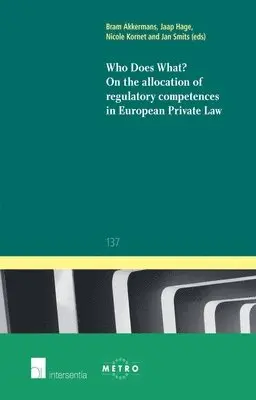
    Who does What? On the Allocation of Regulatory Competences in European Private Law

    AvBram Akkermans,Jaap Hage

    Häftad, Engelska, 2015

    Del 137 i serien Ius Commune: European and Comparative Law Series

    986 kr

    Beställningsvara. Skickas inom 5-8 vardagar. Fri frakt över 249 kr.

    Beskrivning

    As the European Union (EU) matures, there is an increasing debate, partly fuelled by fierce national criticism offered by Eurosceptic politicians, partly initiated by the EU institutions themselves, on the way in which the EU has developed and what the EU must look like in the future. This debate includes a discussion on one of the core aspects of European integration: at which level should the rules be set and who decides where the authority to do so should lie? Private law has an important role to play in this discussion. Many private law rules touch on the core of the internal market as they serve to foster trade or to offer protection to market participants, such as consumers.In 2011, the Maastricht European Private Law Institute (M-EPLI) was founded. M-EPLI researchers combine European Private Law scholarship in the fields of contract, property, commercial and procedural law as well as legal theory. In this book M-EPLI fellows present perspectives on the allocation of competences in European Private Law. This includes both general perspectives and criteria on the basis of which to decide who does what in European Private Law, but also specific perspectives relating to the various fields M-EPLI's researchers cover. All contributions share a common approach in which each author or team of authors addresses the same two questions: (i) What are the criteria to decide upon the ideal design of their field of law for the EU?; (ii) Who should set the rules: what is in the author(s) view the optimal mix of national and European producers of legal norms?

    Produktinformation

    • Utgivningsdatum:2015-05-01
    • Mått:172 x 236 x 17 mm
    • Vikt:560 g
    • Format:Häftad
    • Språk:Engelska
    • Serie:Ius Commune: European and Comparative Law Series
    • Antal sidor:316
    • Förlag:Intersentia Ltd
    • ISBN:9781780683256

    Utforska kategorier

    • Civilrätt inom Juridik

    Mer om författaren

    After graduating in 1978 at the Faculty of law of the University of Leiden, Jaap Hage worked at the same University as scientific assistant/Assistant Professor until 1989. In 1983 he studied also Philosophy and in 1987 he obtained a PhD for the thesis on legal philosophy and meta-ethics, entitled "Feiten en betekenis". From 1989 to 1991, he worked at the Department of computer science, on a research project on the user interface of software to protect from software maintenance. From 1991 he worked first as Associate Professor and from 2006 as a professor at the Law Faculty of the Maastricht University at the Department of interdisciplinary study. His research is in the field of the theory of law, with special emphasis on the logic of legal reasoning and the general concepts of law. Nicole Kornet is since 2013 Associate Professor of Commercial Law at Maastricht University. She graduated from the University of Otago, New Zealand in 1997 with a Bachelor of Laws with first class honours and a Bachelor of Arts. In 1999, she graduated from Maastricht University with a master's degree in Comparative and European Law (cum laude) after participating in the Magister Iuris Communis programme. In September 1999, Nicole joined the private law department of Maastricht University as a junior lecturer. In 2006 she defended her doctoral dissertation entitled "Contract Interpretation and Gap Filling: Comparative and Theoretical Perspectives" and was appointed as Assistant Professor of Commercial Law at Maastricht University. In September 2013 she was appointed as Associate Professor.Nicole is a fellow at the Maastricht European Private Law Institute (M-EPLI) and a member of its coordinating team. She is also a fellow at the Institute for Globalisation and International Regulation (IGIR). Her research focuses on the impact of globalisation on international commercial contract law and practice, in particular on cross-cultural dimensions of international contracting.

    Innehållsförteckning

    • Bram Akkermans, Jaap Hage, Nicole Kornet, Jan SmitsWHO DOES WHAT IN EUROPEAN PRIVATE LAW? AN INTRODUCTION 1. Introduction 2. The Structure of this Book 3. Towards Criteria 4. Conclusions PART I: GENERAL PERSPECTIVESJaap HageTHE JUSTIFICATION OF VALUE JUDGMENTS. THEORETICAL FOUNDATIONS FORARGUMENTS ABOUT THE BEST LEVEL TO REGULATE EUROPEAN PRIVATE LAW 1. The Role of Value Judgments in Law 2. Outline of the Argument 3. Syllogistic Justification 4. Valuation 4.1. The Naturalist Fallacy 4.2. Non-Cognitivism 4.3. Supervenience 4.4. Universalizability 5. The Justification of Standards 5.1. Deductive Validity? 5.2. Justification and Truth 6. Foundationalism and its Pitfalls 6.1. Use of Existing Standards 6.2. Naturalistic Fallacy 6.3. Appeal to Self-evidence6.4. The 'Myth of the Given' 7. Justification through Coherence 7.1. Consistency, Comprehensiveness and Completeness 7.2. Agent-Relativity of Justification 7.3. Defeasible Coherentism 8. Justification on the Balance of Reasons 8.1. Reasons 8.2. Balancing 8.3. Reasoning about Relative Weight 9. Comparative Value Judgments 10. Procedural Approaches to Justification 10.1. Pure, Perfect and Imperfect Procedures10.2. Single Agent Justification of Value Judgments 10.3. Two-Agent Justification of Value Judgments10.4. Concluding on Procedural Justification 11. Summary and Conclusions 12. RecommendationsBibliography Jan M. SmitsWHO DOES WHAT? ON THE DISTRIBUTION OF COMPETENCES AMONG THE EUROPEAN UNION AND THE MEMBER STATES 1. Introduction 2. State-of-the-Art: Focus on Subsidiarity and Federalism 2.1. Introduction 2.2. The Legal Approach: Distribution of Competences and Subsidiarity 2.3. The Economic Approach: the 'Economics of Federalism' 2.4. The Contribution of Political Science 3. Gaps in Present-Day Scholarship and a Search for Criteria 3.1. Introduction: Problems of the Present Approach 3.2. How to make Progress? 4. Finally: the Academic Challenge Bibliography Jaap HageON WHICH LEVEL SHOULD PRIVATE LAW IN EUROPE BE CREATED? 1. Introduction 2. Methodic Preliminaries 2.1. Default Reasoning and Shifts in the Burden of Proof 2.2. Comparing the Alternatives 2.3. The Relevant Data 3. Utilitarianism 3.1. Consequentialism 3.2. One Intrinsic Value 3.3. Aggregation 3.4. Practical Implications 4. The Best Rules 4.1. What are the Best Rules? 4.2. Expertise 4.3. Externalities 4.4. Coherence 4.5. Scope of Rules 5. Autonomy 6. Side-Constraints and Transition 7. Summary 8. Comparison 8.1. Arguments from the Existing Literature 8.2. Parameters 8.3. Conclusion Bibliography PART II: SPECIFIC PERSPECTIVESWilliam Bull, Jiangqiu Ge, Catalina Goanta, Mark Kawakami, Jan SmitsWHO DOES WHAT IN CONSUMER LAW: A SEARCH FOR CRITERIA FOR CENTRALIZEDLAWMAKING 1. Introduction 2. The Starting Point: Consumer Law must be dealt with at the National Level 3. Centralization of European Consumer Law: Justifying the Departure from the Starting Point 3.1. Fragmentation Criterion 3.1.1. Consumer Confidence Factor 3.1.2. Novelty Factor 3.2. Permeability Criterion 3.3. Application of the Criteria 4. Doorstep Selling: Example of when Decision Making at Centralized Level is not Appropriate 5. The Virtual Internal Market: Example of when Decision Making at Centralized Level is Appropriate 5.1. Joe the Consumer (Number Profile) 5.2. Joe the Consumer (Case Law Profile) 5.3. Centralization Criteria are Met 5.4. Online Shopping - the Next Step in Terms of Trust 6. Conclusion Bibliography Anna Beckers, Nicole Kornet, Janwillem OosterhuisWHO DOES WHAT IN COMMERCIAL LAW? THE CASE FOR A MULTI-LEVEL &MULTI-ACTOR APPROACH TO REGULATING COMMERCIAL TRANSACTIONS 1. Introduction 2. A Sketch of the Current Regulatory Landscape for CommercialTransactions 3. How should Commercial Law be Regulated? 3.1. Introduction 3.2. Facilitating Party Autonomy 3.3. Setting the Limits - Regulating Negative Externalities 3.4. Criteria for Determining Who should make Rules for Commercial Transactions 3.4.1. Regulation Serving the Commercial Interest 3.4.2. Regulation Serving the Interests of the Market and Society 3.5. Conclusion 4. Case Studies 4.1. Bills of Exchange - A Historical Perspective 4.2. The Core of Commercial Exchange: Commercial Sales Transactions 4.3. Corporate Social Responsibility in Global Supply-Chains: Regulating Adverse Human Rights Impact of Commercial Parties 5. Conclusion Bibliography Bram AkkermansEUROPEAN UNION CONSTITUTIONAL PROPERTY LAW: SEARCHING FORFOUNDATIONS FOR THE ALLOCATION OF REGULATORY COMPETENCES 1. Introduction 2. European Economic Constitutional Law 3. Property Law and the EU Internal Market 4. Scenario: Return to Socialism or a New Type of Planned Economy 5. Who does What? 6. Scenario: South African Law 7. Beyond the Economic Framework: Property as Democracy (or in Constitutional Context) 8. Multi-Dimensional and Multi-level Property Law 9. Conclusion Bibliography Willem Loof, Anna BerleeCASE STUDY: HARMONIZING SECURITY RIGHTS 1. Introduction 2. The Netherlands 2.1. Security on Future Assets? 2.2. Pledging Claims 2.2.1. Specificity 2.2.2. Pledging by Power of Attorney 2.2.3. The Silent Pledge on Balance 2.3. Retention of Ownership in Dutch Law 2.3.1. The Limitations of Retention of Ownership under Dutch Law 2.3.2. Alternatives 2.4. The Balance of Powers 3. English Law 3.1. Charges 3.1.1. Fixed Charges 3.1.2. Floating Charges 3.1.3. Judicial Inception, Legislative Dismantling 3.1.4. Charges over Book Debts: Fixed or Floating? 3.1.5. Spectrum Plus Ltd 3.2. Reservation of Title 3.2.1. Romalpa Aluminium Ltd. 3.2.2. Balance of Interests in English Law 4. Belgian Reform of Security Rights in Relation to Movables 4.1. Background to the Reform 4.2. Pledge 4.3. Reservation of Ownership 4.4. The Balance of Interest in Belgian Law 5. Harmonization of Security Rights; Article 9 UCC and Book IX DCFR 5.1. The Functional Approach 5.2. Article 9 UCC 6. Book IX DCFR6.1. Key Elements of Harmonization of Security Rights 7. Conclusion Bibliography Caroline Cauffman, Niels PhilipsenWHO DOES WHAT IN COMPETITION LAW: HARMONIZING THE RULES ONDAMAGES FOR INFRINGEMENTS OF THE EU COMPETITION RULES? 1. Introduction 2. Aims and Content of the Directive 2.1. Aims of the Directive 2.2. Content of the Directive 2.2.1. Scope and Definitions 2.2.2. Disclosure of Evidence 2.2.3. Effect of National Decisions, Limitation Periods, Joint and SeveralLiability 2.2.4. Passing-on of Overcharges 2.2.5. Quantification of Harm 2.2.6. Consensual Dispute Resolution 2.2.7. Final Provisions 3. Evaluation of the Directive 3.1. Creating a Level Playing Field: was Harmonization as such Desirable? 3.1.1. Arguments against Harmonization 3.1.1.1. Economics of Federalism 3.1.1.2. Experimentation 3.1.2. Arguments in Favour of Harmonization 3.1.2.1. Economic Arguments 3.1.2.2. Non-Economic Arguments in Favour of Harmonization 3.1.3. Concluding Remarks 3.2. Increasing the Possibilities for Victims of Antitrust Infringements to Obtain Compensation 3.2.1. Collective Action Mechanisms? 3.2.2. Fault Requirements 3.2.3. Burden and Standard of Proof 3.2.4. Collection and Presentation of Evidence 3.2.5. Evidential Value of National Competition Authorities and National Court Decisions 3.2.6. Quantification of Damages 3.2.7. The Passing-on Defence and Indirect Purchaser Claims 3.2.8. Amount of Damages 3.2.9. Time Limitations 3.2.10. Costs3.2.11. Applicable Law 3.2.12. Other Obstacles? 3.3. Improving the Interaction between Public and Private Enforcement of the Competition Rules 4. Conclusion Bibliography Kristel De Smedt, Michael FaureWHO DOES WHAT? ENVIRONMENTAL LIABILITY IN THE EU 1. Introduction 2. Environmental Liability at European Level: a Law and Economics Analysis 2.1. Justification for the ELD 2.2. The Arguments of the Commission tested 2.3. Centralization to Satisfy Demand of Interest Groups? 3. Implementation of the ELD in the Netherlands, Belgium and Germany 3.1. Relevant Aspects of the ELD's Transposition in Belgium 3.2. Relevant Aspects of the ELD's Transposition in the Netherlands 3.3. Relevant Aspects of the ELD's Transposition in Germany 4. Harmonization via the ELD? 5. The ELD's Effects in Practice and Way Forward 6. Conclusion Bibliography