• Fri frakt över 249 kr
  • •
  • Snabba leveranser
  • •
  • Billiga böcker
Kundservice

Du är på sajten för privatpersoner.

Företag, bibliotek eller offentlig verksamhet?

Du handlar på classic.bokus.com, där alla dina funktioner finns intakta.
Till classic.bokus.com
Bokus logotyp. Gå till startsidan.
  • Erbjudanden
  • Nyheter
  • Student
  • Topplistor
  • Barn & ungdom
  • Bokus Play
  • E-böcker
  • Pocketböcker
  • Spel & pussel

Må bättre, för mindre! Upp till 50% rabatt på hälsoböcker

Sidfot

Mina sidor

    Hjälp

    • Kundservice
    • Vanliga frågor och svar
    • Frakt och leverans
    • Retur vid ångerrätt
    • Reklamera vara
    • Betalning
    • Köpvillkor
    • Allmänna villkor
    • Information om webbplatsens tillgänglighet

    Om Bokus

    • Om oss
    • Pressrum
    • För studenter
    • För företag
    • För bibliotek och offentlig verksamhet
    • För leverantörer
    • Hållbarhet

    Populärt

    • Aktuella erbjudanden
    • Presentkort
    • Studentlitteratur
    • Nya böcker
    • Topplistor
    • Signerade böcker
    • Engelska böcker

    Inspiration

    • Boktips
    • BookTok
    • Populära bokserier
    • Barnbokskaraktärer
    • Populära författare
    Logotyp för Bokus
    Följ oss på Facebook (extern länk)Följ oss på Instagram (extern länk)Följ oss på YouTube (extern länk)Följ oss på TikTok (extern länk)
    bokus @ CookiesAnpassa cookiesIntegritetspolicyKöpvillkor
    Till Citymail hemsida (extern länk)Till Budbee hemsida (extern länk)Till Postnord hemsida (extern länk)Till Schenker hemsida (extern länk)Till Early Bird hemsida (extern länk)Till Walleys hemsida (extern länk)
    1. Ekonomi och Ledarskap
    2. Nationalekonomi
    3. Mikroekonomi

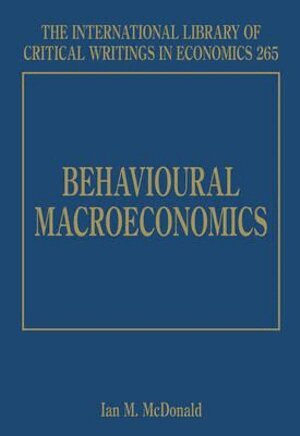
    Behavioural Macroeconomics

    AvIan M. McDonald

    Inbunden, Engelska, 2012

    Del 265 i serien The International Library of Critical Writings in Economics series

    4 307 kr

    Beställningsvara. Skickas inom 5-8 vardagar. Fri frakt över 249 kr.

    Beskrivning

    This invaluable volume brings together seminal articles with a significant behavioural content on various areas in macroeconomics. The topics covered include a historical perspective on psychology and economics, social norms and macroeconomics, the nature of unemployment, unemployment and inflation, consumption and saving, the causes of the global financial crisis, economic growth and happiness and income distribution and the underclass. The collection also covers a broad range of the theories and methods used in behavioural economics. The comprehensive volume, with an original introduction by the editor, will be an essential compendium for researchers and students interested in behavioural economics.

    Produktinformation

    • Utgivningsdatum:2012-04-30
    • Mått:169 x 244 x undefined mm
    • Format:Inbunden
    • Språk:Engelska
    • Serie:The International Library of Critical Writings in Economics series
    • Förlag:Edward Elgar Publishing Ltd
    • ISBN:9781781002582

    Utforska kategorier

    • Mikroekonomi inom Ekonomi och Ledarskap
    • Makroekonomi inom Ekonomi och Ledarskap

    Mer om författaren

    Edited by Ian M. McDonald, Professor of Economics, University of Melbourne, Joint Editor, Australian Economic Review and Fellow of the Academy of Social Sciences, Australia

    Recensioner i media

    'I only wish that Ian McDonald's Behavioural Macroeconomics had been available when I was preparing A Guide to Behavioral Economics; it certainly would have provided me with material to fill in a number of gaps and cite several additional important concerns!'

    Innehållsförteckning

    • Contents:AcknowledgementsIntroduction Ian M. McDonald PART I PSYCHOLOGY AND ECONOMICS – A HISTORICAL PERSPECTIVE1. Luigino Bruni and Robert Sugden (2007), ‘The Road Not Taken: How Psychology was Removed from Economics, and How it Might be Brought Back’ PART II SOCIAL NORMS AND MACROECONOMICS 2. George A. Akerlof (2007), ‘The Missing Motivation in Macroeconomics’PART III THE NATURE OF UNEMPLOYMENT 3. Andrew E. Clark and Andrew J. Oswald (1994), ‘Unhappiness and Unemployment’ 4. M. Daniele Paserman (2008), ‘Job Search and Hyperbolic Discounting: Structural Estimation and Policy Evaluation’PART IV SOME IMPLICATIONS OF EQUITY FOR UNEMPLOYMENT AND INFLATION5. George A. Akerlof and Janet L. Yellen (1990), ‘The Fair Wage-Effort Hypothesis and Unemployment’6. Truman F. Bewley (1995), ‘A Depressed Labor Market as Explained by Participants’7. Ernst Fehr and Armin Falk (1999), ‘Wage Rigidity in a Competitive Incomplete Contract Market’8. Ernst Fehr and Georg Kirchsteiger (1994), ‘Insider Power, Wage Discrimination and Fairness’9. Lawrence H. Summers (1988), ‘Relative Wages, Efficiency Wages and Keynesian Unemployment’Part V SOME IMPLICATIONS OF LOSS AVERSION FOR UNEMPLOYMENT AND INFLATION10. V. Bhaskar (1990), ‘Wage Relativities and the Natural Range of Unemployment’11. Hugh Sibly (2002), ‘Loss Averse Customers and Price Inflexibility’ 12. Ian M. McDonald and Hugh Sibly (2005), ‘The Diamond of Macroeconomic Equilibria and the Non-Inflationary Expansion’ 13. J.N. Nye, I.M. McDonald and H. Sibly (2001), ‘An Estimate of the Range of Equilibrium Rates of Unemployment for Australia’14. John C. Driscoll and Steinar Holden (2004), ‘Fairness and Inflation Persistence’PART VI UNEMPLOYMENT AND INFLATION IN THE SOCIAL WELFARE FUNCTION15. Rafael Di Tella, Robert J. MacCulloch and Andrew J. Oswald (2001), ‘Preferences Over Inflation and Unemployment: Evidence from Surveys of Happiness’PART VII CONSUMPTION AND SAVING 16. Richard H. Thaler and Shlomo Bernatzi (2004), ‘Save More Tomorrow™: Using Behavioural Economics to Increase Employee Saving’17. David Bowman, Deborah Minehart and Matthew Rabin (1999), ‘Loss Aversion in a Consumption-savings Model’18. Isabelle Brocas and Juan D. Carrillo (2008), ‘The Brain as a Hierarchical Organization’PART VIII THE GLOBAL FINANCIAL CRISIS19. Ian M. McDonald (2009), ‘The Global Financial Crisis and Behavioural Economics’PART IX ECONOMIC GROWTH AND HAPPINESS 20. David G. Blanchflower and Andrew J. Oswald (2004), ‘Well-being Over Time in Britain and the USA’21. Bruno S. Frey and Alois Stutzer (2002), ‘What Can Economists Learn from Happiness Research?’22. B. Curtis Eaton and Mukesh Eswaran (2009), ‘Well-being and Affluence in the Presence of a Veblen Good’23. Jonathan D. Cohen (2005), ‘The Vulcanisation of the Human Brain: A Neural Perspective on Interactions Between Cognition and Emotion’PART X INCOME DISTRIBUTION AND THE UNDERCLASS 24. Robert J. Oxoby (2004), ‘Cognitive Dissonance, Status and Growth of the Underclass’