• Fri frakt över 249 kr
  • •
  • Snabba leveranser
  • •
  • Billiga böcker
Kundservice

Du är på sajten för privatpersoner.

Företag, bibliotek eller offentlig verksamhet?

Du handlar på classic.bokus.com, där alla dina funktioner finns intakta.
Till classic.bokus.com
Bokus logotyp. Gå till startsidan.
  • Erbjudanden
  • Nyheter
  • Student
  • Topplistor
  • Barn & ungdom
  • Bokus Play
  • E-böcker
  • Pocketböcker
  • Spel & pussel

10% rabatt på allt med kod: NYSTART10 →

Sidfot

Mina sidor

    Hjälp

    • Kundservice
    • Vanliga frågor och svar
    • Frakt och leverans
    • Retur vid ångerrätt
    • Reklamera vara
    • Betalning
    • Köpvillkor
    • Allmänna villkor
    • Information om webbplatsens tillgänglighet

    Om Bokus

    • Om oss
    • Pressrum
    • För studenter
    • För företag
    • För bibliotek och offentlig verksamhet
    • För leverantörer
    • Hållbarhet

    Populärt

    • Aktuella erbjudanden
    • Presentkort
    • Studentlitteratur
    • Nya böcker
    • Topplistor
    • Signerade böcker
    • Engelska böcker

    Inspiration

    • Boktips
    • BookTok
    • Populära bokserier
    • Barnbokskaraktärer
    • Populära författare
    Logotyp för Bokus
    Följ oss på Facebook (extern länk)Följ oss på Instagram (extern länk)Följ oss på YouTube (extern länk)Följ oss på TikTok (extern länk)
    bokus @ CookiesAnpassa cookiesIntegritetspolicyKöpvillkor
    Till Citymail hemsida (extern länk)Till Budbee hemsida (extern länk)Till Postnord hemsida (extern länk)Till Schenker hemsida (extern länk)Till Early Bird hemsida (extern länk)Till Walleys hemsida (extern länk)
    1. Ekonomi och Ledarskap
    2. Nationalekonomi
    3. Mikroekonomi

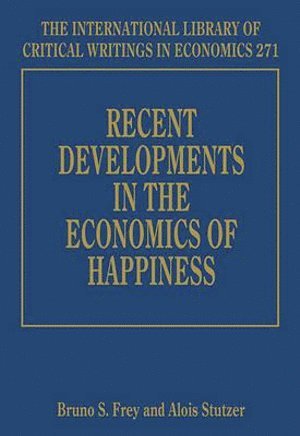
    Recent Developments in the Economics of Happiness

    AvBruno S. Frey,Alois Stutzer

    Inbunden, Engelska, 2013

    Del 271 i serien The International Library of Critical Writings in Economics series

    4 498 kr

    Beställningsvara. Skickas inom 5-8 vardagar. Fri frakt över 249 kr.

    Beskrivning

    What makes people happy in life? This crucial question has the potential to shake up economics. In recent years, dissatisfaction with the understanding of welfare in economics and new opportunities for empirical study of people's subjective well-being have spurred impressive and stimulating new research into the 'dismal' science, resulting in increased interest in the economics of happiness. Professor Frey and Professor Stutzer have selected contributions by leading scholars which offer a wide-ranging overview of recent developments. These include an exploration of the economic determinants of happiness, the importance of social capital and health for well-being and the new life satisfaction approach to valuing public goods. Work on utility misprediction and adaptation challenges the existing fundamentals of economics, and the role of happiness research in public policy is investigated from different perspectives.

    Produktinformation

    • Utgivningsdatum:2013-01-31
    • Mått:169 x 244 x undefined mm
    • Format:Inbunden
    • Språk:Engelska
    • Serie:The International Library of Critical Writings in Economics series
    • Förlag:Edward Elgar Publishing Ltd
    • ISBN:9781781953822

    Utforska kategorier

    • Mikroekonomi inom Ekonomi och Ledarskap
    • Populärekonomi inom Ekonomi och Ledarskap

    Mer om författaren

    Edited by Bruno S. Frey, Distinguished Professor of Behavioural Science, University of Warwick, UK, Guest Professor, Zeppelin University, Friedrichshafen, Germany and Research Director, CREMA – Centre for Research in Economics, Management and the Arts, Switzerland and Alois Stutzer, Professor of Economics, University of Basel, Switzerland

    Innehållsförteckning

    • Contents: AcknowledgementsIntroduction Recent Developments in the Economics of Happiness: A Select Overview Alois Stutzer and Bruno S. FreyPART I MAJOR CONTRIBUTIONS: REVIEWS OF THE NEW APPROACH 1. Bruno S. Frey and Alois Stutzer (2002), ‘What Can Economists Learn from Happiness Research?’2. Daniel Kahneman and Alan B. Krueger (2006), ‘Developments in the Measurement of Subjective Well-Being’3. Mark Kelman (2005), ‘Hedonic Psychology and the Ambiguities of “Welfare”’ PART II ECONOMIC DETERMINANTS OF SUBJECTIVE WELL-BEING 4. Andrew E. Clark, Paul Frijters and Michael A. Shields (2008), ‘Relative Income, Happiness, and Utility: An Explanation for the Easterlin Paradox and Other Puzzles’5. Betsey Stevenson and Justin Wolfers (2008), ‘Economic Growth and Subjective Well-Being: Reassessing the Easterlin Paradox’6. Richard A. Easterlin, Laura Angelescu McVey, Malgorzata Switek, Onnicha Sawangfa and Jacqueline Smith Zweig (2010), ‘The Happiness-Income Paradox Revisited’7. Erzo F.P. Luttmer (2005), ‘Neighbors as Negatives: Relative Earnings and Well-Being’8. Alois Stutzer (2004), ‘The Role of Income Aspirations in Individual Happiness’9. Rafael Di Tella, Robert J. MacCulloch and Andrew J. Oswald (2003), ‘The Macroeconomics of Happiness’ PART III SOCIAL CAPITAL AND HEALTH 10. John F. Helliwell and Robert D. Putnam (2004), ‘The Social Context of Well-Being’11. Leonardo Becchetti, Alessandra Pelloni and Fiammetta Rossetti (2008), ‘Relational Goods, Sociability, and Happiness’12. Angus Deaton (2008), ‘Income, Health, and Well-being Around the World: Evidence from the Gallup World Poll’ PART IV VALUING PUBLIC GOODS: THE LIFE SATISFACTION APPROACH 13. Bernard M.S. van Praag and Barbara E. Baarsma (2005), ‘Using Happiness Surveys to Value Intangibles: The Case of Airport Noise’14. Simon Luechinger (2009), ‘Valuing Air Quality Using the Life Satisfaction Approach’PART V UTILITY MISPREDICTION AND ADAPTATION 15. Daniel Kahneman and Richard H. Thaler (2006), ‘Anomalies: Utility Maximization and Experienced Utility’16. Andrew E. Clark, Ed Diener, Yannis Georgellis and Richard E. Lucas (2008), ‘Lags and Leads in Life Satisfaction: A Test of the Baseline Hypothesis’17. Luis Rayo and Gary S. Becker (2007), ‘Evolutionary Efficiency and Happiness’ PART VI PUBLIC POLICY 18. Richard Layard (2006), ‘Happiness and Public Policy: A Challenge to the Profession’19. Bruno S. Frey and Alois Stutzer (2012), ‘The Use of Happiness Research for Public Policy’