• Fri frakt över 249 kr
  • •
  • Snabba leveranser
  • •
  • Billiga böcker
Kundservice

Du är på sajten för privatpersoner.

Företag, bibliotek eller offentlig verksamhet?

Du handlar på classic.bokus.com, där alla dina funktioner finns intakta.
Till classic.bokus.com
Bokus logotyp. Gå till startsidan.
  • Erbjudanden
  • Nyheter
  • Student
  • Topplistor
  • Barn & ungdom
  • Bokus Play
  • E-böcker
  • Pocketböcker
  • Spel & pussel

10% rabatt på allt med kod NYSTART10 →

Sidfot

Mina sidor

    Hjälp

    • Kundservice
    • Vanliga frågor och svar
    • Frakt och leverans
    • Retur vid ångerrätt
    • Reklamera vara
    • Betalning
    • Köpvillkor
    • Allmänna villkor
    • Information om webbplatsens tillgänglighet

    Om Bokus

    • Om oss
    • Pressrum
    • För studenter
    • För företag
    • För bibliotek och offentlig verksamhet
    • För leverantörer
    • Hållbarhet

    Populärt

    • Aktuella erbjudanden
    • Presentkort
    • Studentlitteratur
    • Nya böcker
    • Topplistor
    • Signerade böcker
    • Engelska böcker

    Inspiration

    • Boktips
    • BookTok
    • Populära bokserier
    • Barnbokskaraktärer
    • Populära författare
    Logotyp för Bokus
    Följ oss på Facebook (extern länk)Följ oss på Instagram (extern länk)Följ oss på YouTube (extern länk)Följ oss på TikTok (extern länk)
    bokus @ CookiesAnpassa cookiesIntegritetspolicyKöpvillkor
    Till Citymail hemsida (extern länk)Till Budbee hemsida (extern länk)Till Postnord hemsida (extern länk)Till Schenker hemsida (extern länk)Till Early Bird hemsida (extern länk)Till Walleys hemsida (extern länk)
    1. Samhälle och politik
    2. Samhälle och kultur
    3. Kultur och medier
    4. Referensverk och tvärvetenskap

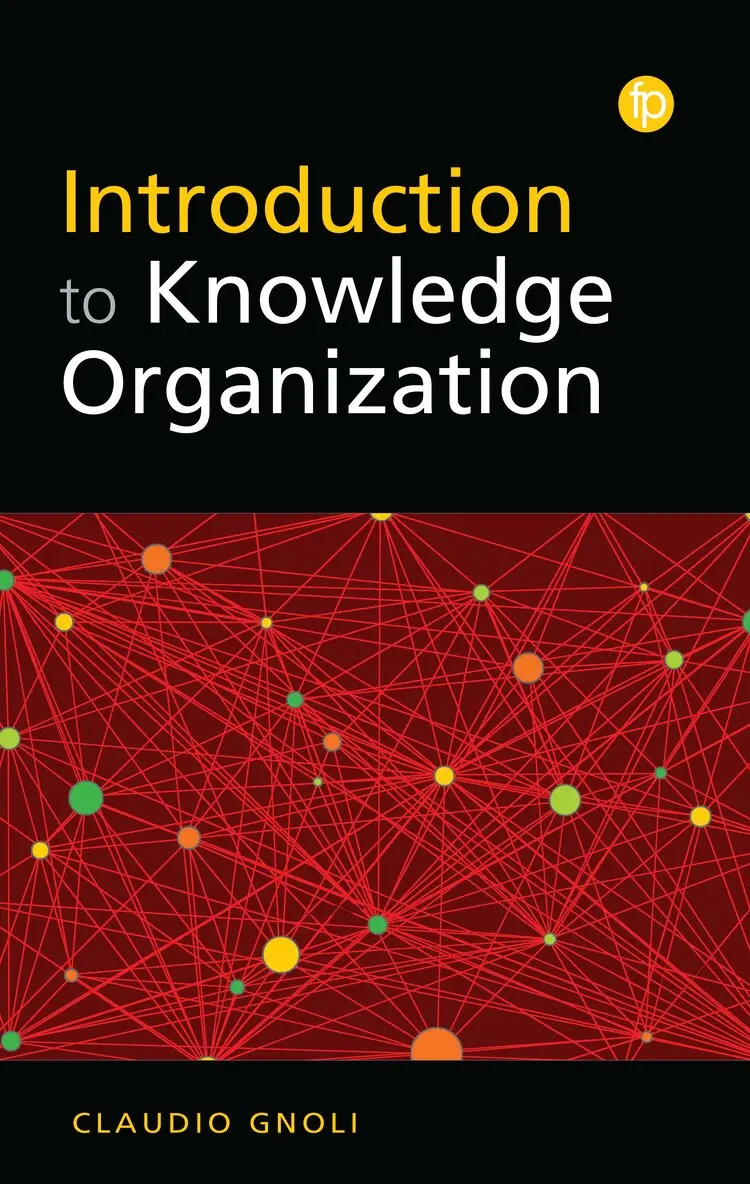
    Introduction to Knowledge Organization

    AvClaudio Gnoli

    Inbunden, Engelska, 2020

    Del i serien Introduction to

    2 091 kr

    Beställningsvara. Skickas inom 5-8 vardagar. Fri frakt över 249 kr.

    Fler format och utgåvor

    Häftad

    Kommande

    Häftad

    1 010 kr

    Beskrivning

    This book provides a complete introduction to the rapidly expanding field of Knowledge organization (KO), presenting historical precedents and theoretical foundations in a discursive, intelligible form, covering the philosophical, linguistic and technical aspects. In the contemporary context of global information exchange through linked data, Knowledge organization systems (KOS) need to be represented in standard inter-operable formats. Different formats for KOS representation including MARC, Dublin Core, SKOS and OWL are introduced as well as the application of Knowledge organization to a variety of activities and contexts: education, encyclopedic knowledge, the Internet, libraries, archives, museums, galleries and other institutions collecting and providing access to recorded knowledge. Key coverage includes:• ontology and epistemology in KO• KO structures: lists, hierarchies, facets...• KO types: tagging, taxonomies, thesauri, classifications...• conceptual analysis of documents• applications in the digital age.Covering theoretical and practical aspects of KO and using real-life examples to illustrate its application, this book will be a valuable resource for students, researchers and practitioners of Knowledge organization, information organization, cataloguing and classification.

    Produktinformation

    • Utgivningsdatum:2020-07-15
    • Mått:159 x 238 x 12 mm
    • Vikt:384 g
    • Format:Inbunden
    • Språk:Engelska
    • Serie:Introduction to
    • Antal sidor:104
    • Förlag:Facet Publishing
    • ISBN:9781783304660

    Utforska kategorier

    • Referensverk och tvärvetenskap inom Samhälle och politik

    Mer om författaren

    Claudio Gnoli is an academic librarian and researcher in knowledge organization at the University of Pavia, Italy. His work focuses on Knowledge organization theory and KO systems - especially faceted classification schemes - and their application to digital information systems. He is co-author of Interdisciplinary Knowledge Organization with R. Szostak and M. Lopez-Huertas (2016), co-editor of the ISKO Encyclopedia of Knowledge Organization and author of numerous journal articles, conference proceedings and four Italian-language titles. He is a member of the Scientific Advisory Council of the International Society for Knowledge Organization, and he serves on the editorial board of the Basel Register of Thesauri, Ontologies & Classifications (BARTOC).

    Recensioner i media

    'Gnoli's text is a well-written, brief, but mighty introduction to knowledge organisation. This book should be acquired by instructors and students of information organization courses who not only want an overview of knowledge organization concepts but want to deepen their understanding of answers to a range of theoretical and practical questions in the field'. - Technical Services Quarterly

    Innehållsförteckning

    • ContentsList of abbreviations1 Focusing the field1.1 What is knowledge?1.1.1 Knowledge as representation of networks1.1.2 Data, information, knowledge, understanding, wisdom1.1.3 Informational systems at various levels1.2 What is organization?1.3 What is knowledge organization (KO)?1.3.1 Personal and social knowledge1.3.2 Knowledge as recorded in documents1.3.3 Organizing public contents1.4 A brief history of KO1.4.1 KO in early civilizations1.4.2 KO in the ancient East1.4.3 KO in ancient Greece1.4.4 KO in the Middle Ages1.4.5 KO in early Modernity1.4.6 Classification in modern libraries1.4.7 KO in the Digital Age2 Theories of knowledge organization2.1 Theories are needed2.2 From precepts to concepts2.3 Bottom-up and top-down procedures2.4 The dimensions of knowledge2.4.1 User-based approaches2.4.2 Collection approaches2.4.3 Documental approaches2.4.4 Perspective approaches2.4.5 Phenomenon approaches3 Structural principles in knowledge organization3.1 Words in natural language3.2 Terms in controlled vocabularies3.3 Lists3.3.1 Alphabetical vs systematic order3.3.2 Literary warrant3.3.3 Canonical sequence3.3.4 Increasing complexity3.3.5 Quantitative measure3.3.6 Spatial contiguity3.3.7 Later-in-evolution3.3.8 Later-in-time3.4 Hierarchies3.4.1 Types3.4.2 Parts3.4.3 Instances3.5 Facets3.5.1 Fundamental categories3.5.2 Citation order of facets3.5.3 Sources of foci3.5.4 Common facets3.6 Themes3.4.1 Base theme and particular themes3.4.2 Phase relationships and free facets3.4.3 Rhemes3.4.4 How much syntax is needed?4 Knowledge organization systems (KOS)4.1 The notion of KOS4.2 The collection dimension of a KOS4.3 Special and general KOS4.4 KOS types4.4.1 Keyword systems and folksonomies4.4.2 Taxonomies4.4.3 Subject heading lists4.4.4 Thesauri4.4.5 Classification schemes4.4.6 Ontologies5 Representation of knowledge organization structures5.1 Headings in paper catalogues catalogs and indexes5.2 Subject authority data in bibliographic databases5.3 Subject metadata of digital documents5.4 The Semantic Web and linked data5.5 KOSs as linked data6 Applying knowledge organization6.1 Organizing phenomena6.2 Organizing educational and reference contents6.3 Indexing documents6.3.1 Content analysis6.3.2 Content representation6.3.3 Automatic methods6.3.4 Non-textual documents6.4 Organizing collections6.5 KO in the digital environment6.5.1 Applying KO to digital documents6.5.2 Problems and benefits of digital KO6.5.3 Designing organized interfaces6.6 ConclusionReferencesIndex