• Fri frakt över 249 kr
  • •
  • Snabba leveranser
  • •
  • Billiga böcker
Kundservice

Du är på sajten för privatpersoner.

Företag, bibliotek eller offentlig verksamhet?

Du handlar på classic.bokus.com, där alla dina funktioner finns intakta.
Till classic.bokus.com
Bokus logotyp. Gå till startsidan.
  • Erbjudanden
  • Nyheter
  • Student
  • Topplistor
  • Barn & ungdom
  • Bokus Play
  • E-böcker
  • Pocketböcker
  • Spel & pussel

Må bättre, för mindre! Upp till 50% rabatt på hälsoböcker

Sidfot

Mina sidor

    Hjälp

    • Kundservice
    • Vanliga frågor och svar
    • Frakt och leverans
    • Retur vid ångerrätt
    • Reklamera vara
    • Betalning
    • Köpvillkor
    • Allmänna villkor
    • Information om webbplatsens tillgänglighet

    Om Bokus

    • Om oss
    • Pressrum
    • För studenter
    • För företag
    • För bibliotek och offentlig verksamhet
    • För leverantörer
    • Hållbarhet

    Populärt

    • Aktuella erbjudanden
    • Presentkort
    • Studentlitteratur
    • Nya böcker
    • Topplistor
    • Signerade böcker
    • Engelska böcker

    Inspiration

    • Boktips
    • BookTok
    • Populära bokserier
    • Barnbokskaraktärer
    • Populära författare
    Logotyp för Bokus
    Följ oss på Facebook (extern länk)Följ oss på Instagram (extern länk)Följ oss på YouTube (extern länk)Följ oss på TikTok (extern länk)
    bokus @ CookiesAnpassa cookiesIntegritetspolicyKöpvillkor
    Till Citymail hemsida (extern länk)Till Budbee hemsida (extern länk)Till Postnord hemsida (extern länk)Till Schenker hemsida (extern länk)Till Early Bird hemsida (extern länk)Till Walleys hemsida (extern länk)
    1. Psykologi och pedagogik
    2. Psykologi
    3. Socialpsykologi och gruppsykologi

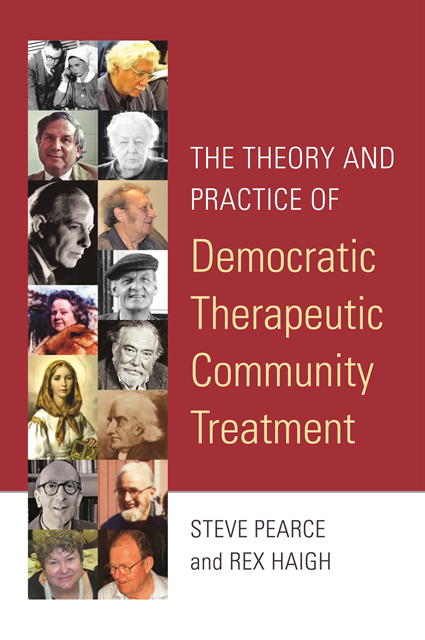
    Theory and Practice of Democratic Therapeutic Community Treatment

    AvRex Haigh,Steve Pearce

    E-bok
    Engelska, 2017

    553 kr

    Läs direkt i Bokus Reader – eller ladda ned till din enhet

    Fler format och utgåvor

    Häftad

    608 kr

    Beskrivning

    Democratic therapeutic communities have been set up all over the world, but until now there has not been a manual that sets out the underlying theories, and describes successful practice. Based on their own substantial experience and expertise, the authors of this new textbook explain how to set up and run modern therapeutic communities as effective evidence-based interventions for personality disorder and other common mental health conditions.Including detailed templates and practical information alongside a wider historical context, this encyclopaedic handbook will enable clinicians to develop and implement a democratic therapeutic community model with confidence. Highlighting the importance of belonging to a wider community, this book also shows how to ensure the needs of patients are considered and met, and that patients themselves can see in detail what this approach entails. This is an invaluable resource for clinicians and service commissioners working in the field of recovery from personality disorder, as well as those working in mental health and healthcare. This book also provides a useful model for professionals working in prisons and the justice system, long-term drug and alcohol rehabilitation and education, and students of group analytic, psychotherapy, and counselling courses.

    Produktinformation

    • Utgivningsdatum:2017-01-19
    • Språk:Engelska
    • Filformat:EPUB
    • Kopieringsskydd:LCP
    • ISBN:9781784504830
    • Förlag:Jessica Kingsley Publishers

    Utforska kategorier

    • Socialpsykologi och gruppsykologi inom Psykologi och pedagogik
    • Psykiatri inom Medicin

    Mer om författaren

    Dr Steve Pearce was a Consultant Psychiatrist and Programme Director for personality disorder services in Oxfordshire and Buckinghamshire. He was Editor-in-Chief of the International Journal of Therapeutic Communities, Chair of the NHS England Residential Personality Disorder Clinical Reference Group, Past President of the British and Irish Group for the Study of Personality Disorder, and Past Chair of the Royal College of Psychiatrists Quality Network for Therapeutic Communities. Rex Haigh is a Consultant Psychiatrist for personality disorder services in East Berkshire. He is also Honorary Professor of Therapeutic Environments and Relational Health in Nottingham University's School of Sociology and Social Policy. He is Founder and Past Chair of the Royal College of Psychiatrists Quality Network for Therapeutic Communities, Founder and Chair of the Royal College of Psychiatrists Enabling Environments Network and Past President of the Association of Therapeutic Communities.

    Recensioner i media

    The NHS is looking for a new interpersonal model of health care provision that will heal patients and retain staff. The values of the Therapeutic Community (empowerment, creativity, search for meaning and democracy) are core parts of what is currently missing. This book is a 'must read' and 'must act' for any thoughtful purchaser, patient or provider - before it is too late.

    Innehållsförteckning

    • Acknowledgements. Preface. Section One: History. 1. A history of therapeutic communities. Section Two: Concepts. 2. Why therapeutic communities? 3. Therapeutic community-specific theory. 4. Belongingness. 5. Responsible agency. 6. Social learning. 7. Emotional progression and narrative. 8. The use of psychodynamic theory and techniques. 9. Group analytic influences and theories. 10. Group processes and systems. 11. Evidence for therapeutic community effectiveness. 12. General approach and principles. Section Three: Practice. 13. Phases and timing. 14. Assessment and selection. 15. Democratic therapeutic community structure. 16. Boundary maintenance. 17. Quality of relationships and therapeutic method. 18. The use of psycho-educational and humanistic methods. 19. Anti-therapeutic processes. Section Four: Organisational Aspects. 20. Organisational relationships. 21. Organisational development. Section Five: Training. 22. Training - introduction. 23. Experiential training for working in therapeutic communities. 24. Supervised clinical practices. Appendices. Further Reading. References. Index.