• Fri frakt över 249 kr
  • •
  • Snabba leveranser
  • •
  • Billiga böcker
Kundservice

Du är på sajten för privatpersoner.

Företag, bibliotek eller offentlig verksamhet?

Du handlar på classic.bokus.com, där alla dina funktioner finns intakta.
Till classic.bokus.com
Bokus logotyp. Gå till startsidan.
  • Erbjudanden
  • Nyheter
  • Student
  • Topplistor
  • Barn & ungdom
  • Bokus Play
  • E-böcker
  • Pocketböcker
  • Spel & pussel

10% studentrabatt med kod TERM26

Sidfot

Mina sidor

    Hjälp

    • Kundservice
    • Vanliga frågor och svar
    • Frakt och leverans
    • Retur vid ångerrätt
    • Reklamera vara
    • Betalning
    • Köpvillkor
    • Allmänna villkor
    • Information om webbplatsens tillgänglighet

    Om Bokus

    • Om oss
    • Pressrum
    • För studenter
    • För företag
    • För bibliotek och offentlig verksamhet
    • För leverantörer
    • Hållbarhet

    Populärt

    • Aktuella erbjudanden
    • Presentkort
    • Studentlitteratur
    • Nya böcker
    • Topplistor
    • Signerade böcker
    • Engelska böcker

    Inspiration

    • Boktips
    • BookTok
    • Populära bokserier
    • Barnbokskaraktärer
    • Populära författare
    Logotyp för Bokus
    Följ oss på Facebook (extern länk)Följ oss på Instagram (extern länk)Följ oss på YouTube (extern länk)Följ oss på TikTok (extern länk)
    bokus @ CookiesAnpassa cookiesIntegritetspolicyKöpvillkor
    Till Citymail hemsida (extern länk)Till Budbee hemsida (extern länk)Till Postnord hemsida (extern länk)Till Schenker hemsida (extern länk)Till Early Bird hemsida (extern länk)Till Walleys hemsida (extern länk)
    1. Historia och arkeologi
    2. Historia
    3. Forntidens historia

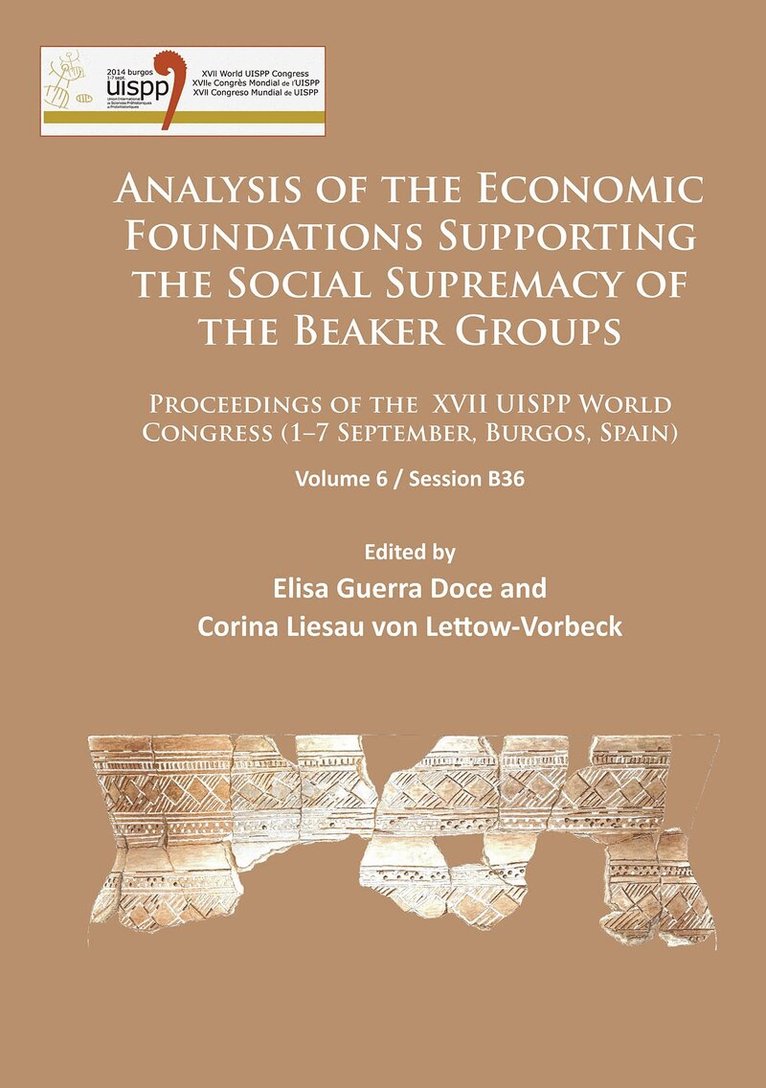
    Analysis of the Economic Foundations Supporting the Social Supremacy of the Beaker Groups

    Proceedings of the XVII UISPP World Congress (1–7 September, Burgos, Spain): Volume 6 / Session B36

    AvElisa Guerra Doce,Corina Liesau von Lettow-Vorbeck

    Häftad, Engelska, 2016

    Del i serien Proceedings of the UISPP World Congress

    466 kr

    Skickas . Fri frakt över 249 kr.

    Beskrivning

    The Bell Beaker phenomenon is one of the most fascinating horizons in European Later Prehistory, due to its vast geographical distribution, the intrinsic value of some of the artefacts comprising the Beaker package, or its supposed links to certain kinds of ritual ceremonies as shown by the frequent deposition of Beaker items in burial contexts. At present, the idea that the Beaker package is best interpreted as a symbol of power common to socially-prominent individuals by the mid-to-late third millennium BC is widely acknowledged by scholars in this field. From this point of view, the Beaker phenomenon is seen as the archaeological evidence representing an ideology which was shared by a number of prehistoric societies geographically scattered throughout much of Western and Central Europe, or, more specifically, was only shared by elite individuals within these territories.The strategies employed by these individuals to attain such privileged statuses, however, are poorly known. Therefore, in the framework of the XVII World UISPP Congress, held in September 2014 in Burgos (Spain), a session entitled ‘Analysis of the economic foundations supporting the social supremacy of the Beaker groups’ (B36) was organised by this volume’s two editors. The session focused mostly on examining this issue at a European level, and less on the study of the Beaker package itself, as a way of looking at the economic foundations that helped these individuals attain their higher social statuses.The proximity of Beaker sites to natural routes of communication highlights the importance of exchange networks through which people, objects and ideas may have circulated through Europe during this time. The Amesbury Archer in southern England is one of the best examples of interaction within Beaker territories. Having said this, considering that Beaker pots themselves were not exchanged over long distances, attention must be paid to other mechanisms of diffusion. The present volume comprises the papers presented at this session suggesting that Beaker groups may have controlled certain products and technologies.

    Produktinformation

    • Utgivningsdatum:2016-02-28
    • Mått:205 x 290 x 7 mm
    • Vikt:1 110 g
    • Format:Häftad
    • Språk:Engelska
    • Serie:Proceedings of the UISPP World Congress
    • Antal sidor:166
    • Förlag:Archaeopress
    • ISBN:9781784913076

    Utforska kategorier

    • Forntidens historia inom Historia och arkeologi
    • Arkeologiska perioder och områden inom Historia och arkeologi

    Innehållsförteckning

    • Foreword to the XVII UISPP Congress Proceedings Series Edition (Luiz Oosterbeek) ; Introduction (Elisa Guerra Doce and Corina Liesau von Lettow-Vorbeck) ; Graves of metallurgists in the Moravian Beaker Cultures (Jaroslav Peška) ; Bell Beaker funerary copper objects from the center of the Iberian Peninsula in the context of the Atlantic connections (Concepción Blasco Bosqued, Ignacio Montero and Raúl Flores Fernández) ; Bell Beaker connections along the Atlantic façade: the gold ornaments from Tablada del Rudrón, Burgos, Spain (Andrew P. Fitzpatrick, Germán Delibes de Castro, Elisa Guerra Doce and Javier Velasco Vázquez) ; Prestige indicators and Bell Beaker ware at Valencina de la Concepción (Sevilla, Spain) (Ana Pajuelo Pando and Pedro M. López Aldana) ; Some prestige goods as evidence of interregional interactions in the funerary practices of the Bell Beaker groups of Central Iberia (Corina Liesau von Lettow-Vorbeck) ; Salt and Beakers in the third millennium BC (Elisa Guerra Doce) ; The role of flint arrowheads in Bell Beaker groups of the Central Iberian Peninsula (Patricia Ríos Mendoza) ; El Peñón de la Zorra (Villena, Alicante, Spain): change and continuity in settlement pattern during Bell Beaker (Gabriel García Atiénzar) ; Elements for the definition of the Bell Beaker horizon in the lower Ebro Valley: preliminary approaches (Anna Gómez, Patricia Ríos Mendoza, Marc Piera and Miquel Molist)