• Fri frakt över 249 kr
  • •
  • Snabba leveranser
  • •
  • Billiga böcker
Kundservice

Du är på sajten för privatpersoner.

Företag, bibliotek eller offentlig verksamhet?

Du handlar på classic.bokus.com, där alla dina funktioner finns intakta.
Till classic.bokus.com
Bokus logotyp. Gå till startsidan.
  • Erbjudanden
  • Nyheter
  • Student
  • Topplistor
  • Barn & ungdom
  • Bokus Play
  • E-böcker
  • Pocketböcker
  • Spel & pussel

10% studentrabatt med kod TERM26

Sidfot

Mina sidor

    Hjälp

    • Kundservice
    • Vanliga frågor och svar
    • Frakt och leverans
    • Retur vid ångerrätt
    • Reklamera vara
    • Betalning
    • Köpvillkor
    • Allmänna villkor
    • Information om webbplatsens tillgänglighet

    Om Bokus

    • Om oss
    • Pressrum
    • För studenter
    • För företag
    • För bibliotek och offentlig verksamhet
    • För leverantörer
    • Hållbarhet

    Populärt

    • Aktuella erbjudanden
    • Presentkort
    • Studentlitteratur
    • Nya böcker
    • Topplistor
    • Signerade böcker
    • Engelska böcker

    Inspiration

    • Boktips
    • BookTok
    • Populära bokserier
    • Barnbokskaraktärer
    • Populära författare
    Logotyp för Bokus
    Följ oss på Facebook (extern länk)Följ oss på Instagram (extern länk)Följ oss på YouTube (extern länk)Följ oss på TikTok (extern länk)
    bokus @ CookiesAnpassa cookiesIntegritetspolicyKöpvillkor
    Till Citymail hemsida (extern länk)Till Budbee hemsida (extern länk)Till Postnord hemsida (extern länk)Till Schenker hemsida (extern länk)Till Early Bird hemsida (extern länk)Till Walleys hemsida (extern länk)
    1. Historia och arkeologi
    2. Arkeologi
    3. Arkeologiska perioder och områden

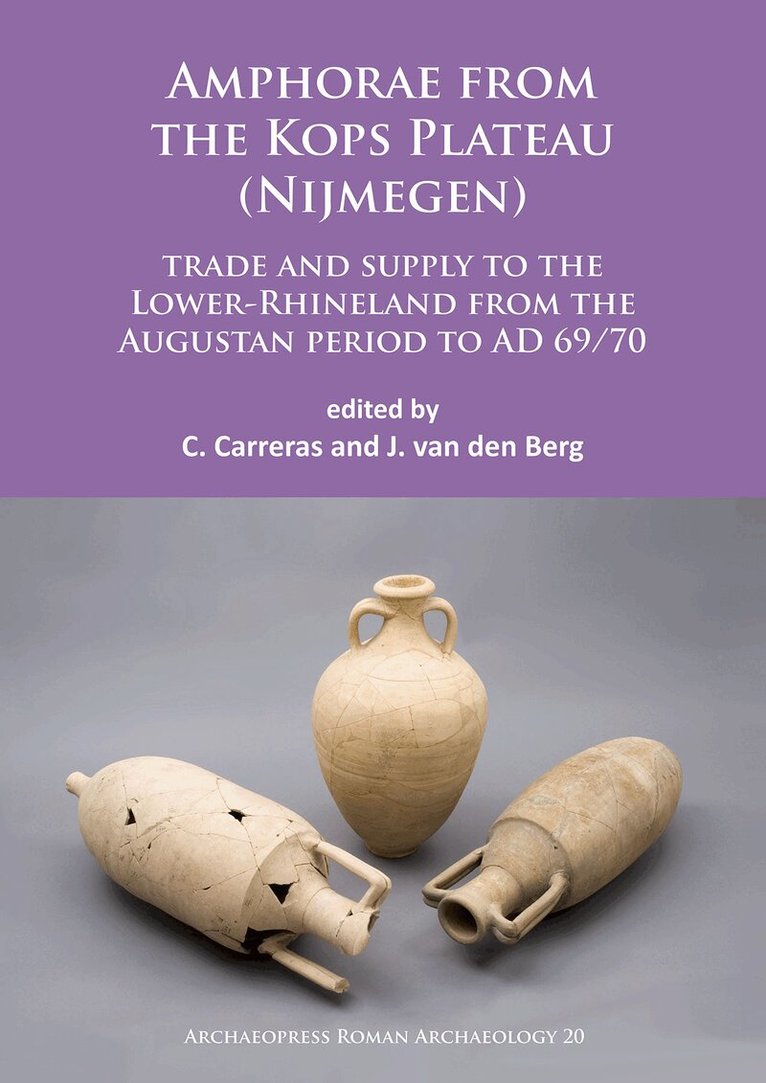
    Amphorae from the Kops Plateau (Nijmegen): trade and supply to the Lower-Rhineland from the Augustan period to AD 69/70

    AvCèsar Carreras,Joost van den Berg

    Häftad, Engelska, 2017

    Del 20 i serien Archaeopress Roman Archaeology

    998 kr

    Skickas . Fri frakt över 249 kr.

    Beskrivning

    In the year 19 BC, Roman legions arrived in Nijmegen with the aim of conquering the Rhenish territories from the local populations. In addition to the legionaries themselves, the Roman army required a regular provision of staple supplies in order to keep such a war machine in top condition. The archaeological evidence for this provision is a myriad of organic remains (i.e. seeds, bones, pollen) as well as ceramic containers such as amphorae. One of the first military camps at Nijmegen, together with that on the Hunerberg, was Kops Plateau. This timber fortress – the most northerly military site of the Julio-Claudian period – dating from 12 BC to AD 69, has provided an extraordinary amphora assemblage. At a time when most Roman roads were still only projects, this distant military outpost received amphora products from all over the Mediterranean basin – from Palestine to Greece in the east to Baetica and northern Africa in the west as well as from the Italian core. In addition to amphorae, Kops Plateau also provided a wide repertory of regional vessels whose contents are unknown. The amphorae from Kops Plateau represent a singular example of Roman military supply in northern Europe at a very early date. Their analysis sheds light on trading routes in the Atlantic regions, and from Gaul to Germany; indeed also on the Claudian invasion of Britain.

    Produktinformation

    • Utgivningsdatum:2017-02-13
    • Mått:205 x 290 x 18 mm
    • Vikt:1 970 g
    • Format:Häftad
    • Språk:Engelska
    • Serie:Archaeopress Roman Archaeology
    • Antal sidor:418
    • Förlag:Archaeopress
    • ISBN:9781784915421

    Utforska kategorier

    • Arkeologiska perioder och områden inom Historia och arkeologi

    Mer om författaren

    Cèsar Carreras Monfort is currently senior lecturer in the field of Classical Archaeology at the Department of Antiquity Science at Universitat Autònoma de Barcelona (UAB) since 2011. Before, he was lecturer in the Department of Humanities of the Universitat Oberta de Catalunya (UOC) since 1997. He has a PhD in Ancient History (1995) from the Universitat de Barcelona, another PhD in Archaeology (1994) from Southampton University (United Kingdom) and a Master Science in Computer applications in archaeology (1991) from Southampton University (United Kingdom). He is currently involved in excavations at the Roman towns of Iesso (Guissona) and Iulia Libica (Llívia) and the Roman Republican fortress of Puig Castellar (Biosca). He has published many books and papers on amphorae found in Britain, Germany, Italy, Spain and now the Netherlands. ; Joost van den Berg studied Ancient History and Roman Provincial Archaeology at the Radboud University of Nijmegen. Since then he has worked as curator for the archaeological collections of municipality of Nijmegen, the province of Gelderland and the Gallo-Roman Museum in Tongeren. He has also been employed as a Roman finds specialist for Radboud University and the Nijmegen archaeological service. Currently he is the curator for the archaeological collection of the province of Zeeland (Stichting Cultureel Erfgoed Zeeland) in Middelburg.

    Innehållsförteckning

    • Preface (David Williams) ; Chapter 1. Introduction (Cèsar Carreras & Joost van den Berg) ; Chapter 2. Methodology (Cèsar Carreras, F. S. Beijaard & N. Polak) ; Chapter 3. Amphorae from the West: Hispania (Spain and Portugal) (Horacio González Cesteros, Rui Roberto de Almeida & Cèsar Carreras) ; Chapter 4. Amphorae from the West: Gaul (Florian Schimmer & Joost van den Berg) ; Chapter 5. Amphorae from the Roman Heartland: Imports from Italy (Florian Schimmer) ; Chapter. 6. Amphorae from Africa, the Aegean and the Levant (Joost van den Berg & Florian Schimmer) ; Chapter. 7. Regional Amphorae from pre-Flavian Nijmegen: a new Group of Intra-Regional Containers (Joost van den Berg) ; Chapter 8. Amphorae-Epigraphy: Stamps, Graffiti and Tituli Picti from Roman Nijmegen (Piero Berni Millet & Stephan Weiß-König) ; Chapter 9. Excursus: Amphorae from the Early-Augustan Legionary Camp on the Hunerberg, Nijmegen (Joost van den Berg, Horacio González Cesteros & Ryan Niemeijer) ; Chapter 10. Conclusions (Cèsar Carreras & Joost van den Berg) ; Chapter 11. References