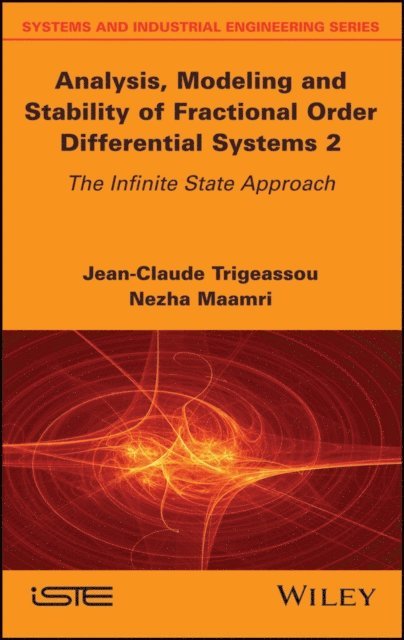
Analysis, Modeling and Stability of Fractional Order Differential Systems 2
The Infinite State Approach
AvJean-Claude Trigeassou,Nezha Maamri
1 868 kr
Beställningsvara. Skickas inom 5-8 vardagar. Fri frakt över 249 kr.
Beskrivning
Produktinformation
- Utgivningsdatum:2020-01-21
- Mått:163 x 236 x 31 mm
- Vikt:794 g
- Format:Inbunden
- Språk:Engelska
- Antal sidor:432
- Förlag:ISTE Ltd and John Wiley & Sons Inc
- ISBN:9781786304551
Utforska kategorier
Mer om författaren
Jean-Claude Trigeassou is Honorary Professor at Bordeaux University, France, and has been associated with the research activities of its IMS-LAPS lab since 2006. His main research interests include the modeling of fractional order systems, based on the infinite state approach.Nezha Maamri is Associate Professor at Poitiers University, France. Her research activities concern the method of moments, robust control using integer order and fractional order controllers, plus the modeling, initialization and stability of fractional order systems.
Innehållsförteckning
- Foreword xiiiPreface xvPart 1. Initialization, State Observation and Control 1Chapter 1. Initialization of Fractional Order Systems 31.1. Introduction 31.2. Initialization of an integer order differential system 41.2.1. Introduction 41.2.2. Response of a linear system 41.2.3. Input/output solution 61.2.4. State space solution 71.2.5. First-order system example 81.3. Initialization of a fractional differential equation 101.3.1. Introduction 101.3.2. Free response of a simple FDE 101.4. Initialization of a fractional differential system 141.4.1. Introduction 141.4.2. State space representation 141.4.3. Input/output formulation 151.5. Some initialization examples 171.5.1. Introduction 171.5.2. Initialization of the fractional integrator 171.5.3. Initialization of the Riemann–Liouville derivative 191.5.4. Initialization of an elementary FDS 211.5.5. Conclusion 33Chapter 2. Observability and Controllability of FDEs/FDSs 352.1. Introduction 352.2. A survey of classical approaches to the observability and controllability of fractional differential systems 372.2.1. Introduction 372.2.2. Definition of observability and controllability 372.2.3. Observability and controllability criteria for a linear integer order system 372.2.4. Observability and controllability of FDS 392.3. Pseudo-observability and pseudo-controllability of an FDS 402.3.1. Introduction 402.3.2. Elementary approach 412.3.3. Cayley–Hamilton approach 452.3.4. Gramian approach 492.3.5. Gilbert’s approach 522.3.6. Conclusion 572.3.7. Pseudo-controllability example 582.4. Observability and controllability of the distributed state 602.4.1. Introduction 602.4.2. Observability of the distributed state 622.4.3. Controllability of the distributed state 642.5. Conclusion 65Chapter 3. Improved Initialization of Fractional Order Systems 673.1. Introduction 673.2. Initialization: problem statement 683.3. Initialization with a fractional observer 713.3.1. Fractional observer definition 713.3.2. Stability analysis 723.3.3. Convergence analysis 743.3.4. Numerical example 1: one-derivative system 763.3.5. Numerical example 2: non-commensurate order system 783.4. Improved initialization 813.4.1. Introduction 813.4.2. Non-commensurate order principle 823.4.3. Gradient algorithm 843.4.4. One-derivative FDE example 873.4.5. Two-derivative FDE example 91A.3. Appendix 95A.3.1. Convergence of gradient algorithm 95A.3.2. Stability and limit value of λ 98Chapter 4. State Control of Fractional Differential Systems 994.1. Introduction 994.2. Pseudo-state control of an FDS 1004.2.1. Introduction 1004.2.2. Numerical simulation example 1014.3. State control of the elementary FDE 1034.3.1. Introduction 1034.3.2. State control of a fractional integrator 1044.4. State control of an FDS 1214.4.1. Introduction 1214.4.2. Principle of state control 1224.4.3. State control of two integrators in series 1244.4.4. Numerical example 1264.4.5. State control of a two-derivative FDE 1294.4.6. Pseudo-state control of the two-derivative FDE 1304.5. Conclusion 131Chapter 5. Fractional Model-based Control of the Diffusive RC Line 1335.1. Introduction 1335.2. Identification of the RC line using a fractional model 1345.2.1. Introduction 1345.2.2. An identification algorithm dedicated to fractional models 1345.2.3. Simulation of the diffusive RC line 1395.2.4. Experimental identification 1495.3. Reset of the RC line 1545.3.1. Introduction 1545.3.2. Natural relaxation 1555.3.3. Principle of the reset technique 1565.3.4. Proposed reset procedure 1585.3.5. Experimental results 1595.3.6. Comments 1645.3.7. Conclusion 165Part 2. Stability of Fractional Differential Equations and Systems 167Chapter 6. Stability of Linear FDEs Using the Nyquist Criterion 1696.1. Introduction 1696.2. Simulation and stability of fractional differential equations 1716.2.1. Simulation of an FDE 1716.2.2. Stability of the simulation scheme 1726.2.3. Stability analysis of FDEs using the Nyquist criterion 1746.3. Stability of ordinary differential equations 1756.3.1. Introduction 1756.3.2. Open-loop transfer function 1766.3.3. Drawing of H OL (jω) graph in the complex plane 1776.3.4. Stability of the third-order ODE 1786.3.5. Conclusion 1826.4. Stability analysis of FDEs 1826.4.1. Introduction 1826.4.2. Drawing of H OL (jω) graph in the complex plane 1826.4.3. Stability of the one-derivative FDE 1846.4.4. Stability of the two-derivative FDE 1876.4.5. Stability of the N-derivative FDE 1946.4.6. Conclusion 1956.5. Stability analysis of ODEs with time delays 1956.5.1. Introduction 1956.5.2. Definitions 1966.5.3. Stability analysis 1966.5.4. Application to an example 1986.6. Stability analysis of FDEs with time delays 2006.6.1. Definitions 2006.6.2. Stability 2016.6.3. Application to an example 202Chapter 7. Fractional Energy 2057.1. Introduction 2057.2. Pseudo-energy stored in a fractional integrator 2067.3. Energy stored and dissipated in a fractional integrator 2117.3.1. Introduction 2117.3.2. Electrical distributed network 2117.3.3. Stored energy 2147.3.4. Power dissipated in the fractional integrator 2157.3.5. Energy storage 2167.3.6. Integer order and fractional order integrators 2197.3.7. Characterization of fractional energy and its dissipation 2267.3.8. Fractional energy invariance 2317.4. Closed-loop and open-loop fractional energies 2347.4.1. Introduction 2347.4.2. Energy of the closed-loop model 2347.4.3. Energy of the open-loop model 2377.4.4. Stored energies with a step input excitation 239Chapter 8. Lyapunov Stability of Commensurate Order Fractional Systems 2478.1. Introduction 2478.2. Lyapunov stability of a one-derivative FDE 2498.2.1. Problem statement 2498.2.2. Numerical simulation 2518.2.3. Physical interpretation 2538.2.4. Theoretical interpretation 2548.3. Lyapunov stability of an N-derivative FDE 2588.3.1. Introduction 2588.3.2. The integer order case 2588.3.3. Lyapunov function of N-derivative systems 2618.3.4. Stability condition 2658.4. Lyapunov stability of a two-derivative commensurate order FDE 2698.4.1. Introduction 2698.4.2. State space model of the open-loop representation 2708.4.3. State space models of the closed-loop representation 2718.4.4. Energy and stability of the open-loop representation 2728.4.5. Energy and stability of the closed-loop representation 2748.4.6. Definition of a stability test for a > 0 2768.5. Lyapunov stability of an N-derivative FDE ( N > 2 ) 2818.5.1. Introduction 2818.5.2. Problem statement 2828.5.3. LMI generalization for N = 3 2838.5.4. Application example 289A.8. Appendix 290A.8.1. Lemma 290A.8.2. Matignon’s criterion 291Chapter 9. Lyapunov Stability of Non-commensurate Order Fractional Systems 2939.1. Introduction 2939.2. Stored energy, dissipation and energy balance in fractional electrical devices 2959.2.1. Usual capacitor and inductor devices 2959.2.2. Fractional capacitor and inductor 2969.2.3. Energy storage and dissipation in fractional devices 2999.2.4. Reversibility of energy and energy balance 3019.3. The usual series RLC circuit 3029.3.1. Introduction 3029.3.2. Analysis of the series RLC circuit 3029.3.3. Stability analysis 3049.4. The series RLC* fractional circuit 3069.4.1. Introduction 3069.4.2. Analysis of the series RLC* circuit 3069.4.3. Experimental stability analysis 3079.4.4. Theoretical stability analysis 3109.4.5. Conclusion 3149.5. The series RLL*C* circuit 3159.5.1. Circuit modeling 3159.5.2. Stability analysis 3179.6. The series RL*C* fractional circuit 3209.6.1. Introduction 3209.6.2. Analysis of the series RL*C* circuit 3209.6.3. Theoretical stability analysis 3229.7. Stability of a commensurate order FDE: energy balance approach 3259.7.1. Introduction 3259.7.2. Analysis of the commensurate order FDE 3259.7.3. Application to stability 3279.8. Stability of a commensurate order FDE: physical interpretation of the usual approach 3289.8.1. Introduction 3289.8.2. Commensurate order system 3299.8.3. Lyapunov function of a fractional differential system 3299.8.4. Stability analysis 3319.8.5. Conclusion 334A.9. Appendix 335A.9.1. The infinite length LG line 335A.9.2. Energy storage and dissipation in the fractional capacitor 339A.9.3. Some integrals 341Chapter 10. An Introduction to the Lyapunov Stability of Nonlinear Fractional Order Systems 34310.1. Introduction 34310.2. Indirect Lyapunov method 34410.2.1. Introduction 34410.2.2. Linearization 34410.2.3. Nonlinear system analysis 34510.2.4. Local stability of a one-derivative nonlinear fractional system 34910.3. Lyapunov direct method 35310.3.1. Introduction 35310.3.2. The variable gradient method 35310.3.3. Nonlinear system with one derivative 35410.3.4. Nonlinear system with two fractional derivatives 35710.4. The Van der Pol oscillator 36310.4.1. Electrical nonlinear system 36310.4.2. Van der Pol oscillator 36410.4.3. Simulation of the nonlinear system 36410.4.4. Limit cycle 36510.5. Analysis of local stability 36610.5.1. Linearization 36610.5.2. Local stability 36710.5.3. Validation of stability results 36910.6. Large signal analysis 37110.6.1. Introduction 37110.6.2. Approximation of the first harmonic [MUL 09] 37110.6.3. Lyapunov function and oscillation frequency 37210.6.4. Amplitude of the limit cycle 37210.6.5. Prediction of the limit cycle 374References 377Index 395
Mer från samma författare
Analysis, Modeling and Stability of Fractional Order Differential Systems 1
Nezha Maamri, Jean-Claude Trigeassou
2 216 kr
Analysis, Modeling and Stability of Fractional Order Differential Systems 1
Nezha Maamri, Jean-Claude Trigeassou
2 216 kr
Analysis, Modeling and Stability of Fractional Order Differential Systems 2
Nezha Maamri, Jean-Claude Trigeassou
2 216 kr
Analysis, Modeling and Stability of Fractional Order Differential Systems 2
Nezha Maamri, Jean-Claude Trigeassou
2 216 kr
Analysis, Modeling and Stability of Fractional Order Differential Systems 1
Jean-Claude Trigeassou, Nezha Maamri
Inbunden, 2019
1 868 kr
Partial Moments in System Identification
Régis Ouvrard, Thierry Poinot, Jean-Claude Trigeassou
Inbunden, 2024
1 436 kr
Partial Moments in System Identification
Jean-Claude Trigeassou, Thierry Poinot, Regis Ouvrard
1 754 kr
Du kanske också är intresserad av
- Nyhet
Analysis, Modeling and Stability of Fractional Order Differential Systems 2
Nezha Maamri, Jean-Claude Trigeassou
2 216 kr
Analysis, Modeling and Stability of Fractional Order Differential Systems 2
Nezha Maamri, Jean-Claude Trigeassou
2 216 kr
Analysis, Modeling and Stability of Fractional Order Differential Systems 1
Nezha Maamri, Jean-Claude Trigeassou
2 216 kr
Analysis, Modeling and Stability of Fractional Order Differential Systems 1
Nezha Maamri, Jean-Claude Trigeassou
2 216 kr
Analysis, Modeling and Stability of Fractional Order Differential Systems 1
Jean-Claude Trigeassou, Nezha Maamri
Inbunden, 2019
1 868 kr
Partial Moments in System Identification
Régis Ouvrard, Thierry Poinot, Jean-Claude Trigeassou
Inbunden, 2024
1 436 kr
Partial Moments in System Identification
Jean-Claude Trigeassou, Thierry Poinot, Regis Ouvrard
1 754 kr