• Fri frakt över 249 kr
  • •
  • Snabba leveranser
  • •
  • Billiga böcker
Kundservice

Du är på sajten för privatpersoner.

Företag, bibliotek eller offentlig verksamhet?

Du handlar på classic.bokus.com, där alla dina funktioner finns intakta.
Till classic.bokus.com
Bokus logotyp. Gå till startsidan.
  • Erbjudanden
  • Nyheter
  • Student
  • Topplistor
  • Barn & ungdom
  • Bokus Play
  • E-böcker
  • Pocketböcker
  • Spel & pussel

10% rabatt på allt med kod NYSTART10 →

Sidfot

Mina sidor

    Hjälp

    • Kundservice
    • Vanliga frågor och svar
    • Frakt och leverans
    • Retur vid ångerrätt
    • Reklamera vara
    • Betalning
    • Köpvillkor
    • Allmänna villkor
    • Information om webbplatsens tillgänglighet

    Om Bokus

    • Om oss
    • Pressrum
    • För studenter
    • För företag
    • För bibliotek och offentlig verksamhet
    • För leverantörer
    • Hållbarhet

    Populärt

    • Aktuella erbjudanden
    • Presentkort
    • Studentlitteratur
    • Nya böcker
    • Topplistor
    • Signerade böcker
    • Engelska böcker

    Inspiration

    • Boktips
    • BookTok
    • Populära bokserier
    • Barnbokskaraktärer
    • Populära författare
    Logotyp för Bokus
    Följ oss på Facebook (extern länk)Följ oss på Instagram (extern länk)Följ oss på YouTube (extern länk)Följ oss på TikTok (extern länk)
    bokus @ CookiesAnpassa cookiesIntegritetspolicyKöpvillkor
    Till Citymail hemsida (extern länk)Till Budbee hemsida (extern länk)Till Postnord hemsida (extern länk)Till Schenker hemsida (extern länk)Till Early Bird hemsida (extern länk)Till Walleys hemsida (extern länk)
    1. Naturvetenskap och teknik
    2. Matematik och naturvetenskap
    3. Matematik

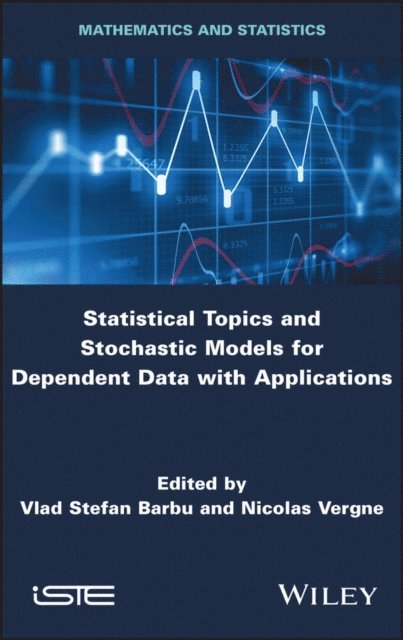
    Statistical Topics and Stochastic Models for Dependent Data with Applications

    AvVlad Stefan Barbu,Vlad Stefan Barbu

    Inbunden, Engelska, 2020

    1 800 kr

    Beställningsvara. Skickas inom 5-8 vardagar. Fri frakt över 249 kr.

    Beskrivning

    This book is a collective volume authored by leading scientists in the field of stochastic modelling, associated statistical topics and corresponding applications. The main classes of stochastic processes for dependent data investigated throughout this book are Markov, semi-Markov, autoregressive and piecewise deterministic Markov models. The material is divided into three parts corresponding to: (i) Markov and semi-Markov processes, (ii) autoregressive processes and (iii) techniques based on divergence measures and entropies. A special attention is payed to applications in reliability, survival analysis and related fields.

    Produktinformation

    • Utgivningsdatum:2020-11-27
    • Mått:10 x 10 x 10 mm
    • Vikt:454 g
    • Format:Inbunden
    • Språk:Engelska
    • Antal sidor:288
    • Förlag:ISTE Ltd and John Wiley & Sons Inc
    • ISBN:9781786306036

    Utforska kategorier

    • Matematik inom Naturvetenskap och teknik

    Mer om författaren

    Vlad Stefan Barbu is Associate Professor in Statistics with LMRS at the University of Rouen Normandy, France. His main research focuses on statistics of stochastic processes and on techniques based on divergence measures, with a particular interest in semi-Markov and hidden semi-Markov processes.Nicolas Vergne is Associate Professor in Statistics with LMRS at the University of Rouen Normandy. His research work is in statistics, focusing on different Markov-type models: drifting Markov models, semi-Markov models, hidden Markov models and bioinformatics.

    Innehållsförteckning

    • Preface xiVlad Stefan BARBU and Nicolas VERGNEPart 1. Markov and Semi-Markov Processes 1Chapter 1. Variable Length Markov Chains, Persistent Random Walks: A Close Encounter 3Peggy CÉNAC, Brigitte CHAUVIN, Frédéric PACCAUT and Nicolas POUYANNE1.1. Introduction 31.2. VLMCs: definition of the model 61.3. Definition and behavior of PRWs 91.3.1. PRWs in dimension one 91.3.2. PRWs in dimension two 131.4. VLMC: existence of stationary probability measures 151.5. Where VLMC and PRW meet 191.5.1. Semi-Markov chains and Markov additive processes 191.5.2. PRWs induce semi-Markov chains 201.5.3. Semi-Markov chain of the α-LIS in a stable VLMC 221.5.4. The meeting point 231.6. References 27Chapter 2. Bootstraps of Martingale-difference Arrays Under the Uniformly Integrable Entropy 29Salim BOUZEBDA and Nikolaos LIMNIOS2.1. Introduction and motivation 292.2. Some preliminaries and notation 302.3. Main results 352.4. Application for the semi-Markov kernel estimators 362.5. Proofs 412.6. References 45Chapter 3. A Review of the Dividend Discount Model: From Deterministic to Stochastic Models 47Guglielmo D’AMICO and Riccardo DE BLASIS3.1. Introduction 473.2. General model 483.3. Gordon growth model and extensions 503.3.1. Gordon model 503.3.2. Two-stage model 513.3.3. H model 523.3.4. Three-stage model 523.3.5. N-stage model 533.3.6. Other extensions 533.4. Markov chain stock models 543.4.1. Hurley and Johnson model 543.4.2. Yao model 563.4.3. Markov stock model 573.4.4. Multivariate Markov chain stock model 613.5. Conclusion 643.6. References 65Chapter 4. Estimation of Piecewise-deterministic Trajectories in a Quantum Optics Scenario 69Romain AZAЇS and Bruno LEGGIO4.1. Introduction 694.1.1. The postulates of quantum mechanics 694.1.2. Dynamics of open quantum Markovian systems 714.1.3. Stochastic wave function: quantum dynamics as PDPs 744.1.4. Estimation for PDPs 764.2. Problem formulation 774.2.1. Atom-field interaction 774.2.2. Piecewise-deterministic trajectories 784.2.3. Measures 804.3. Estimation procedure 804.3.1. Strategy 804.3.2. Least-square estimators 824.3.3. Numerical experiments 834.4. Physical interpretation 864.5. Concluding remarks 874.6. References 88Chapter 5. Identification of Patterns in a Semi-Markov Chain 91Brenda Ivette GARCIA-MAYA and Nikolaos LIMNIOS5.1. Introduction 915.2. The prefix chain 935.3. The semi-Markov setting 945.4. The hitting time of the pattern 1005.5. A genomic application 1025.6. Concluding remarks 1065.7. References 106Part 2. Autoregressive Processes 109Chapter 6. Time Changes and Stationarity Issues for Continuous Time Autoregressive Processes of Order p 111Valérie GIRARDIN and Rachid SENOUSSI6.1. Introduction 1116.2. Basics 1126.3. Stationary AR processes 1146.3.1. Formulas for the two first-order moments 1146.3.2. Examples 1166.3.3. Conditions for stationarity of CAR1(p) processes 1186.4. Time transforms 1256.4.1. Properties of time transforms 1256.4.2. MS processes 1316.5. Conclusion 1326.6. Appendix 1336.7. References 136Chapter 7. Sequential Estimation for Non-parametric Autoregressive Models 139Ouerdia ARKOUN, Jean-Yves BRUA and Serguei PERGAMENCHTCHIKOV7.1. Introduction 1397.2. Main conditions 1417.3. Pointwise estimation with absolute error risk 1427.3.1. Minimax approach 1427.3.2. Adaptive minimax approach 1447.3.3. Non-adaptive procedure 1457.3.4. Sequential kernel estimator 1487.3.5. Adaptive sequential procedure 1517.4. Estimation with quadratic integral risk 1537.4.1. Passage to a discrete time regression model 1557.4.2. Model selection 1597.4.3. Main results 1617.5. References 164Part 3. Divergence Measures and Entropies 167Chapter 8. Inference in Parametric and Semi-parametric Models: The Divergence-based Approach 169Michel BRONIATOWSKI8.1. Introduction 1698.1.1. Csiszár divergences, variational form 1708.1.2. Dual form of the divergence and dual estimators in parametric models 1728.1.3. Decomposable discrepancies 1788.2. Models and selection of statistical criteria 1838.3. Non-regular cases: the interplay between the model and the criterion 1848.3.1. Test statistics 1858.4. References 187Chapter 9. Dynamics of the Group Entropy Maximization Processes and of the Relative Entropy Group Minimization Processes Based on the Speed-gradient Principle 189Vasile PREDA and Irina BĂNCESCU9.1. Introduction 1909.1.1. The SG principle 1919.1.2. Entropy groups 1939.2. Group entropies and the SG principle 1969.2.1. Total energy constraint 1999.3. Relative entropy group and the SG principle 2029.3.1. Equilibrium stability 2059.3.2. Total energy constraint 2059.4. A new (G, a) power relative entropy group and the SG principle 2069.5. Conclusion 2109.6. References 210Chapter 10. Inferential Statistics Based on Measures of Information and Divergence 215Alex KARAGRIGORIOU and Christos MESELIDIS10.1. Introduction 21510.2. Divergence measures 21610.2.1. ϕ-Divergences 21610.2.2. α-Divergences 21710.2.3. Bregman divergences 21810.3. Properties of divergence measures 21910.4. Model selection criteria 22010.5. Goodness of fit tests 22210.5.1. Simple null hypothesis 22210.5.2. Composite null hypothesis 22310.6. Simulation study 22710.7. References 231Chapter 11. Goodness-of-Fit Tests Based on Divergence Measures for Frailty Models 235Filia VONTA11.1. Introduction 23511.2. The proposed goodness-of-fit test 23611.3. Main results 24011.4. Frailty models 24311.5. Simulations 24411.5.1. Linear models for the estimation of critical values 24711.5.2. Size of the test 24811.6. References 250List of Authors 253Index 257