• Fri frakt över 249 kr
  • •
  • Snabba leveranser
  • •
  • Billiga böcker
Kundservice

Du är på sajten för privatpersoner.

Företag, bibliotek eller offentlig verksamhet?

Du handlar på classic.bokus.com, där alla dina funktioner finns intakta.
Till classic.bokus.com
Bokus logotyp. Gå till startsidan.
  • Erbjudanden
  • Nyheter
  • Student
  • Topplistor
  • Barn & ungdom
  • Bokus Play
  • E-böcker
  • Pocketböcker
  • Spel & pussel

10% rabatt på allt med kod NYSTART10 →

Sidfot

Mina sidor

    Hjälp

    • Kundservice
    • Vanliga frågor och svar
    • Frakt och leverans
    • Retur vid ångerrätt
    • Reklamera vara
    • Betalning
    • Köpvillkor
    • Allmänna villkor
    • Information om webbplatsens tillgänglighet

    Om Bokus

    • Om oss
    • Pressrum
    • För studenter
    • För företag
    • För bibliotek och offentlig verksamhet
    • För leverantörer
    • Hållbarhet

    Populärt

    • Aktuella erbjudanden
    • Presentkort
    • Studentlitteratur
    • Nya böcker
    • Topplistor
    • Signerade böcker
    • Engelska böcker

    Inspiration

    • Boktips
    • BookTok
    • Populära bokserier
    • Barnbokskaraktärer
    • Populära författare
    Logotyp för Bokus
    Följ oss på Facebook (extern länk)Följ oss på Instagram (extern länk)Följ oss på YouTube (extern länk)Följ oss på TikTok (extern länk)
    bokus @ CookiesAnpassa cookiesIntegritetspolicyKöpvillkor
    Till Citymail hemsida (extern länk)Till Budbee hemsida (extern länk)Till Postnord hemsida (extern länk)Till Schenker hemsida (extern länk)Till Early Bird hemsida (extern länk)Till Walleys hemsida (extern länk)
    1. Medicin
    2. Medicin: icke kliniska discipliner

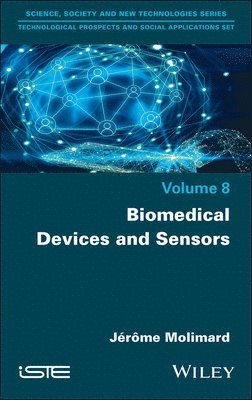
    Biomedical Devices and Sensors

    AvJérôme Molimard

    Inbunden, Engelska, 2024

    Del i serien ISTE Invoiced

    1 772 kr

    Beställningsvara. Skickas inom 5-8 vardagar. Fri frakt över 249 kr.

    Beskrivning

    Monitoring the human body is a key element of digital health science. Low-cost sensors derived from smartphones or smartwatches may give the impression that sensors are readily available; however, to date, very few of them are actually medical devices.Designing medical devices requires us to undertake a specific approach demanding special skills, as it concerns the integrity of the human body. The process is tightly framed by state regulations in order to ensure compliance with quality assessment, risk management and medical ethics requirements.This book aims to give biomedical students an overview on medical devices design. It firstly gives a historical and economical approach, then develops key elements in medical device design with reference to EU and US regulations, and finally describes sensors for the human body. The clinical approach is presented as the central element in medical device qualification and this offers a perspective on the use of numerical simulation, particularly since its continued growth in the USA; despite the fact that the approach is strictly limited by regulations.

    Produktinformation

    • Utgivningsdatum:2024-09-17
    • Mått:156 x 234 x 14 mm
    • Vikt:585 g
    • Format:Inbunden
    • Språk:Engelska
    • Serie:ISTE Invoiced
    • Antal sidor:224
    • Förlag:ISTE Ltd and John Wiley & Sons Inc
    • ISBN:9781786309464

    Utforska kategorier

    • Medicin: icke kliniska discipliner inom Medicin
    • Biokemisk teknik inom Naturvetenskap och teknik
    • Biomedicinsk teknik inom Medicin

    Mer om författaren

    Jérôme Molimard is Professor at École des Mines Saint-Étienne, France. His research focuses on the mechanical interaction between medical devices and the human body through a crossdisciplinary approach between numerical modeling, experimental and clinical studies, in order to better understand their mode of action.

    Innehållsförteckning

    • Foreword ixReynald CONVERTChapter 1. Medical Device: Definition, History and Economic Background 11.1. Definition 11.2. Examples of medical devices 31.2.1. Surgery equipment 31.2.2. Medical imaging 51.3. Medical device industry 101.3.1. The industrial sector 101.3.2. Importance of medical device in the economy 11Chapter 2. Medical Device Design and Development 132.1. Medical device design is much more than device design. 132.2. Product ideation and conceptualization 152.3. Regional and international standard for addressing regulation and compliance need 182.4. EU medical device regulation (MDR2017) 202.5. Design control regulations (for FDA 21CFR820) 212.6. Risk management procedures (ISO 14711) 252.7. Conclusion 28Chapter 3. Medical Sensors 293.1. Selection of medical sensors 293.1.1. Introduction 293.1.2. Electric signalization 293.1.3. Thermal measurement 373.1.4. Biomechanical measurements 423.1.5. Exercises 50Chapter 4. Measurement Quality 514.1. Measurement quality 514.1.1. Introduction 514.1.2. Calibration 524.1.3. Vocabulary 534.1.4. Metrological testing 554.1.5. Evaluating uncertainties 584.2. Key notions in signal processing 644.2.1. Signal sampling 644.2.2. Denoising a signal 664.2.3. Time frequency representation 714.2.4. Extracting the information for high quantity of noisy data 734.2.5. Exercises 78Chapter 5. Numerical Simulation and Medical Devices 815.1. Role of numerical simulation in medical device design 815.1.1. General design workflow for medical device 815.1.2. Introduction example 825.2. General context 835.2.1. Agency policies 835.2.2. Report structure 855.3. Report details 875.3.1. Background 875.3.2. Question of interest 875.3.3. Computation model 885.3.4. Model risk 915.3.5. Model validation 935.3.6. Ranking the model credibility 945.3.7. Computational model credibility assessment 955.3.8. Results and discussion 96Chapter 6. Global Ethics Rule Beyond Clinical Trials 996.1. Medical ethics, from Hippocrates to the Declaration of Geneva 996.2. Evolution of ethics rules for clinical trials 1026.3. Declaration of Helsinki 1066.4. Ethics for engineers 116Chapter 7. Clinical Trials Process 1217.1. Clinical trials in the design process 1217.1.1. Before clinical testing 1217.1.2. Institutional guidelines 1237.1.3. Clinical trials before going to market (EU — MEDDEV 2.7/1) 1247.1.4. Bibliographically-based clinical proof and demonstration of equivalence 1257.1.5. Clinical trials after going to market (EU — MDR2017 and EU — MEDDEV 2.12-1 rev 8) 1267.2. Insight: MDR2017 and the French implementation 1277.3. Classification of clinical trials 1327.4. Insight: the ISO 14155 1377.4.1. Ethics consideration 1377.4.2. Planning of the clinical investigation 1397.4.3. Clinical investigation follow-up 1407.4.4. Ending a clinical investigation 142Chapter 8. Introduction to Biostatistics 1458.1. Introduction 1458.2. Selection rules for statistical processing 1458.3. Hypothesis testing 1478.3.1. General principle on hypothesis testing 1478.3.2. Error of the first and second king, power of a test 1508.3.3. Comparing two sets of variables: parametric or nonparametric testing 1548.3.4. Example: pressure applied by a compression bandage 1578.4. Linear regression 1588.4.1. Mathematics of linear regression 1588.4.2. Analysis of variance 1608.4.3. Correlation between parameters 164Chapter 9. Longitudinal Practice with Sensor Design 1679.1. Design 1679.2. Session 2: building an IMU-based sensor 1689.2.1. Step 1: software installation 1699.2.2. Step 2: wiring 1699.2.3. Step 3: uploading code to the board 1709.3. Session 3: signal procession and metrology 1719.4. Session 4: sleep apnea 172Chapter 10. Longitudinal Practice Focused on Clinical Trial 17510.1. Session 1: frailty problems 17510.2. Session 2: project draft 17610.3. Session 3: design of a clinical trial (1) 17710.4. Session 4: design of a clinical trial (2) 17710.5. Session 5: defense in front of the IRB 178Appendix: Clinical Trial Form 179References 193Index 199